


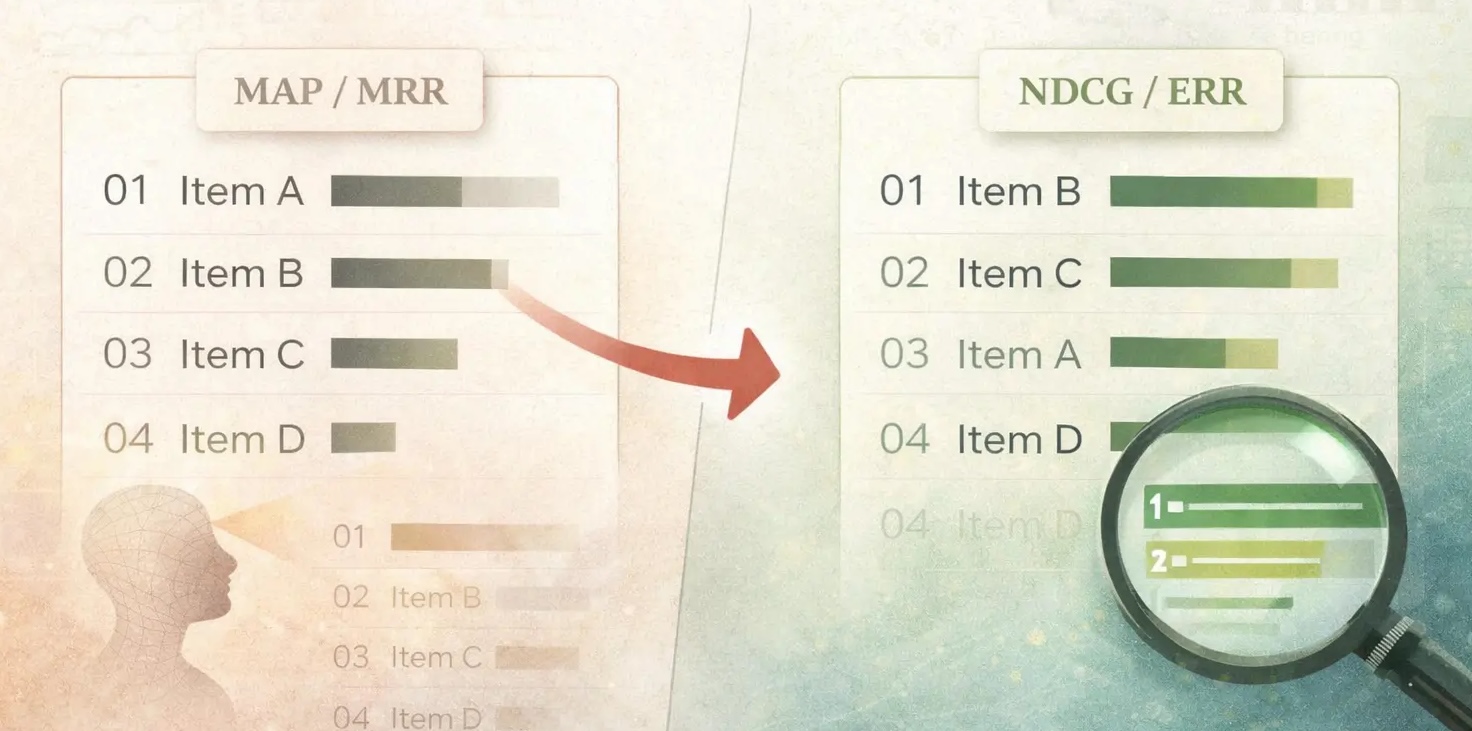
often use Mean Reciprocal Rank (MRR) and Mean Average Precision (MAP) to assess the quality of their rankings. In this post, we will discuss why \(MAP\) and \(MRR\) poorly aligned with modern user behavior in search ranking. We then look at two metrics that serve as better alternatives to \(MRR\) and \(MAP\).
What are MRR and MAP?
Mean Reciprocal Rank (MRR)
Mean Reciprocal Rank (\(MRR\)) is the average rank where the first relevant item occurs.
$$\mathrm{RR} = \frac{1}{\text{rank of first relevant item}}$$
In e-commerce, the first relevant rank can be the rank of the first item clicked in response to a query

For the above example, assume the relevant item is the second item. This means:
$$\mathrm{Reciprocal Rank} = \frac{1}{2}$$
Reciprocal rank is calculated for all the queries in the evaluation set. To get a single metric for all the queries, we take the mean of reciprocal ranks to get the Mean Reciprocal Rank
$$\mathrm{Mean Reciprocal Rank} = \frac{1}{N}\sum_{i=1}^N {\frac{1}{\text{Rank of First Relevant Item}}}$$
where \(N\) is the number of queries. From this definition, we can see that \(MRR\) focuses on getting one relevant result early. It doesn’t measure what happens after the first relevant result.
Mean Average Precision (MAP)
Mean Average Precision (\(MAP\) measures how well the system retrieves relevant items and how early they are shown. We begin by first calculating Average Precision (AP) for each query. We define AP as
$$\mathrm{AP} = \frac{1}{|R|}\sum_{k=1}^{K}\mathrm{Precision@}k \cdot \mathbf{1}[\text{item at } k \text{ is relevant}]$$
where \(|R|\) is the number of relevant items for the query
\(\mathrm{MAP}\) is the average of \(\mathrm{AP}\) across queries
The above equation looks a lot, but it is actually simple. Let’s use an example to break it down. Assume a query has 3 relevant items, and our model predicts the following order:
Rank: 1 2 3 4 5
Item: R N R N R
(R = relevant, N = not relevant)
To compute the \(MAP\), we compute the AP at each relevant position:
- @1: Precision = 1/1 = 1.0
- @3: Precision = 2/3 ≈ 0.667
- @5: Precision = 3/5 = 0.6
$$\mathrm{AP} = \frac{1}{3}(1.0 + 0.667 + 0.6) = 0.756$$
We calculate the above for all the queries and average them to get the \(MAP\). The AP formula has two important components:
- Precision@k: Since we use Precision, retrieving relevant items earlier yields higher precision values. If the model ranks relevant items later, Precision@k reduces due to a larger k
- Averaging the Precisions: We average the precisions over the total number of relevant items. If the system never retrieves an item or retrieves it beyond the cutoff, the item contributes nothing to the numerator while still counting in the denominator, which reduces \(AP\) and \(MAP\).
Why MAP and MRR are Bad for Search Ranking
Now that we have covered the definitions, let’s understand why \(MAP\) and \(MRR\) are not used for search results ranking.
Relevance is Graded, not Binary
When we compute \(MRR\), we take the rank of the first relevant item. In \(MRR\), we treat all relevant items the same. It makes no difference if a different relevant item shows up first. In reality, different items tend to have different relevance.
Similarly, in \(MAP\), we use binary relevance- we simply look for the next relevant item. Again, \(MAP\) makes no distinction in the relevance score of the items. In real cases, relevance is graded, not binary.
Item     : 1 2 3
Relevance: 3 1 0
\(MAP\) and \(MRR\) both ignore how good the relevant item is. They fail to quantify the relevance.
Users Scan Multiple Results
This is more specific to \(MRR\). In \(MRR\) computation, we record the rank of the first relevant item. And ignore everything after. It can be good for lookups, QA, etc. But this is bad for recommendations, product search, etc.
During search, users don’t stop at the first relevant result (except for cases where there is only one correct response). Users scan multiple results that contribute to overall search relevancy.
MAP overemphasizes recall
\(MAP\) computes
$$\mathrm{AP} = \frac{1}{|R|}\sum_{k=1}^{K}\mathrm{Precision@}k \cdot \mathbf{1}[\text{item at } k \text{ is relevant}]$$
As a consequence, every relevant item contributes to the scoring. Missing any relevant item hurts the scoring. When users make a search, they are not interested in finding all the relevant items. They are interested in finding the best few options. \(MAP\) optimization pushes the model to learn the long tail of relevant items, even if the relevance contribution is low, and users never scroll that far. Hence, \(MAP\) overemphasizes recall.
MAP Decays Linearly
Consider the example below. We place a relevant item at three different positions and compute the AP
| Rank | Precision@k | AP |
|---|---|---|
| 1 | 1/1 = 1.0 | 1.0 |
| 3 | 1/3 ≈ 0.33 | 0.33 |
| 30 | 1/30 ≈ 0.033 | 0.033 |
AP at Rank 30 looks worse than Rank 3, which looks worse than Rank 1. The AP score decays linearly with the rank. In reality, Rank 3 vs Rank 30 is more than a 10x difference. It’s more like seen vs not seen.
\(MAP\) is position-sensitive but only weakly. It doesn’t reflect how user behavior changes with position. \(MAP\) is position-sensitive through Precision@k, where the decay with rank is linear. This does not reflect how user attention drops in search results.
NDCG and ERR are Better Choices
For search results ranking, \(NDCG\) and \(ERR\) are better choices. They fix the issues that \(MRR\) and \(MAP\) suffer from.
Expected Reciprocal Rank (ERR)
Expected Reciprocal Rank (\(ERR\)) assumes a cascade user model wherein a user does the following
- Scans the list from top to bottom
- At each rank \(i\),
- With probability \(R_i\), the user is satisfied and stops
- With probability \(1- R_i\), the user continues looking ahead
\(ERR\) computes the expected reciprocal rank of this stopping position where the user is satisfied:
$$\mathrm{ERR} = \sum_{r=1}^n \frac{1}{r} \cdot {R}_r \cdot \prod_{i=1}^{r-1}{1-{R}_i}$$
where \(R_i\) is \(R_i = \frac{2^{l_i}-1}{2^{l_m}}\) and \(l_m\) is the maximum possible label value.
Let’s understand how \(ERR\) is different from \(MRR\).
- \(ERR\) uses \(R_i = \frac{2^{l_i}-1}{2^{l_m}}\), which is graded relevance, so a result can partially satisfy a user
- \(ERR\) allows for multiple relevant items to contribute. Early high-quality items reduce the contribution of later items
Example 1
We’ll take a toy example to understand how \(ERR\) and \(MRR\) differ
Rank     : 1 2 3
Relevance: 2 3 0- \(MRR\) = 1 (relevant item is at first place)
- \(ERR\) =
- \(R_1 = {(2^2 – 1)}/{2^3} = {3}/{8}\)
- \(R_2 ={(2^3 – 1)}/{2^3} = {7}/{8}\)
- \(R_3 ={(2^0 – 1)}/{2^3} = 0\)
- \(ERR = (1/1) \cdot R_1 + (1/2) \cdot R_2 + (1/3) \cdot R_3 = 0.648\)
- \(MRR\) says perfect ranking. \(ERR\) says not perfect because a higher relevance item appears later
Example 2
Let’s take another example to see how a change in ranking impacts the \(ERR\) contribution of an item. We will place a highly relevant item at different positions in a list and compute the \(ERR\) contribution for that item. Consider the cases below
- Ranking 1: \([8, 4, 4, 4, 4]\)
- Ranking 2: \([4, 4, 4, 4, 8]\)
Lets compute
| Relevance l | 2^l − 1 | R(l) |
|---|---|---|
| 4 | 15 | 0.0586 |
| 8 | 255 | 0.9961 |
Using this to compute the full \(ERR\) for both the rankings, we get:
- Ranking 1: \(ERR\) ≈ 0.99
- Ranking 2: \(ERR\) ≈ 0.27
If we specifically look at the contribution of the item with the relevance score of 8, we see that the drop in contribution of that term is 6.36x. If the penalty were linear, the drop would be 5x.
| Scenario | Contribution of relevance-8 item |
|---|---|
| Rank 1 | 0.9961 |
| Rank 5 | 0.1565 |
| Drop factor | 6.36x |
Normalized Discounted Cumulative Gain (NDCG)
Normalized Discounted Cumulative Gain (\(NDCG\)) is another great choice that is well-suited for ranking search results. \(NDCG\) is built on two main ideas
- Gain: Items with higher relevance scores are worth much more
- Discount: items appearing later are worth much less since users pay less attention to later items
NDCG combines the idea of Gain and Discount to create a score. Additionally, it also normalizes the score to allow comparison between different queries. Formally, gain and discount are defined as
- \(\mathrm{Gain} = 2^{l_r}-1\)
- \(\mathrm{Discount} = log_2(1+r)\)
where \(l\) is the relevance label of an item at position \(r\) and \(r\) is the position at which it occurs.
Gain has an exponential form, which rewards higher relevance. This ensures that items with a higher relevance score contribute much more. The logarithmic discount penalizes the later ranking of relevant items. Combined and applied to the entire ranked list, we get the Discounted Cumulative Gain:
$$\mathrm{DCG@K} = \sum_{r=1}^{K} \frac{2^{l_r}-1}{\mathrm{log_2(1+r)}}$$
for a given ranked list \(l_1, l_2, l_3, …l_k\). \(DCG@K\) computation is helpful, but the relevance labels can vary in scale across queries, which makes comparing \(DCG@K\) an unfair comparison. So we need a way to normalize the \(DCG@K\) values.
We do that by computing the \(IDCG@K\), which is the ideal discounted cumulative gain. \(IDCG\) is the maximum possible \(DCG\) for the same items, obtained by sorting them by relevance in descending order.
$$\mathrm{DCG@K} = \sum_{r=1}^{K} \frac{2^{l^*_r}-1}{\mathrm{log_2(1+r)}}$$
\(IDCG\) represents a perfect ranking. To normalize the \(DCG@K\), we compute
$$\mathrm{NDCG@K} = \frac{\mathrm{DCG@K}}{\mathrm{IDCG@K}}$$
\(NDCG@K\) has the following properties
- Bounded between 0 and 1
- Comparable across queries
- 1 is a perfect ordering
Example: Good vs Slightly Worse Ordering
In this example, we will take two different rankings of the same list and compare their \(NDCG\) values. Assume we have items with relevance labels on a 0-3 scale.
Ranking A
Rank     : 1 2 3
Relevance: 3 2 1
Ranking B
Rank     : 1 2 3
Relevance: 2 1 3
Computing the \(NDCG\) components, we get:
| Rank | Gain (2^l − 1) | Discount log₂(1 + r) | A contrib | B contrib |
|---|---|---|---|---|
| 1 | 7 | 1.00 | 7.00 | 3.00 |
| 2 | 3 | 1.58 | 1.89 | 4.42 |
| 3 | 1 | 2.00 | 0.50 | 0.50 |
- DCG(A) = 9.39
- DCG(B) = 7.92
- IDCG = 9.39
- NDCG(A) = 9.39 / 9.39 = 1.0
- NDCG(B) = 7.92 / 9.39 = 0.84
Thus, swapping a relevant item away from rank 1 causes a large drop.
NDCG: Additional Discussion
The discount that forms the denominator of the \(DCG\) computation is logarithmic in nature. It increases much slower than linearly.
$$\mathrm{discount(r)}=\frac{1}{\mathrm{log2(1+r)}}$$
Let’s see how this compares with the linear decay:
| Rank (r) | Linear (1/r) | Logarithmic (1 / log₂(1 + r)) |
|---|---|---|
| 1 | 1.00 | 1.00 |
| 2 | 0.50 | 0.63 |
| 5 | 0.20 | 0.39 |
| 10 | 0.10 | 0.29 |
| 50 | 0.02 | 0.18 |
- \(1/r\) decays faster
- \(1/log(1+r)\) decays slower
Logarithmic discount penalizes later ranks less aggressively than a linear discount. The difference between rank 1 → 2 is larger, but the difference between rank 10 → 50 is small.
The log discount has a diminishing marginal reduction in penalizing later ranks due to its concave shape. This prevents \(NDCG\) from becoming a top-heavy metric where ranks 1-3 dominate the score. A linear penalty would ignore reasonable choices lower down.
A logarithmic discount also reflects the fact that user attention drops sharply at the top of the list and then flattens out instead of decreasing linearly with rank.
Conclusion
\(MAP\) and \(MRR\) are useful information retrieval metrics, but are poorly suited for modern search ranking systems. While \(MAP\) focuses on finding all the relevant documents, \(MRR\) treats a ranking problem as a single-position metric. \(MAP\) and \(MRR\) both ignore the graded relevance of items in a search and treat them as binary: relevant and not relevant.
\(NDCG\) and \(ERR\) better reflect real user behavior by accounting for multiple positions, allowing items to have non-binary scores, while giving higher importance to top positions. For search ranking systems, these position-sensitive metrics are not just a better choice- they are necessary.
Further Reading
- LambdaMART (good explanation)
- Learning To Rank (highly recommend reading this. It’s long and thorough, and also the inspiration for this article!)
