


Throughout 2025, SEO professionals reported the same story to leadership: organic traffic was down, clicks were declining, and attribution no longer made sense.
AI-driven search experiences, zero-click results, and platform-level answers widened the gap between discovery and measurable visits, making it harder than ever to accurately report on organic performance.
For many organizations, this showed up as double-digit, year-over-year declines in reported organic traffic and leads.
The C-suite asked the obvious questions: Why are clicks down? Why does organic traffic look 25% lower than last year? Is SEO actually hurting the business?
The problem wasn’t that organic search stopped working. It was that the way most organizations measure it no longer reflects how discovery happens today.
Why last-touch attribution is the wrong model for 2026
We have not been accurately measuring organic search.
Many organizations still rely on last-touch attribution, which measures the end of the customer journey – not the start.
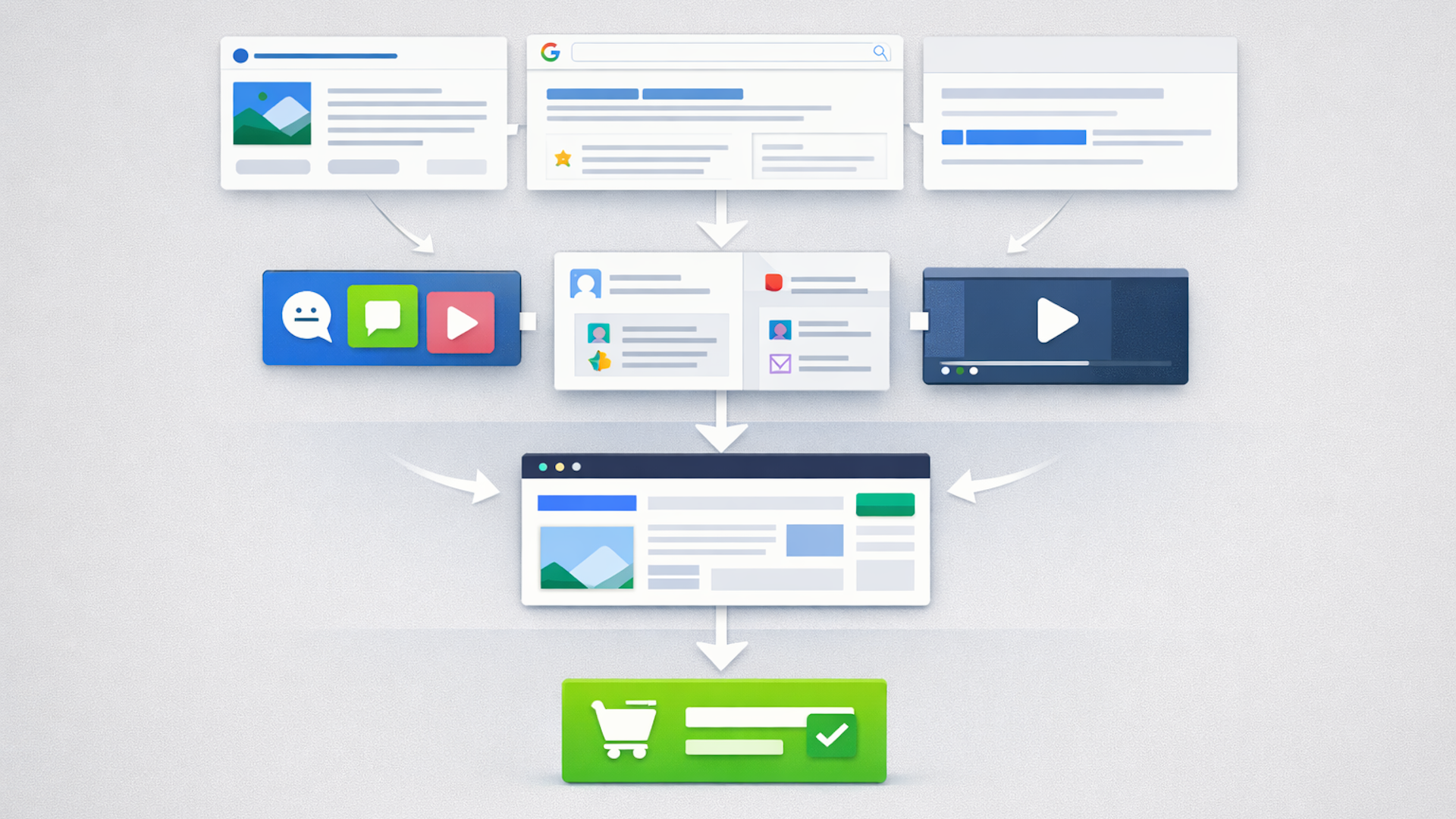
Our attribution models are linear – Search → Click → Convert – but user behavior is not.
Most traditional attribution models assume discovery leads to a measurable click.
Today, AI-driven SERPs are challenging that assumption and widening the gap between influence and revenue credit.
Last-touch attribution rewards the finish line – not the start of the race.
Which is to say, last-touch attribution collapses in an AI-first, zero-click world, especially for organic search. AI-driven search is accelerating attribution blind spots.
Our measurement is not broken. It’s outdated and doesn’t tell us the holistic story.
As an industry, we need to rethink our KPIs and how to measure success.
We need to tell the full data story throughout the entire customer journey, from the very top and down to the click and conversion.
Dig deeper: Marketing attribution guide: Models, tools, & best practices
So why is last touch a problem?
Last-touch attribution only measures the end of the customer journey.
Because of that, it misses all interactions that occur before the conversion, across channels like Google, Reddit, YouTube, AI Overviews, AI Mode, ChatGPT, Instagram, email, paid SERP listings, and more.
Most users of Google Analytics or Adobe Analytics rely on last-touch attribution when setting up their analytics.
This works as a baseline, but to tell the full story, you also need to understand where your first touches are coming from.
This is especially true as traditional organic traffic – click-throughs from the SERPs – continues to decline with the rise of AI Overviews and AI Mode.
Do you have the data you need for first-touch attribution?
Many organizations have data that is messy, siloed, and replete with quality and integrity issues.
Take a look at yours and ask yourself whether you can easily find the answer to these questions:
- How are my customers entering the marketing funnel through organic?
- Should it be paid, direct, referral, or AI that gets the conversion attribution?
- Do I have a sense of AI referrals? Have we set up a different channel in our analytics platform to capture AI referrals specifically?
- Can we tell the difference in conversion rates based on which channel is the first touchpoint? For example, how is the paid conversion rate different when organic is the first touch point? Or when it’s not?
If users aren’t searching more and clicking through to your site, it doesn’t mean organic is necessarily down or that your SEO program is not working well and is not worth it.
It’s likely that you’re either not measuring SEO accurately or appropriately.
So what’s the answer here?
Clean up your data, invest time in analyzing every channel that’s driving traffic to your website, and really dig into how organic search is still impacting your overall SEO efforts.
Dig deeper: Measuring zero-click search: Visibility-first SEO for AI results
Get the newsletter search marketers rely on.
Why first-touch analytics will prove organic results still matter
When a user searches and your brand is mentioned – but not linked – in an AI response, discovery has still happened.
If that same user visits your site the next day through social or direct, or shows up at a brick-and-mortar store, does that mean SEO didn’t work?
Of course not!
Organic results brought the user into the funnel just by being referenced, cited, visible – top of mind.
But how do you measure that when the last-touch was a direct, or social, or referral click and/or conversion?
Organic search was the entry point – even without a click – and arguably extremely important to other channels.
Without knowing and measuring first-touch and last-touch attribution, marketers can’t answer this question.
Organic search often introduces the category, frames the problem, and establishes credibility and perception about your brand before a buyer ever visits a website, watches a video, or visits a forum.
Dig deeper: 7 must-know marketing attribution definitions to avoid getting gamed
Visibility is the key SEO phrase of 2026
The new SEO currency in 2026 isn’t keywords, impressions, or clicks – it’s visibility through mentions and citations.
If AI systems select which brands to cite, organic visibility becomes a prerequisite for consideration, not just traffic.
Remember what “organic” means today: a user searches and discovers your brand on their own, without paid promotion. Ten or 15 years ago, that usually meant Google.
Today, however, a potential customer can search, discover, and research brands everywhere: YouTube, Reddit, Instagram, TikTok, ChatGPT, and, yes, still “Google it.”
They can also get answers and information summarized through Web Guide, AI Overviews, and AI Mode without a visit to the company’s website.
As marketers, we need to get clever about what visibility means today and how we will expand it.
Dig deeper: How to build search visibility before demand exists
2026 is the year to grow SEO, not shrink it
As search becomes more fragmented and AI-driven experiences reduce clicks, SEO’s role in discovery has not diminished – it has moved earlier in the journey.
The problem isn’t that organic search stopped working. It’s that post-click measurement no longer captures where influence actually begins.
Last-touch attribution undervalues early discovery and systematically under-credits SEO, especially in an AI-first, zero-click environment.
First-touch analysis helps correct that by connecting organic visibility to downstream influence, conversions, and revenue.
AI Overviews, AI Mode, and platforms like ChatGPT are accelerating these measurement gaps, and best practices are still emerging.
But this isn’t a new challenge for the industry. We’ve navigated data silos and attribution blind spots before.
In 2026, the teams that collaborate across analytics, SEO, and other channels – and invest in first-touch measurement – will be best positioned to prove organic’s impact and make better, more complete decisions.
Those who modernize how SEO is measured will be the ones who continue to justify and grow investment, even as clicks decline.
Dig deeper: MTA vs. MMM: Which marketing attribution model is right for you?
Contributing authors are invited to create content for Search Engine Land and are chosen for their expertise and contribution to the search community. Our contributors work under the oversight of the editorial staff and contributions are checked for quality and relevance to our readers. Search Engine Land is owned by Semrush. Contributor was not asked to make any direct or indirect mentions of Semrush. The opinions they express are their own.
