


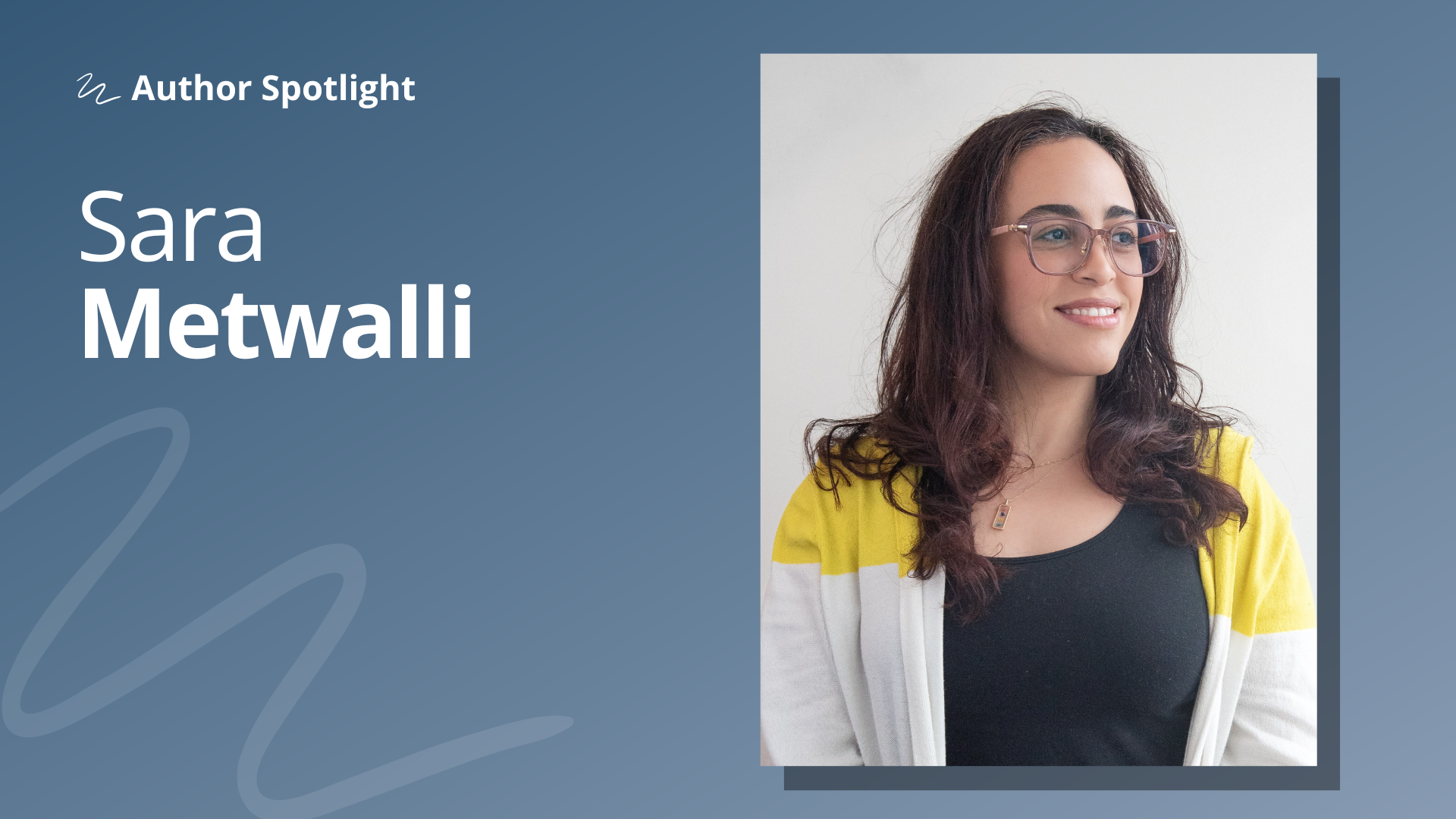
In the Author Spotlight series, TDS Editors chat with members of our community about their career path in data science and AI, their writing, and their sources of inspiration. Today, we’re thrilled to share our conversation with Sara A. Metwalli.
Sara is a quantum computing researcher at the Quantum Software Lab, exploring how machine learning and quantum systems intersect and how to write software for quantum computers. She writes about quantum topics with a focus on clarity, realism, and separating hype from what actually works. Sara also loves working out, reading, writing, and exploring the world. She has lived in Egypt, Japan, the US, and now in Scotland.
When we last spoke with you five years ago — in our very first Author Spotlight! — you were in the early stages of your PhD program in Japan. What have you been up to?
It feels like forever since we did the last author spotlight! I started writing for TDS in 2019. I was preparing to start my PhD, did so in 2020, and I finished it in 2024. I must admit that writing for TDS helped me get through the isolation of being a PhD student during COVID.
I moved to the U.S. in mid-2024, right after defending my thesis, and worked for six months as an outreach and education coordinator before returning to academia for a one-year postdoc. I finally moved to Scotland in October of last year.
In the five years since that Q&A, we’ve witnessed the arrival of LLMs and agents, among other innovations. How has the rise of everyday AI tools affected your work — and life in general?
The increase in popularity of LLMs changed the world and not just my life. As a person mainly in academia, I’ve always read the papers and talked to the researchers who worked on these technologies. I worked with them and discussed their ideas. I always find it interesting how research grows outside of research labs — how researchers don’t know how a technology will be used once everyone has access to it.
The sudden, explosive popularity of generative AI made me more aware of the importance of sharing research as it develops, rather than only when it matures.
I do believe LLMs can be used to make a lot of people’s lives easier, but they can be misused to cause harm. Finding the balance on a personal level, on a professional level, and on a community level is a challenge that any emerging technology faces at first.
Your interest in quantum technology started long before the field started to generate serious buzz in the past couple of years. What drew you to this area in the first place?
My interest in quantum tech started somewhere around 2018! I was doing my master’s and working as a teaching assistant for a quantum physics class. I enjoyed the class greatly, and the professor did a great job explaining things I never understood before.
When I was considering pursuing a PhD, the field of quantum computing was just starting to bloom: IBM had shared its intention to make its devices public and released Qiskit. It was exciting, complex, and mentally challenging (the three things that attract me to any field). It had the math, the potential, and the coding. I asked the professor I was working with if he knew anyone willing to take on a PhD student with no quantum background to do a PhD, and to my surprise, he did. The person he introduced me to turned out to be my PhD supervisor.
I love software and math, and quantum combines these two with the potential for great applications. Today, I am a researcher in the Quantum Software Lab at the University of Edinburgh, in Scotland. I am working on the bridge between data science and quantum computing, as well as on quantum machine learning and the applications of quantum computing.
Your public writing on TDS has shifted in the past year or two to focus almost exclusively on quantum. Why is it important for data and ML professionals to learn about this technology?
Since “quantum” is a buzzword, misinformation about it has exploded. As someone in the field, I hate seeing people being misled by false information. I do see the potential of quantum, and I see how fast it is developing. I think the only reason it is improving so quickly is the involvement of people outside academia. I believe data scientists are essential to the development of quantum computing, and quantum computing has the potential to change the way we think about data science and machine learning.
I personally believe that data scientists should care about quantum computing because many of the core tasks they already work on (such as optimization, sampling, and large-scale linear algebra) are exactly the kinds of problems quantum algorithms aim to speed up or handle differently. Quantum approaches, such as the Quantum Approximate Optimization Algorithm and Quantum Machine Learning, have the potential to improve performance in areas such as model training, complex simulations, and decision-making under uncertainty.
Realistically, today’s hardware is still limited, but the long-term impact could reshape how difficult data problems are solved. So it is a chance not just to be ready for the next big step in tech, but also to be part of shaping that technology.
What’s your experience been like as a public author in the age of ChatGPT, Gemini, and the rest? What motivates you to write these days?
That is a great question! I love generative AI; it shows how far we, as humans, have been able to take technology. But it is, after all, a machine; it is an algorithm that finds patterns: it has no soul, no experience.
I continue to write and read posts by authors I like because teaching or transferring knowledge is a human thing. ChatGPT can give you the basics of a topic, but someone who has been through the learning process can tell you more, as they will consider the obstacles they faced and the challenges they overcame. They can relate to the readers more than AI can — and that, for me, is very important.
To learn more about Sara’s work and stay up-to-date with her latest articles, you can follow her on TDS.
