


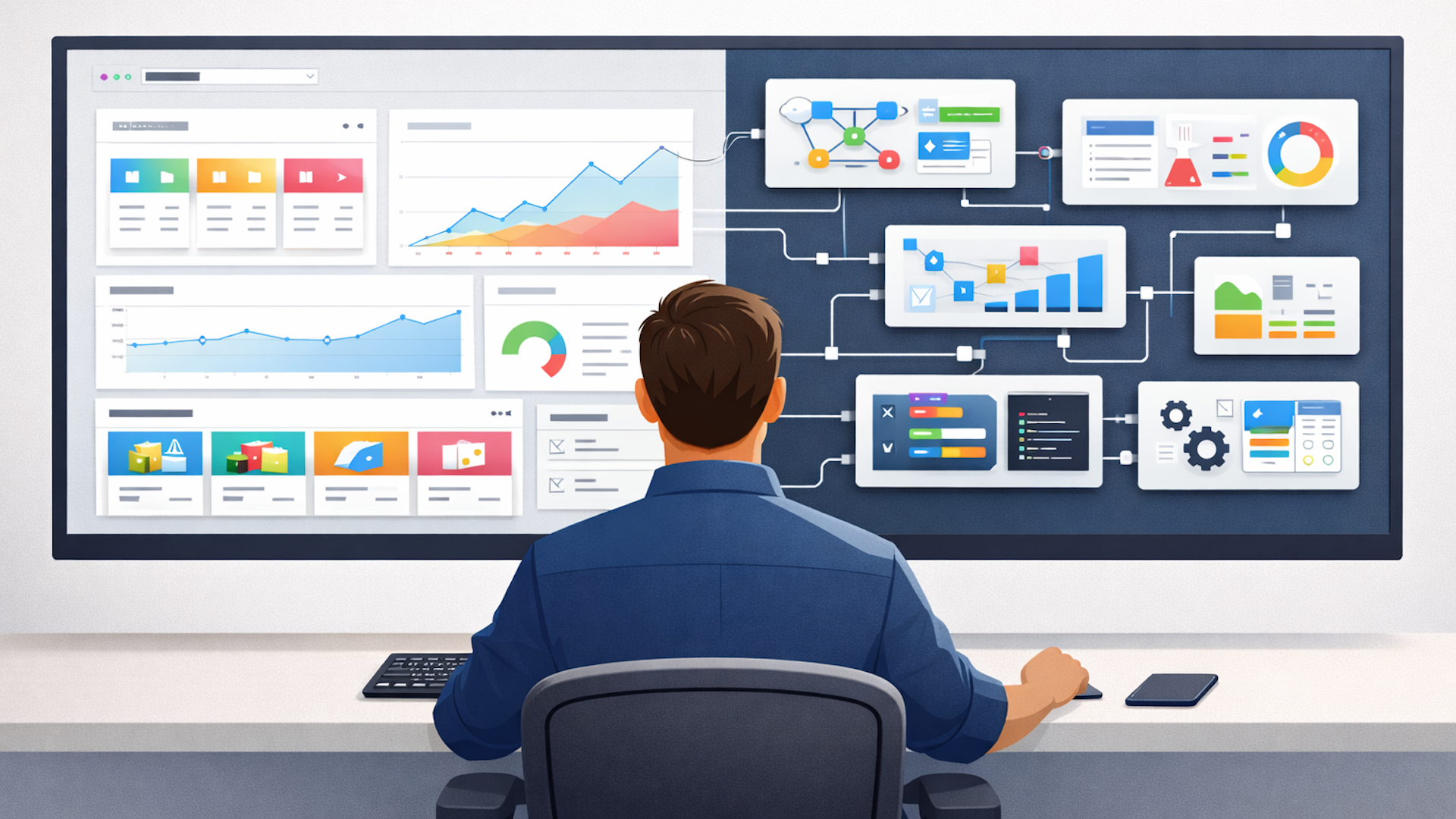
Automation has been reshaping PPC account management for years, from rules, scripts, and API-driven workflows inside Google Ads.
Most marketers are already comfortable with automated bidding, data-driven optimization, and other AI-powered enhancements.
The next shift goes further. Two developments in particular are changing how PPC campaigns are managed and optimized: AI agents and vibe coding.
Together, they point to a more autonomous way of working, where execution increasingly moves to AI – while marketers focus on strategy, systems, and creative direction.
This shift unlocks new levels of efficiency and flexibility, but it also changes what effective PPC management looks like.
Agentic AI: Google Ads has its own agentic AI integrated
Google released its Agentic Ads Advisor in November 2025.
The tool uses the latest Gemini models to help advertisers surface insights and improve campaign performance.
Google describes Ads Advisor as:
- “[Y]our AI partner that helps you proactively manage campaigns directly within Google Ads. It helps you understand your business context and simplifies your work by learning from your interactions to improve campaign results.”
The goal is to help advertisers analyze and optimize campaigns more efficiently.
But it raises an important question: what should an agentic AI tool actually do?
An agentic AI should function as an autonomous agent.
It should surface information when needed, but it should also be able to operate independently when appropriate.
That includes identifying opportunities to improve campaign setup, assets and ad copy, search terms, and other inputs.
More importantly, it should be capable of implementing certain changes, not just recommending them.
That is where agentic AI needs to go. As Jyll Saskin Gales noted after testing the tool, Google’s Ads Advisor is useful in places but not yet capable of acting autonomously.
How agentic AI can be used in PPC workflows
AI agents are meant to be autonomous.
They should be able to make decisions without constant human input, actively managing, adjusting, and optimizing campaigns in real time.
If an agentic AI only provides advice or reporting, much of its potential is lost.
In practical terms, agentic AI can handle bidding strategies, ad placements, audience targeting, and creative testing.
Instead of simply adjusting bids or budgets, it can make decisions on the fly, optimizing campaigns based on live performance data, seasonality, competitive activity, and user behavior trends.
This represents a fundamental shift in how PPC accounts are managed.
As agentic AI takes on more operational work, PPC professionals can spend more time on strategic decision-making.
Over time, it is likely that many advertisers will rely on the same algorithms, campaign types, and AI agents.
When that happens, competitive advantage will depend less on tooling and more on strategy.
Differentiation will come from classic marketing fundamentals:
- Positioning.
- Value propositions.
- Offers.
- Website quality.
- Brand awareness.
- Creative assets.
Those are the areas where marketers can still outpace competitors using the same AI-driven systems.
Dig deeper: Agentic PPC: What performance marketing could look like in 2030
Why agentic AI is relevant for advanced PPC marketers
For experienced PPC marketers, the appeal of agentic AI lies in its ability to scale campaigns without sacrificing strategic control.
That is where it becomes a true game-changer.
- Real-time optimization: Instead of waiting a full day for bid adjustments to take effect, agentic AI can respond within minutes, allowing campaigns to adapt quickly to changing market conditions.
- Data-driven creativity: Agentic AI is not limited to performance metrics. It can analyze creative elements and audience interactions, testing combinations of visuals, copy, and CTAs to identify top-performing ads.
- Reduced human error: With less manual intervention, the risk of mistakes or missed opportunities declines. This allows PPC professionals to spend more time on higher-level strategy rather than execution.
Despite the potential, agentic AI still requires informed oversight.
PPC professionals must understand how to evaluate and apply AI outputs, especially when aligning decisions with broader marketing objectives.
That matters because current tools are still limited. Google’s own agentic AI implementation still has limitations.
In addition, many advertisers want tools that operate according to their own rules and priorities.
That is where vibe coding comes in.
Get the newsletter search marketers rely on.
In parallel with the rise of agentic AI, another concept is gaining traction in marketing: vibe coding.
At its core, vibe coding is a way of working with AI-powered platforms to build more personalized, intuitive, and data-driven campaigns, tools, landing pages, or other systems.
In short, vibe coding lets you act as a developer, even if you are not one.
With tools such as Cursor, Lovable, and AI Studio, you can describe what you need and let the system build it.
By refining prompts over time, you can end up with a personalized tool that does exactly what you want, in your own style.
Vibe coding has been especially valuable in my own work.
Professionally, I have built tools such as:
- An SEO schema markup generator.
- A campaign and SEO audit tool.
- A system that generates marketing ideas by simply entering a website URL.
It has also extended beyond work, including:
- A tool that tracks daily calorie and nutrition intake.
- Another that creates custom CrossFit workouts based on Garmin and Strava data.
Once you start building this way, it becomes easy to keep expanding what you create.
Dig deeper: How vibe coding is changing search marketing workflows
Applying vibe coding to PPC workflows
Beyond building standalone tools, vibe coding becomes more powerful when combined with agentic AI.
That combination allows marketers to build their own AI agents for PPC work.
Frederick Vallaeys has shown how to build custom tools for PPC campaigns, though his example relies on manually entering data before the tool can operate.
By adding an AI agent layer, that step can be automated.
Instead of manual inputs, the agent can pull data through the Google Ads API, process and format it as needed, and then execute specific tasks.
In Vallaeys’ example, that task is seasonality analysis.
From there, the possibilities expand.
You can build:
- A keyword agent to identify new opportunities.
- An ad copy agent that generates creative based on performance data.
- A creative agent that produces new image assets.
Data agents, video agents, and other specialized agents can be connected into a single system, resulting in a custom agentic AI tool built through vibe coding.
The future: Where agentic AI and vibe coding will take PPC
The rise of these technologies brings both challenges and opportunities.
By embracing agentic AI and vibe coding, PPC marketers can streamline operations, improve campaign performance, and stay competitive while also standing out from peers.
The future of PPC is autonomous, data-driven, and more personalized than ever.
Embracing agentic AI and vibe coding creates a clear advantage for marketers who understand how to apply them effectively.
That advantage benefits internal teams and, ultimately, customers.
These technologies are not here to replace PPC professionals.
They are designed to extend capabilities, reduce manual effort, and enable better results with less friction.
PPC is becoming increasingly AI-powered, and adapting to that shift is no longer optional.
For practical examples of how AI agents and vibe coding are already being applied, follow Alfred Simon, Mike Rhodes, and Ales Sturala.
Contributing authors are invited to create content for Search Engine Land and are chosen for their expertise and contribution to the search community. Our contributors work under the oversight of the editorial staff and contributions are checked for quality and relevance to our readers. Search Engine Land is owned by Semrush. Contributor was not asked to make any direct or indirect mentions of Semrush. The opinions they express are their own.
