



As marketers, we love a great funnel. It provides clarity on how our strategies are working. We have conversion rates and can track the customer journey from discovery through conversion. But in today’s AI-first world, our funnel has gone dark.
We can’t yet fully measure visibility in AI experiences like ChatGPT or Perplexity. While emerging tools offer partial insights, their data isn’t comprehensive or consistently reliable. Traditional metrics like impressions and clicks still don’t tell the whole story in these spaces, leaving marketers facing a new kind of measurement gap.
To help bring clarity, let’s look at what we know and don’t know about measuring the value of structured data (also known as schema markup). By understanding both sides, we can focus on what’s measurable and controllable today, and where the opportunities lie as AI changes how customers discover and engage with our brands.
Why Most ‘AI Visibility’ Data Isn’t Real
AI has created a hunger for metrics. Marketers, desperate to quantify what’s happening at the top of the funnel, are turning to a wave of new tools. Many of these platforms are creating novel measurements, such as “brand authority on AI platforms,” that aren’t grounded in representative data.
For example, some tools are trying to measure “AI prompts” by treating short keyword phrases as if they were equivalent to consumer queries in ChatGPT or Perplexity. But this approach is misleading. Consumers are writing longer, context-rich prompts that go far beyond what keyword-based metrics suggest. These prompts are nuanced, conversational, and highly personalized – nothing like traditional long-tail queries.
These synthetic metrics offer false comfort. They distract from what’s actually measurable and controllable. The fact is, ChatGPT, Perplexity, and even Google’s AI Overviews aren’t providing us with clear and comprehensive visibility data.
So, what can we measure that truly impacts visibility? Structured data.
What Is AI Search Visibility?
Before diving into metrics, it’s worth defining “AI search visibility.” In traditional SEO, visibility meant appearing on page one of search results or earning clicks. In an AI-driven world, visibility means being understood, trusted, and referenced by both search engines and AI systems. Structured data plays a role in this evolution. It helps define, connect, and clarify your brand’s digital entities so that search engines and AI systems can understand them.
The Knowns: What We Can Measure With Confidence For Structured Data
Let’s talk about what is known and measurable today with regard to structured data.
Increased Click-Through Rates From Rich Results
From data in our quarterly business review, we see, by implementing structured data on a page, the content qualifies for a rich result, and enterprise brands consistently see an increase in click-through rates. Google currently supports more than 30 types of rich results, which continue to appear in organic search.
For example, from our internal data, in Q3 2025, one enterprise brand in the home appliances industry saw click-through rates on product pages increase by 300% when a rich result was awarded. Rich results continue to provide both visibility and conversion gains from organic search.
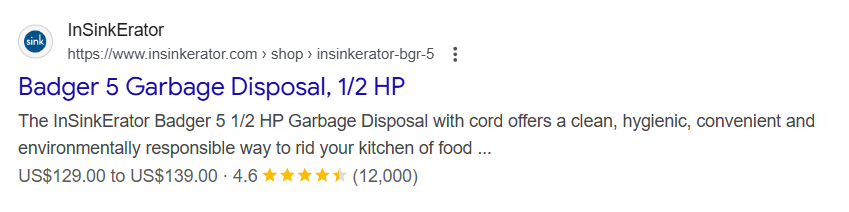 Example of a product rich result on Google’s search engine results page (Screenshot by author, November 2025)
Increased Non-Branded Clicks From Robust Entity Linking
It’s important to distinguish between basic schema markup and robust schema markup with entity linking that results in a knowledge graph. Schema markup describes what’s on a page. Entity linking connects those things to other well-defined entities across your site and the web, creating relationships that define meaning and context.
An entity is a unique and distinguishable thing or concept, such as a person, product, or service. Entity linking defines how those entities relate to one another, either through external authoritative sources like Wikidata and Google’s knowledge graph or your own internal content knowledge graph.
For example, imagine a page about a physician. The schema markup would describe the physician. Robust, semantic markup would also connect to Wikidata and Google’s knowledge graph to define their specialty, while linking to the hospital and medical services they provide.
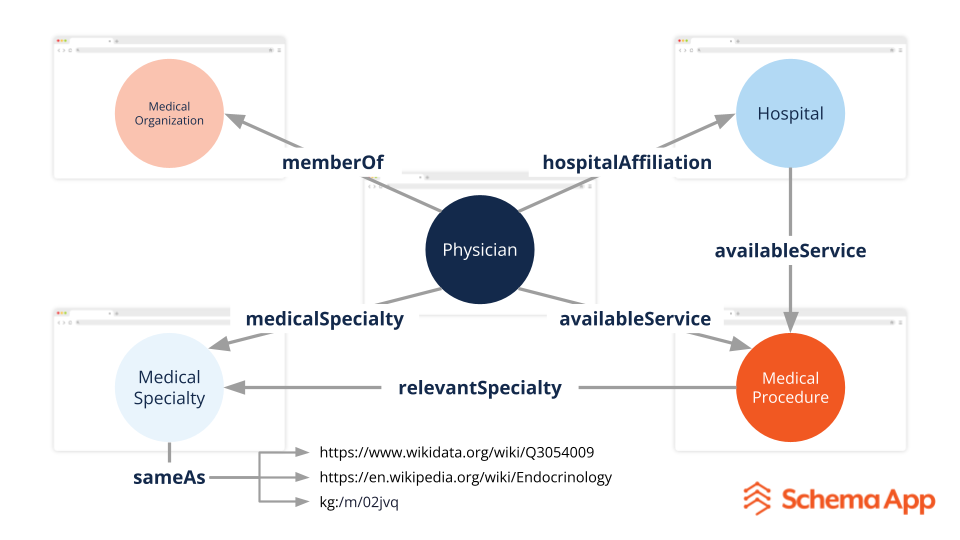 Image from author, November 2025
AIO Visibility
Traditional SEO metrics can’t yet measure AI experiences directly, but some platforms can identify some instances when a brand is mentioned in an AI Overview (AIO) result.
Research from a BrightEdge report found that adopting entity-based SEO practices supports stronger AI visibility. The report noted:
“AI prioritizes content from known, trusted entities. Stop optimizing for fragmented keywords and start building comprehensive topic authority. Our data shows that authoritative content is three times more likely to be cited in AI responses than narrowly focused pages.”
The Unknowns: What We Can’t Yet Measure
While we can measure the impact of entities in schema markup through existing SEO metrics, we don’t yet have direct visibility into how these elements influence large language model (LLM) performance.
How LLMs Are Using Schema Markup
Visibility starts with understanding – and understanding starts with structured data.
Evidence for this is growing. In Microsoft’s Oct. 8, 2025 blog post, “Optimizing Your Content for Inclusion in AI Search Answers (Microsoft Advertising,” Krishna Madhaven, Principal Product Manager for Microsoft Bing, wrote:
“For marketers, the challenge is making sure their content is easy to understand and structured in a way that AI systems can use.”
He added:
“Schema is a type of code that helps search engines and AI systems understand your content.”
Similarly, Google’s article, “Top ways to ensure your content performs well in Google’s AI experiences on Search,” reinforces that “structured data is useful for sharing information about your content in a machine-readable way.”
Why are Google and Microsoft both emphasizing structured data? One reason may be cost and efficiency. Structured data helps build knowledge graphs, which serve as the foundation for more accurate, explainable, and trustworthy AI. Research has shown that knowledge graphs can reduce hallucinations and improve performance in LLMs:
While schema markup itself isn’t typically ingested directly to train LLMs, the retrieval phase in retrieval-augmented generation (RAG) systems plays a crucial role in how LLMs respond to queries. In recent work, Microsoft’s GraphRAG system generates a knowledge graph (via entity and relation extraction) from textual data and leverages that graph in its retrieval pipeline. In their experiments, GraphRAG often outperforms a baseline RAG approach, especially for tasks requiring multi-hop reasoning or grounding across disparate entities.
This helps explain why companies like Google and Microsoft are encouraging enterprise brands to invest in structured data – it’s the connective tissue that helps AI systems retrieve accurate, contextual information.
Beyond Page-Level SEO: Building Knowledge Graphs
There’s an important distinction between optimizing a single page for SEO and building a knowledge graph that connects your entire enterprise’s content. In a recent interview with Robby Stein, VP of Product at Google, it was noted that AI queries can involve dozens of subqueries behind the scenes (known as query fan-out). This suggests a level of complexity that demands a more holistic approach.
To succeed in this environment, brands must move beyond optimizing pages and instead build knowledge graphs, or rather, a data layer that represents the full context of their business.
The Semantic Web Vision, Realized
What’s really exciting is that the vision for the semantic web is here. As Tim Berners-Lee, Ora Lassila, and James Hendler wrote in “The Semantic Web” (Scientific American, 2001):
“The Semantic Web will enable machines to comprehend semantic documents and data, and enable software agents roaming from page to page to execute sophisticated tasks for users.”
We’re seeing this unfold today, with transactions and queries happening directly within AI systems like ChatGPT. Microsoft is already preparing for the next stage, often called the “agentic web.” In November 2024, RV Guha – creator of Schema.org and now at Microsoft – announced an open project called NLWeb. The goal of NLWeb is to be “the fastest and easiest way to effectively turn your website into an AI app, allowing users to query the contents of the site by directly using natural language, just like with an AI assistant or Copilot.”
In a recent conversation I had with Guha, he shared that NLWeb’s vision is to be the endpoint for agents to interact with websites. NLWeb will use structured data to do this:
“NLWeb leverages semi-structured formats like Schema.org…to create natural language interfaces usable by both humans and AI agents.”
Turning The Dark Funnel Into An Intelligent One
Just as we lack real metrics for measuring brand performance in ChatGPT and Perplexity, we also don’t yet have full metrics for schema markup’s role in AI visibility. But we do have clear, consistent signals from Google and Microsoft that their AI experiences do, in part, use structured data to understand content.
The future of marketing belongs to brands that are both understood and trusted by machines. Structured data is one factor towards making that happen.
More Resources:
Featured Image: Roman Samborskyi/Shutterstock
