


The web has strong opinions about what “AI-written” content looks like, and even stronger ones about what’s supposedly wrong with it. Scroll any content marketer’s LinkedIn feed, and you’ll find confident claims that em dashes and other AI “tells” signal bad, automated writing.
The problem with these debates is that they often confuse taste with performance. What counts as “bad writing” will always be subjective. But if the goal for content marketers is to communicate clearly and compete in the information marketplace, the practical question should be: which LLM habits actually turn readers off?
To find out, we analyzed a large dataset of content marketing pages to identify which AI writing “tics” we see most often called out to understand which are turning off readers — and the ones we may be calling out for no reason.
How we built our ‘AI tics’ study
At this point, you’ve probably all seen them, too:
- “In today’s fast-paced digital landscape…”
- “It’s important to note that…”
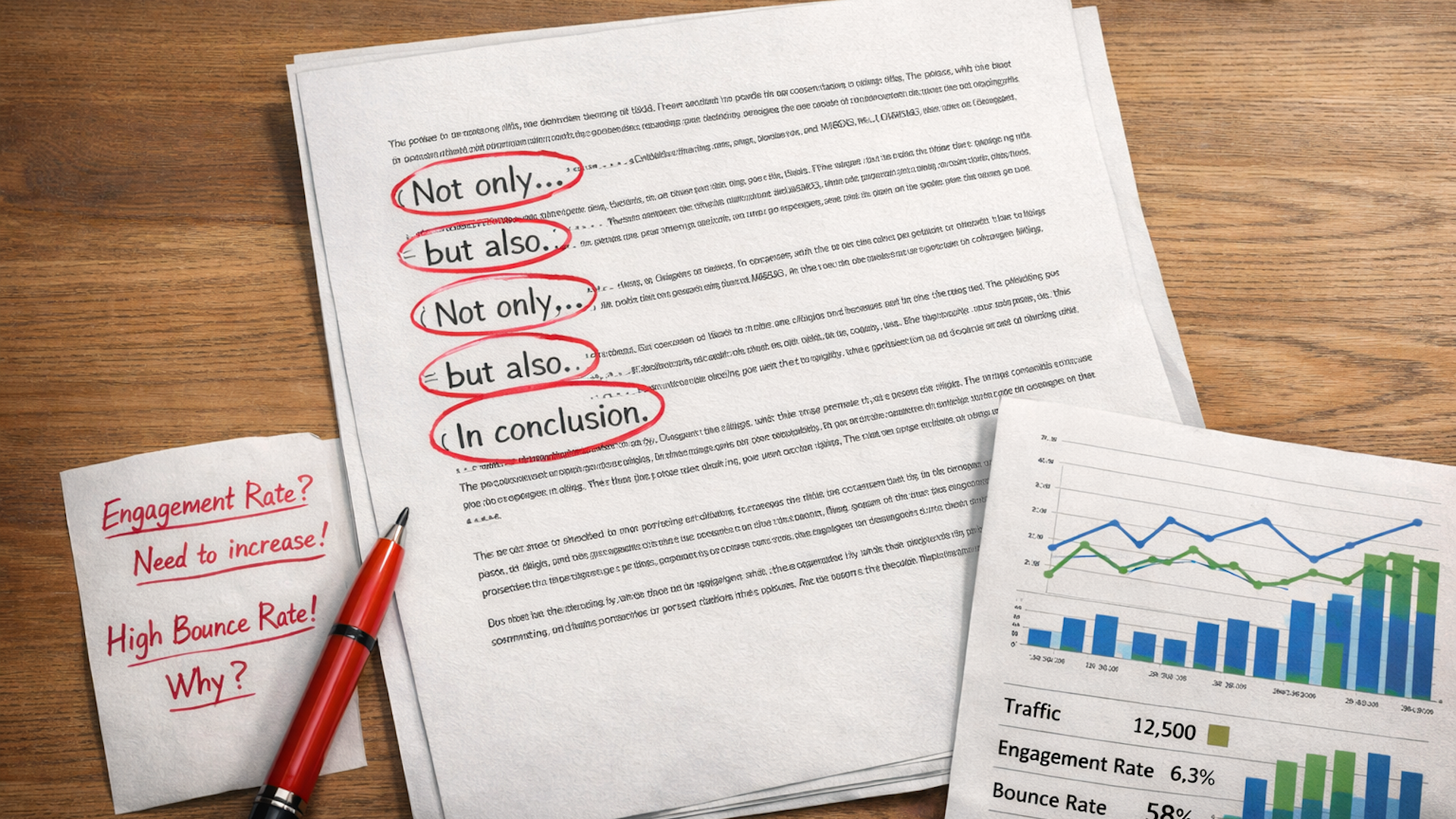
- “Not only… but also” (repeated over, and over and over…)
- “In conclusion” (even when nothing has been concluded)
The second you notice them, it’s hard not to see them everywhere an LLM has helped produce copy. Many readers report hating these LLM patterns. But how exactly are they impacting user engagement?
To find out, we gathered a list of the most common AI writing tells we and others have noticed. These include:
- “Not only… but also” constructions: “Not only does X do Y, but it also does Z.”
- Sentence starts with “then,” “this,” or” that”: “Then you should…” “Then the system…” “This shows…” “This means…”
- Introductory filler: “In this article,” “We’ll explore,” and “Let’s take a look”.
- “Conclusion” starters: “In conclusion,” or other AI equivalents of clearing your throat.
- Em dashes: The most infamous punctuation mark in today’s content marketing.
From there, we built a dataset of:
- 10 domains of varied site size and monthly traffic, in a wide array of industries including tech, ecommerce, healthcare, education, analytics, and more
- 1,000+ content marketing URLs, built from a mix of workflows including posts that were either fully human-written, written collaboratively by humans and AI, or completely AI-generated.
Then we standardized our dataset by:
- Aligning shorter posts and cornerstone content by standardizing every writing tic as occurrences per 1,000 words. Since longer articles naturally contain more of, well, everything, a 3,000-word guide would otherwise look “worse” than a 600-word post simply because it has more sentences.
- Excluding any page under 500 words. Very short pages don’t give enough room for stylistic patterns to emerge, and their engagement metrics are likely driven more by intent than by engagement alone.
- Prioritizing engagement rate as the primary performance metric. Engagement rate best captures a reader’s first real decision: “Do I stay, or do I leave?” GA4 registers an engaged session as any lasting 10 or more seconds. While 10 seconds may sound brief to assess whether a post is AI, it’s long enough for a user to skim an introduction, notice awkward or repetitive writing patterns, and scan headings to decide whether the content feels worth continuing.
Dig deeper: A smarter way to approach AI prompting
Your customers search everywhere. Make sure your brand shows up.
The SEO toolkit you know, plus the AI visibility data you need.
Start Free Trial
Get started with

Why tracking total AI tics wasn’t enough
Our first instinct was to average the number of AI tics per 1,000 words and compare the pages’ performance.
At a glance, this seemed like a clean way to separate human writing from AI-influenced writing. But the picture quickly got complicated by one tic in particular — the infamous em dash — which dominated the dataset and heavily skewed the averages.

The issue pointed to a larger problem: AI tics are messy by definition. AI is trained on human writing. So if certain patterns show up frequently, that doesn’t mean they’re uniquely “AI.” It may just mean they’re common in English prose.
To compare, we ran the same tic counter on two known controls: a novel I published in 2021 (which I could guarantee was written without ChatGPT, Grammarly, or other AI-assisted tools). This scored a startlingly above-average 6.9 tics per 1,000 words.
Next, we scored “Hamlet,” the famous Shakespearean play, which scored an even higher ≈11.4 tics per 1,000 words. Shakespeare, it turns out, is more “AI-coded” than many AI-generated blog posts.
Ultimately, we assessed that this is almost entirely due to the em dash, which is likely to appear in droves in many human writers’ prose as well as AI-produced copy.
With this in mind, we analyzed each “tell” individually, still standardizing per 1,000 words. The story became much clearer — and far more useful for writers trying to decide what’s actually worth avoiding.
Dig deeper: How to make your AI-generated content sound more human
Get the newsletter search marketers rely on.
The AI tics impacting performance
Not all posts are the same, and many different factors impact the success or failure of any page of content marketing. That’s perhaps why our data showed that most AI “tells” didn’t correlate strongly with performance or non-performance.
Anything smaller than plus/minus .1 correlation is statistically insignificant. However, there were a handful worth noting with a larger impact than others.

‘Not only’ and ‘not just’ structures may be driving users away
Phrases built around “not only…” or “not just…but also” stood out with larger-than-average negative correlations with engagement rate. While these constructions, when used occasionally, can add emphasis, the data shows that frequent use is associated with high user bounce rates.
AI-assisted writers and editors should take note, as many of the AI-generated posts we reviewed tripped over themselves with these constructions. In one instance, we found a single blog post that used “not only” and “but also” 12 separate times.
The strongest negative correlation in the entire dataset was observed in sentences beginning with “Conclusion,” typically section headers preceding a call to action. The clearest AI stylistic red flag we found, posts with headers starting with “Conclusion” had the largest negative correlation (≈ -0.118) with post engagement rate.
Since this tic traditionally comes at the conclusion of a post, it’s clear readers may quickly scroll down over the entirety of these posts before bouncing — or else that posts with these final headings tend to be lower-quality on average.
Em dashes correlated slightly positively
Em dashes were by far the most common stylistic tic in the dataset. They also produced one of the most surprising results: a slight positive correlation with engagement rate.
Despite widespread online chatter treating em dashes as an “AI artifact,” this data suggests they’re not hurting performance, and they may even align with better engagement. (As someone who genuinely likes em dashes — this was deeply validating.)
A plausible explanation may be that writers who use em dashes tend to write more explanatory, nuanced sentences rather than short, flat declarations. Those kinds of sentences often appear in longer, more thoughtful content that many readers actually engage with.
That said, this doesn’t mean em dashes cause engagement. Too much of a good thing is still too much of a good thing. But it does challenge the idea that em dashes are the bugbear content marketers make them out to be.
Dig deeper: An AI-assisted content process that outperforms human-only copy
3 practical takeaways for content teams
Here’s what content marketers can act on today.
1. Don’t over-optimize for AI detection
Google doesn’t issue SEO rankings like a monotonic punishment score for “AI style.” Most phrases we looked at didn’t correlate with engagement at all.
Don’t rewrite content just because someone declared a phrase “AI writing.” Write for reader usefulness and clarity above all.
2. Be mindful of how you wrap up
Explicit conclusion blocks aren’t bad — but generic, formulaic patterns are likely turning readers away.
Consider blending conclusions into analysis, using subtler transitions, or adding new value with headers, instead of signposting obvious structure.
3. Use the punctuation that makes sense
If your style calls for em-dashes? In this dataset, they were actually associated with better reader engagement. Use them.
Don’t miss the forest for fake plastic trees
AI is likely here to stay in content workflows. But the issues with “bad” AI writing aren’t limited to linguistic tics and punctuation. While we all have our stylistic opinions, we should be careful about turning stylistic hot takes into editorial law.
Write valuable writing. Think about readers first. And don’t panic every time someone on Twitter or LinkedIn decrees that “X phrase = AI.”
Contributing authors are invited to create content for Search Engine Land and are chosen for their expertise and contribution to the search community. Our contributors work under the oversight of the editorial staff and contributions are checked for quality and relevance to our readers. Search Engine Land is owned by Semrush. Contributor was not asked to make any direct or indirect mentions of Semrush. The opinions they express are their own.
