


AI image generators have been brewing (generating?) up a storm for the last few years. If you’ve been on social media, watched prime time news shows, or read a magazine, AI-generated images have been impossible to miss. These kinds of AI-generated images are everywhere, and sometimes you won’t even realize. If you want to join in the fun, or add some AI-powered features to your business workflows, the apps on this list will give you what you’re looking for.
I’ve been writing about AI image generators since Google Deep Dream in 2015. That’s about as long as anyone outside of a computer science lab has realistically been thinking about these tools, and I’m really excited by how far they’ve come.
I’m going to try to avoid the thorny discussions around artistic merit, whether or not these tools are replacing or augmenting artists, and copyright infringement in training data, at least where I can. I’m also going to steer clear of some of the controversial uses these models have been put to. You’re reading this on the Zapier blog, so I’m going to assume you have a good personal or professional need for an image generator.
While you’ve probably tested these image generators before, if you haven’t tried one in a while, it’s worth taking a few hours to play around with one of these newer text-to-image AI apps. Things have improved massively, so it’s worth understanding what they can do, even just from a technical perspective. Whether you like it or not, we’re all seeing a lot of their output at the moment. And there will only be more to come.
The best AI image generators
How do AI image generators work?
All these AI image generators take a text prompt and then turn it—as best they can—into a matching image. This opens up some wild possibilities, since your prompt can be anything from “an impressionist oil painting of a Canadian man riding a moose through a forest of maple trees” to “a painting in the style of Vermeer of a large fluffy Irish wolfhound enjoying a pint of beer in a traditional pub” or “a photograph of a donkey on the moon.”

Seriously, the only real limits are your imagination, the AI image generator’s ability to comprehend your prompt, and any content filters put in place to stop plagiarism, copyright infringement, and bad actors flooding the internet with AI-generated violence or other NSFW content.
Most AI image generators work in a pretty similar way. Billions of image-text pairs are used to train a neural network (basically, a very fancy computer algorithm modeled loosely on the human brain) on what things are. By allowing it to process near-countless images, it learns what dogs, the color red, Vermeers, and everything else are. Once this is done, you have an AI that can interpret almost any prompt—though there is a skill in setting things up so it can do so accurately.

The next step is to actually render the AI-generated image. There are two primary ways of doing this:
Diffusion models work by starting with a random field of noise, and then editing it in a series of steps to match its understanding of the prompt.
Autoregression models work by generating chunks of the image at a time, predicting the next chunk based on what they’ve already created. These are the current state-of-the-art models.
What makes the best AI image generator?
How we evaluate and test apps
Our best apps roundups are written by humans who’ve spent much of their careers using, testing, and writing about software. Unless explicitly stated, we spend dozens of hours researching and testing apps, using each app as it’s intended to be used and evaluating it against the criteria we set for the category. We’re never paid for placement in our articles from any app or for links to any site—we value the trust readers put in us to offer authentic evaluations of the categories and apps we review. For more details on our process, read the full rundown of how we select apps to feature on the Zapier blog.
There’s a reason that AI image generators have become incredibly popular over the past three or four years: before that, they were pretty bad. The technology underlying them was incredibly cool and impressive, at least to research scientists, but the images they could output were underwhelming. Even the original DALL·E was more of a fun novelty than a world-shaking revelation when it launched in 2021.
Now that these text-to-image generators have been around for a while, there’s some real competition between the different models. They’ve really increased in quality and can now even generate text with some reliability. If all you care about is the current “best” model, check out Artificial Analysis’s Image Arena. But we’ve reached the stage where the top 50 or so models are all excellent, so other features and usability matter more than they used to.
So, to find the best AI art generators, I set some pretty strict criteria:
I was looking for apps that allowed you to generate AI images from a text prompt (and to a lesser degree, an image prompt). Tools that have you upload a dozen of your photos and then spit out AI-generated portraits are fun, but they aren’t the kind of general-purpose image generators I was considering.
I was looking at the AI image generators themselves, not tools built on top of them. For example, NightCafe is an AI picture generator that has a great community and app, but it just enables you to use open source models like FLUX and Stable Diffusion, fine-tuned models based on various versions of them, various APIs for current models, as well as a handful of older generative models. It’s worth checking out, but it doesn’t meet my criteria for its own entry on this list.
Aside from all that, I also considered how easy each AI image creator is to use, what kinds of controls and customization options it provides (for things like AI image upscale), what pricing model it has, and most important of all: how good were the results? The best AI image generators are now far less likely to create weird or impossible-looking things.
I’ve been using and writing about text-to-image generators since the original DALL·E launched, and about photography and art for more than a decade, so I’m pretty familiar with how all these tools work—and their various pros, cons, and bonkers behaviors. But writing this article was actually the first time I’ve put so many AI image generators head-to-head with the same prompts. The results were fascinating, and I’m delighted to say all the apps on the list offer genuine reasons to use them.
How to use AI image generation at work
Interested in AI, but not quite sure how you’d use it at work? Here are a few of the ways people are turning to AI image generation in their roles:
Generating hero images for blog posts
Creating social media posts
Generating slide decks and storyboards
Creating personalized images for customers
Learn more about how to use AI image generation at work.
The best AI image generators at a glance
Best for | Access options | Price | Parent company | |
|---|---|---|---|---|
Ease of use and overall quality | ChatGPT; API | Free with ChatGPT; fewer restrictions with ChatGPT Plus at $20/month | OpenAI | |
Google users | Google Gemini; API | Limited availability on free plan; included with Google AI Plus plan at $8/month | ||
Artistic results | Web app; Discord | From $10/month for ~200 images/month and commercial usage rights | Midjourney | |
Adhering to prompts | Web app | Limited free plan; Pro plan at $20/month with more generations and private images | Reve | |
Accurate text | Web app | Limited free plan; from $20/month for 1,000 monthly priority credits | Ideogram AI | |
Customization and control | NightCafe, Tensor.Art, Civitai, and lots of other apps; API; downloading it to a local server | Depends on the platform | Black Forest Labs | |
Using AI-generated images in photos | firefly.adobe.com, Photoshop, Express, and other Adobe tools | Limited free credits; from $9.99 for 2,000 credits/month | Adobe | |
Graphic design | Web app | Free for 30 credits/day; from $12/month for full features | Recraft |
The best AI image generator overall
ChatGPT (GPT Image 1.5)

ChatGPT pros:
Incredibly easy to use and a best-in-class model
Included with ChatGPT plans, so you get a lot of AI for your money
Integrates with Zapier
ChatGPT cons:
After OpenAI’s DALL·E model kickstarted the text-to-image boom, it seemed to take a backseat to the company’s language models. DALL·E 2 and DALL·E 3 were good when they debuted, but were both quickly overtaken by other models. But since last year, OpenAI has been back with a bang. GPT Image 1.5 is integrated with ChatGPT, which can now natively generate images.
GPT Image 1 is one of the best image generators available. It’s also ridiculously easy to use: tell ChatGPT what you want to see, and it’ll create the image. Unfortunately, because it uses an autoregression model instead of diffusion, it’s much slower than the other image generators on this list—and it only generates a single image. If you’re only occasionally generating a few images, this isn’t a big deal, but it’s worth noting.
It’s really solid across the board: accurate text rendering, easy editing, understanding of numbers and position, the list goes on. Its best feature, though, is what’s caused it to go viral a few times. It’s great at adhering to image prompts (and it’s pretty good at adhering to regular prompts, too). If you upload a photo and direct it to create the image in the style of Picasso, Vermeer, or, yes, Studio Ghibli, it will do an exceptional job. It’s also pretty good at incorporating feedback—ask it to change just one element of your image and it generally will.
You get limited access to image creation on ChatGPT’s free plan. If you want to use it more, you’ll need to subscribe to ChatGPT Plus or Pro.
In addition to image generation through ChatGPT, OpenAI offers an API, which means you can connect ChatGPT to Zapier to do things like automatically create images from Google Forms or HubSpot responses—or any other apps you use. Learn more about how to automate ChatGPT, or get started with a pre-made template.
ChatGPT pricing: Free users and ChatGPT Go users ($8/month) can access it, but if you don’t want to run into limits, image generation is included as part of ChatGPT Plus at $20/month.
The best AI image generator for Google users
Nano Banana (Gemini 3.1 Flash Image Preview)

Nano Banana pros:
Nano Banana cons:
Nano Banana 2 (officially Gemini 3.1 Flash, but no one calls it that) is Google’s answer to ChatGPT’s image generation. Despite the silly name, Nano Banana is a serious contender. It’s especially good at editing existing images. If you’re a Google user, using it through Gemini is a very easy choice.
While Nano Banana can create incredible results, I found its prompt adherence and direct editing tools lagged a little behind other models. While I was able to change a tennis ball into a chicken, I couldn’t get Nano Banana to have the chicken run away from my dog and not toward it. When I asked it to change the moose in the image above into a cow, it managed it perfectly but couldn’t change the direction of travel without making a weird two-headed-no-tailed monster. Similarly, in prompts with lots of details, it missed a few. The other big catch is that it watermarks your images.
Google’s image models have been solid for the past while, but they’ve always fallen a little short. Nano Banana fixes that. Prompt adherence aside, it’s one of the top models currently available—and here’s hoping Google can iron out those last few quirks.
You can even add Nano Banana to the rest of your AI workflows with Zapier’s Gemini integration, so you can create images in Gemini based on triggers in all your other apps.
Nano Banana pricing: Limited availability on free plan; included with Google AI Plus plan at $8/month and Google AI Pro plan at $20/month.
The best AI image generator for artistic results
Midjourney

Midjourney pros:
Midjourney cons:
For a long time, Midjourney produced my favorite results of all of the image generators on this list. Other apps have finally surpassed it in quality, especially when it comes to adhering exactly to your prompts, but I still feel Midjourney produces some of the most visually appealing and interesting results with great textures and colors. It helps that you now have to fine-tune the model to match your visual preferences.
Best of all, Midjourney’s web app is increasingly excellent. It’s come a long way since the time you had to access it through Discord.
Still, as you can probably guess, Midjourney isn’t totally free of quirks: by default, every image you generate is posted publicly on Midjourney’s Explore page and can be viewed on your profile. It gives everything a cool community aspect, but it means that anyone who cares to look can see what you’re creating. While not necessarily a problem for artists, this might be a dealbreaker if you’re looking to use Midjourney for business purposes. It’s also worth noting that Midjourney is in the midst of a lawsuit with Disney and Universal; not much has come of it yet, and a lot of these suits have petered out, but it’s worth being aware of.
Midjourney’s help docs are really good and walk you through getting started with both the web app and Discord, and they show you how to control all its various features, from selecting model versions and upscaling to using character references and its personalization tools. It’s one of the most feature-filled apps on this list, and once you understand the different options, the results you can get are genuinely amazing.
Midjourney’s free trials are still suspended, but they’re occasionally reinstated for a few days. If you miss a free trial window, the Basic Plan starts at $10/month and comes with 3.3 hours of GPU time per month, or around 200 images. You also get the option to buy additional GPU time, and you can use your images commercially.
Midjourney pricing: From $10/month for the Basic Plan that allows you to generate ~200 images/month and provides commercial usage rights.
The best AI image generator for adhering to prompts
Reve
Reve Image pros:
Reve Image cons:
Reve Image is an image model that essentially came out of nowhere in March 2025. It instantly jumped to the top of Artificial Analysis’s leaderboard—and it’s still comfortably in the top tier. It’s an incredibly powerful image generator with best-in-class prompt adherence and very effective editing.
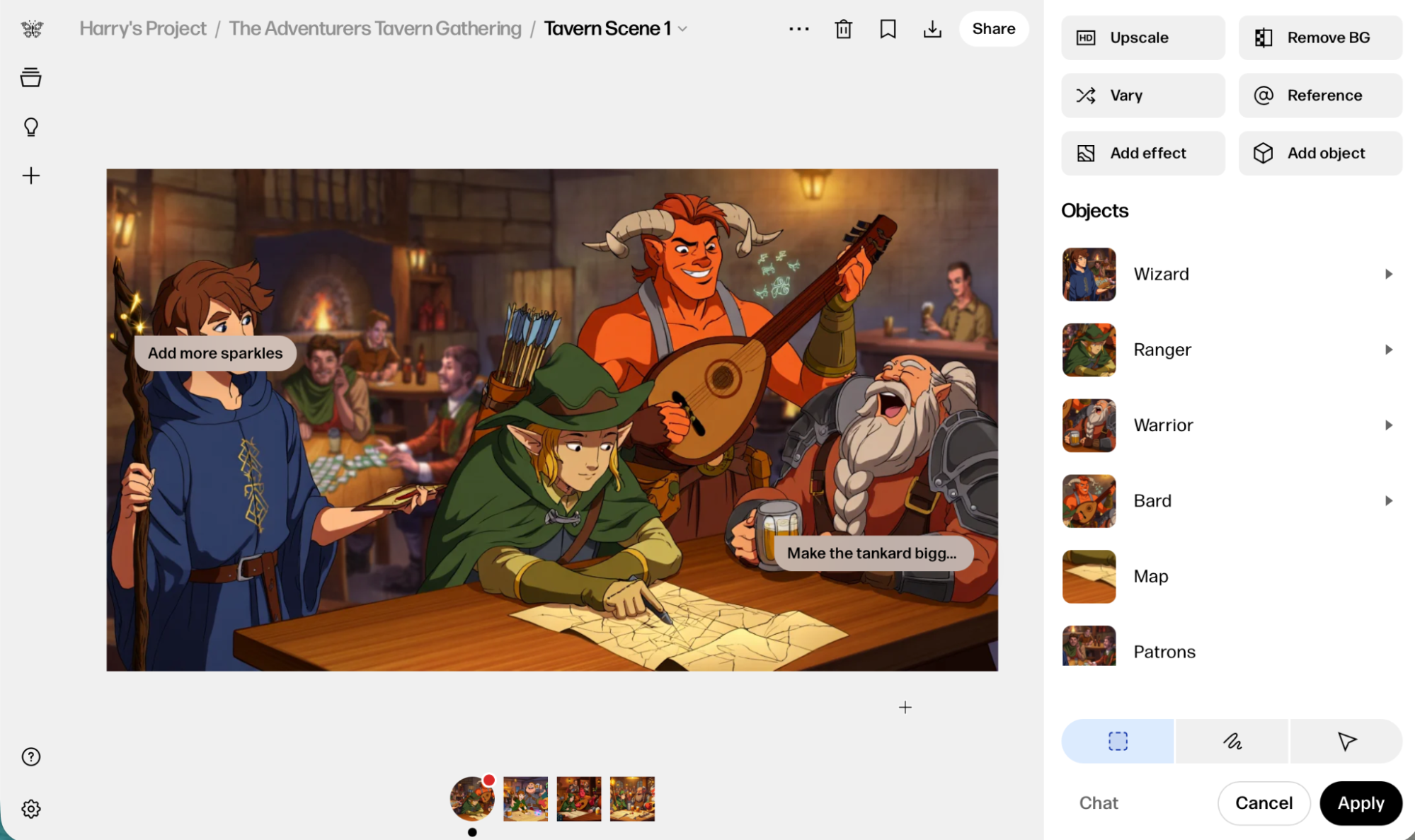
In plain English, that means Reve Image is able to stick closely to the prompt you give it. If you ask for, say, an image with a warrior holding a sword and a wizard holding a staff, that’s what you’ll get—not a warrior with a staff and a wizard with a sword. This kind of adherence has been a struggle for image generators, especially as prompts get longer and more complicated. I was pretty blown away by just how many details Reve Image could manage.
On top of that, Reve Image is great with text, different styles, photorealism, and editing. If you want to make changes, you can add text notes to the areas of the image and it will regenerate everything. It’s a great way to work.
Sadly, Reve Image has axed its credit-based pricing. The free plan gets you a limited number of generations; the Pro plan gets you the vague “100x more usage” for $20/month.
Reve Image pricing: Free plan; Pro plan at $20/month with more generations and private images.
Best AI image generator for accurate text
Ideogram
Ideogram pros:
Ideogram cons:
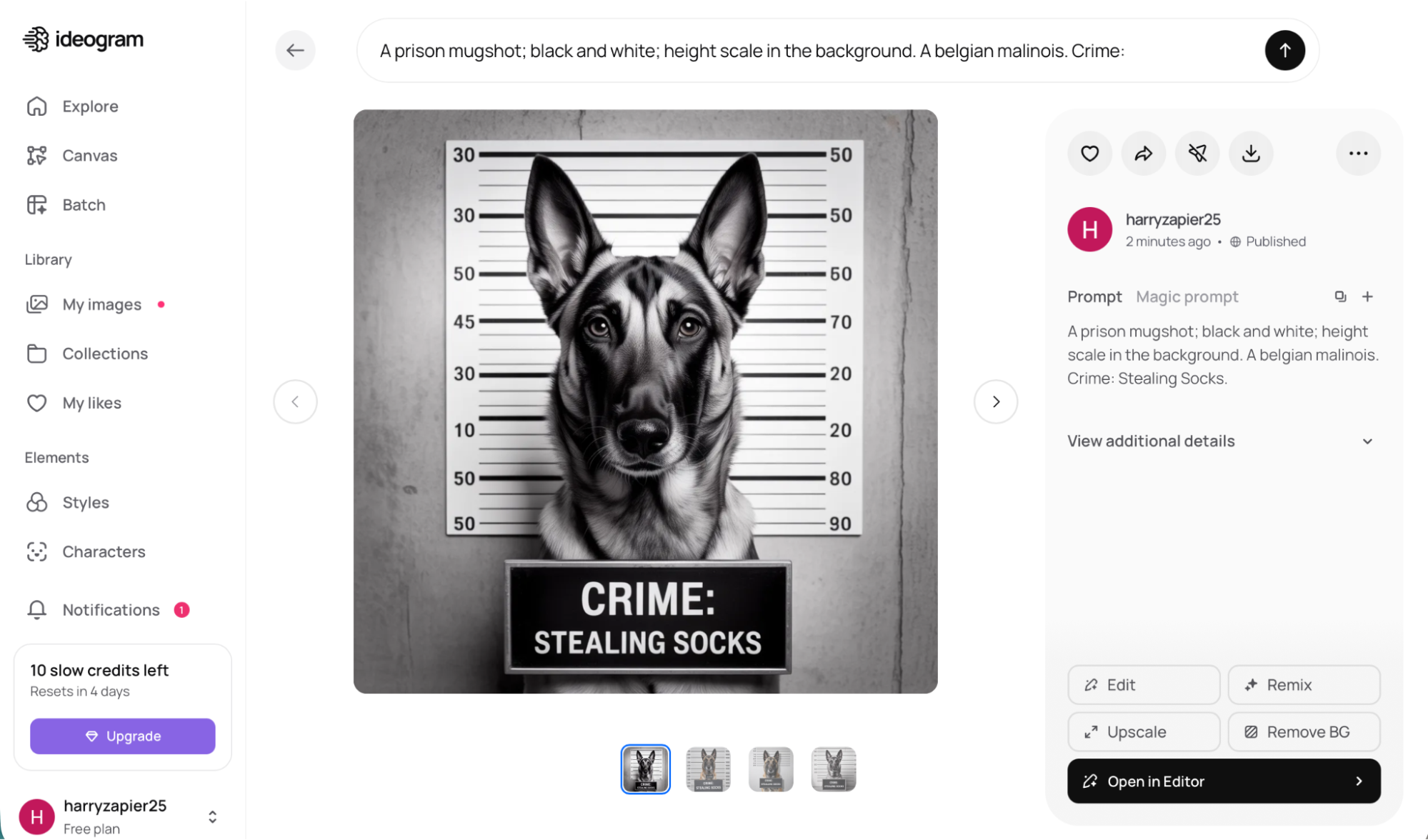
Although they’re getting better, most AI image generators still struggle to generate text correctly—the diffusion process just doesn’t lend itself to precisely rendering letters. Ideogram, though, has cracked it. Its latest 3.0 algorithm is able to accurately and reliably include text along with any generated image.
What makes this more impressive is Ideogram is also one of the best image generators overall. It has an intuitive web app and some nice features like an image editor and the ability to use any image as the basis for a new one. There’s a Batch Generator that allows you to upload a spreadsheet with a list of prompts, a canvas feature that allows for more complex designs, and a Character creator that allows you to put the same person in any scene you can imagine. In my testing, it was up there with Midjourney in terms of quality.
Ideogram even has a free plan. With it, you’re limited to 10 credits a week, you have to wait a few minutes for a generation to start, and you only get Ideogram’s basic features, but it’s still a great way to get a feel for one of the best AI image generators available.
Ideogram pricing: Limited free plan; from $20/month for Plus plan with 1,000 monthly priority credits.
Best AI image generator for customization and control
FLUX

FLUX pros:
FLUX cons:
As Stability.ai, the makers of Stable Diffusion, started collapsing back in 2024, a significant portion of the team left the company to found Black Forest Labs. Their FLUX series are now the premier open text-to-image models.
There are a few different versions of FLUX: FLUX.2 Max, FLUX.2 Pro, FLUX.2 Flex, FLUX.2 Klein, as well as older FLUX 1.1 models. They’re all excellent and are being widely embraced by the AI art community. They’re designed for prompt-based editing.
Right now, if you’re looking to get into open AI image generation rather than just using one of the simpler text-to-image tools, I’d suggest experimenting with FLUX. The different models have different licensing terms, so make sure to check them out. You can find out more over on GitHub.
For non-developers, the simplest way to use FLUX is through online AI art generators like NightCafe, Tensor.Art, and Civitai—though the FLUX playground is much improved. Sign up for a free account, give it a go, and compare it side by side with some of the other models. But again, be warned that the content on these sites may not be entirely SFW.
FLUX pricing: Depends on the platform, but many offer free credits so you can try them out.
Best AI image generator for integrating AI-generated images into photos
Adobe Firefly

Adobe Firefly pros:
Integrates well with Adobe’s apps, especially Photoshop
Powerful when it’s matching an image
Adobe Firefly cons:
Adobe has been building AI tools into its apps for almost two decades, so it should be no surprise that it has one of the most powerful text-to-image generators—at least in terms of how it integrates with other tools. You can try out its AI model, Firefly, on the web for free or through Adobe Express, but it’s at its best in the latest version of Photoshop. (It also supports other models now, including Nano Banana and GPT Image 1.5, but I’m going to focus on Firefly.)
Firefly has a few tricks up its sleeve. In addition to being capable of generating new images from a detailed text description, it can create text effects from a written prompt (think, the word “TOAST” written with letters that look like they’re made from toast), recolor vector artwork, or add AI-generated elements to your images. You can test all these out through the web app, but it’s that last feature where Firefly stands out.
Taken purely as a text-to-image generator, Firefly’s results can be pretty hit and miss. It can match the best image generators for some prompts, but for others, I question what it was aiming to do. On the other hand, its integration with Photoshop, the industry standard image editor, is next level.
The two best features are Generative Fill and Generative Expand. With Generative Fill, you use Photoshop’s regular tools to select an area of your image, and then, just by clicking a button and typing a prompt, you can replace it with something else. With Generative Expand, you can add to the outside of your image. Crucially, both tools understand the context of your image. In the screenshot above, you can see that Photoshop has matched the depth-of-field blur for the forest I added using Generative Fill. It looks cohesive.
As much as other tools started the conversation about image-generating AIs, Adobe’s Firefly was the first implementation of an AI photo generator that didn’t feel like a party trick but a tool. Other apps are now doing similar things, but Firefly is unique in that it’s available to the millions of professionals who use Adobe apps every day.
Firefly pricing: Limited free credits; from $9.99 for Firefly Standard with 2,000 credits/month; Photoshop is available from $19.99/month as part of the Creative Cloud Photography Plan, which comes with 25 generative credits per month.
The best AI image generator for graphic design
Recraft

Recraft pros:
Recraft cons:
Recraft is probably the most impressive app on this list. Its model is excellent and able to generate whatever you want, from photorealistic images to interesting logo designs. But it’s the tools that Recraft has built around its model that really make it stand out.
Here’s one example. Recraft allows you to create image sets that all fit the same style and color panel from a single set of prompts. You have all the style, color, and controls you need to dial things in, and it does an exceptional job right off the bat. Once you’re happy with your images, you can export them as JPGs (fine), PNGs (better), or SVGs (amazing). Instead of being limited to small individual images, right from Recraft, you can create matching scalable design elements.
On top of that, you can use Recraft to create product mockups that combine multiple AI elements, in-paint and out-paint to add elements and combine images, adjust images and AI-generated work, remove backgrounds, and so much more. It’s got collaboration tools, a great workspace, and you can export your work to other apps like Photoshop or Illustrator. It’s a real continuation of what Adobe has done integrating Firefly into Photoshop, and it’s also adding additional third-party models.
Recraft Pricing: Free for 30 credits/day and limited features. From $12/month for Basic with 1,000 credits/month, commercial rights, and more artistic controls.
Other AI image generators worth trying out
Over the past year, the overall standard of image generators has really improved. There are now a dozen different models that are almost equivalent in quality. I feel the eight above are the best choices for most people, but there are a handful of other apps that warrant mentioning:
Leonardo.Ai. In addition to offering FLUX, image creation tool Leonardo.Ai (now owned by Canva) has developed its own Lucid Origin and Phoenix models. It’s a solid platform that’s aimed at businesses and creators. (Full disclosure: I’ve worked with them in the past, but I’d recommend it regardless. It only doesn’t make the list because it puts so much emphasis on other models.)
Generative AI by Getty. Designed to generate commercially safe images, Generative AI by Getty is…fine. If you need images with zero commercial risk, it’s worth a look—but the legal system doesn’t seem to care about companies using images from Midjourney or Ideogram at this point.
Luma Photon. Luma Photon is another great model, though I found the Dream Machine app that uses it a bit too offbeat.
Playground. Playground is great for creating designs, but its reliance on a template system meant I felt it was a little out of scope for the list.
There are a number of excellent models from Chinese AI companies, including ByteDance SeedDream 5.0, Hunyuan Image 3.0 by Tencent, KlingAI Image 3.0, and Qwen Image. I found they weren’t as easy to access or as feature-filled as the apps on the list above, but they’re worth checking out if you see them.
Grok. Grok has a good but very controversial image generator. The issues around its use keep it off the list.
If you want a laundry list of every AI image generator out there, including those that are built on top of all the models I’ve talked about, I made that too. It includes more than two dozen image generators: some are built into other tools, like AI writing apps, photo editing apps, or stock photo sites; some let you select from multiple models; and each one differs on how it approaches AI image generation. So if none of the apps on this list feel natural to you, check out my list of the top AI art generators, and see if anything stands out.
How to use an AI image generator
Ok, so you know what the best options are, but…now what? The team at Zapier has put together a bunch of resources to help you understand how to use these tools—and put them to work.
First, tutorials and walkthroughs for some of the best AI image generators:
Plus, a guide for how to write effective AI art prompts, so you can get what you’re looking for faster (and better) when generating images.
Once you’ve got the basics down, it’s time to use these tools for more than just creating wacky pictures. Here are some tips for how to use AI image generators at work.
And finally, you can automate your AI image generators, so they do their magic behind the scenes and connect to all the other apps you use.
The legal and ethical implications of AI-generated images
AI-generated images are everywhere now, but that doesn’t mean we shouldn’t be asking questions about how they should (or shouldn’t) be used.
There aren’t clear laws in place surrounding AI-generated images. And that goes for both sides of the coin: the U.S. Copyright Office suggests that AI-generated content isn’t copyright-protected without some kind of significant human input to the process, and there aren’t rules to protect artists whose work was scraped for AI training. (That’s why Firefly was trained on licensed images and public domain content only.) They’ve reaffirmed this stance, and the courts (including the Supreme Court) have sided with their interpretation.
You’re not likely to get into trouble for using AI-generated images for a few social media posts or blog hero images, but because there’s no line drawn in the sand yet, it can be risky to develop an entire strategy around AI-generated art. The results of the Midjourney vs. Disney and Universal case could be enlightening, but it may not affect regular users regardless of how it falls out. (For what it’s worth, Hollywood and Netflix seem to already be using AI image generators all the time.)
Then there’s the issue of bias. As of now, AI has a lot of the same biases as humans, and that can lead to everything from the portrayal of stereotypes to harmful content. I experienced this myself with the outputs I got from some of the apps while testing them, though other tools take deliberate steps to add diversity to the images they generate. It’s up to us as humans to avoid it by reviewing AI-generated content for bias and refining our prompts to eliminate that bias as much as possible.
What’s next for AI image generators?
AI image generating is a rapidly evolving space—and more powerful models are available each time I update this article. (I’ve had to update this article five times over the past 18 months.) It’s wild how good text-to-image models like Image 1.5, Reve, Midjourney, Ideogram, and FLUX are getting at rendering tricky concepts repeatedly. While they’re still a somewhat niche tool now, if they continue getting better at this pace, they could really shake things up.
Related reading:
This article was originally published in March 2023. The most recent update was in April 2026.
