


is at the core of AI infrastructure, powering multiple AI features from Retrieval-Augmented Generation (RAG) to agentic skills and long-term memory. As a result, the demand for indexing large datasets is growing rapidly. For engineering teams, the transition from a small-scale prototype to a full-scale production solution is when the required storage and corresponding bill for vector database infrastructure start to become a significant pain point. This is when the need for optimization arises.
In this article, I explore the main approaches for vector database storage optimization: Quantization and Matryoshka Representation Learning (MRL) and analyze how these techniques can be used separately or in tandem to reduce infrastructure costs while maintaining high-quality retrieval results.
Deep Dive
The Anatomy of Vector Storage Costs
To understand how to optimize an index, we first need to look at the raw numbers. Why do vector databases get so expensive in the first place?
The memory footprint of a vector database is driven by two primary factors: precision and dimensionality.
- Precision: An embedding vector is typically represented as an array of 32-bit floating-point numbers (Float32). This means each individual number inside the vector requires 4 bytes of memory.
- Dimensionality: The higher the dimensionality, the more “space” the model has to encapsulate the semantic details of the underlying data. Modern embedding models generally output vectors with 768 or 1024 dimensions.
Let’s do the math for a standard 1024-dimensional embedding in a production environment:
- Base Vector Size: 1024 dimensions * 4 bytes = 4 KB per vector.
- High Availability: To ensure reliability, production vector databases utilize replication (typically a factor of 3). This brings the true memory requirement to 12 KB per indexed vector.
While 12 KB sounds trivial, when you transition from a small proof-of-concept to a production application ingesting millions of documents, the infrastructure requirements explode:
- 1 Million Vectors: ~12 GB of RAM
- 100 Million Vectors: ~1.2 TB of RAM
If we assume cloud storage pricing is about $5 USD per GB/month, an index of 100 million vectors will cost about $6,000 USD per month. Crucially, this is just for the raw vectors. The actual index data structure (like HNSW) adds substantial memory overhead to store the hierarchical graph connections, making the true cost even higher.
In order to optimize storage and therefore minimize costs, there are two main techniques:
Quantization
Quantization is the technique of reducing the space (RAM or disk) required to store the vector by reducing precision of its underlying numbers. While a standard embedding model outputs high-precision 32-bit floating-point numbers (float32), storing vectors with that precision is expensive, especially for large indexes. By reducing the precision, we can drastically reduce storage costs.
There are three primary types of quantization used in vector databases:
Scalar quantization — This is the most common type used in production systems. It reduces precision of the vector’s number from float32 (4 bytes) to int8 (1 byte), which provides up to 4x storage reduction while having minimal impact on the retrieval quality. In addition, the reduced precision speeds up distance calculations when comparing vectors, therefore slightly reducing the latency as well.
Binary quantization — This is the extreme end of precision reduction. It converts float32 numbers into a single bit (e.g., 1 if the number is > 0, and 0 if <= 0). This delivers a massive 32x reduction in storage. However, it often results in a steep drop in retrieval quality since such a binary representation does not provide enough precision to describe complex features and basically blurs them out.
Product quantization — Unlike scalar and binary quantization, which operate on individual numbers, product quantization divides the vector into chunks, runs clustering on these chunks to find “centroids”, and stores only the short ID of the closest centroid. While product quantization can achieve extreme compression, it is highly dependent on the underlying dataset’s distribution and introduces computational overhead to approximate the distances during search.
Note: Because product quantization results are highly dataset-dependent, we will focus our empirical experiments on scalar and binary quantization.
Matryoshka Representation Learning (MRL)
Matryoshka Representation Learning (MRL) approaches the storage problem from a completely different angle. Instead of reducing the precision of individual numbers within the vector, MRL reduces the overall dimensionality of the vector itself.
Embedding models that support MRL are trained to front-load the most critical semantic information into the earliest dimensions of the vector. Much like the Russian nesting dolls that the technique is named after, a smaller, highly capable representation is nested within the larger one. This unique training allows engineers to simply truncate (slice off) the tail end of the vector, drastically reducing its dimensionality with only a minimal penalty to retrieval metrics. For example, a standard 1024-dimensional vector can be cleanly truncated down to 256, 128, or even 64 dimensions while preserving the core semantic meaning. As a result, this technique alone can reduce the required storage footprint by up to 16x (when moving from 1024 to 64 dimensions), directly translating to lower infrastructure bills.
The Experiment
Note: Complete, reproducible code for this experiment is available in the GitHub repository.
Both MRL and quantization are powerful techniques for finding the right balance between retrieval metrics and infrastructure costs to keep the product features profitable while providing high-quality results to users. To understand the exact trade-offs of these techniques—and to see what happens when we push the limits by combining them—we set up an experiment.
Here is the architecture of our test environment:
- Vector Database: FAISS, specifically utilizing the HNSW (Hierarchical Navigable Small World) index. HNSW is a graph-based Approximate Nearest Neighbour (ANN) algorithm widely used in vector databases. While it significantly speeds up retrieval, it introduces compute and storage overhead to maintain the graph relationships between vectors, making optimization on large indexes even more critical.
- Dataset: We utilized the mteb/hotpotQA (cc-by-sa-4.0 license) dataset (available via Hugging Face). It is a robust collection of question/answer pairs, making it ideal for measuring real-world retrieval metrics.
- Index Size: To ensure this experiment remains easily reproducible, the index size was limited to 100,000 documents. The original embedding dimension is 384, which provides an excellent baseline to demonstrate the trade-offs of different approaches.
- Embedding Model: mixedbread-ai/mxbai-embed-xsmall-v1. This is a highly efficient, compact model with native MRL support, providing a great balance between retrieval accuracy and speed.
Storage Optimization Results

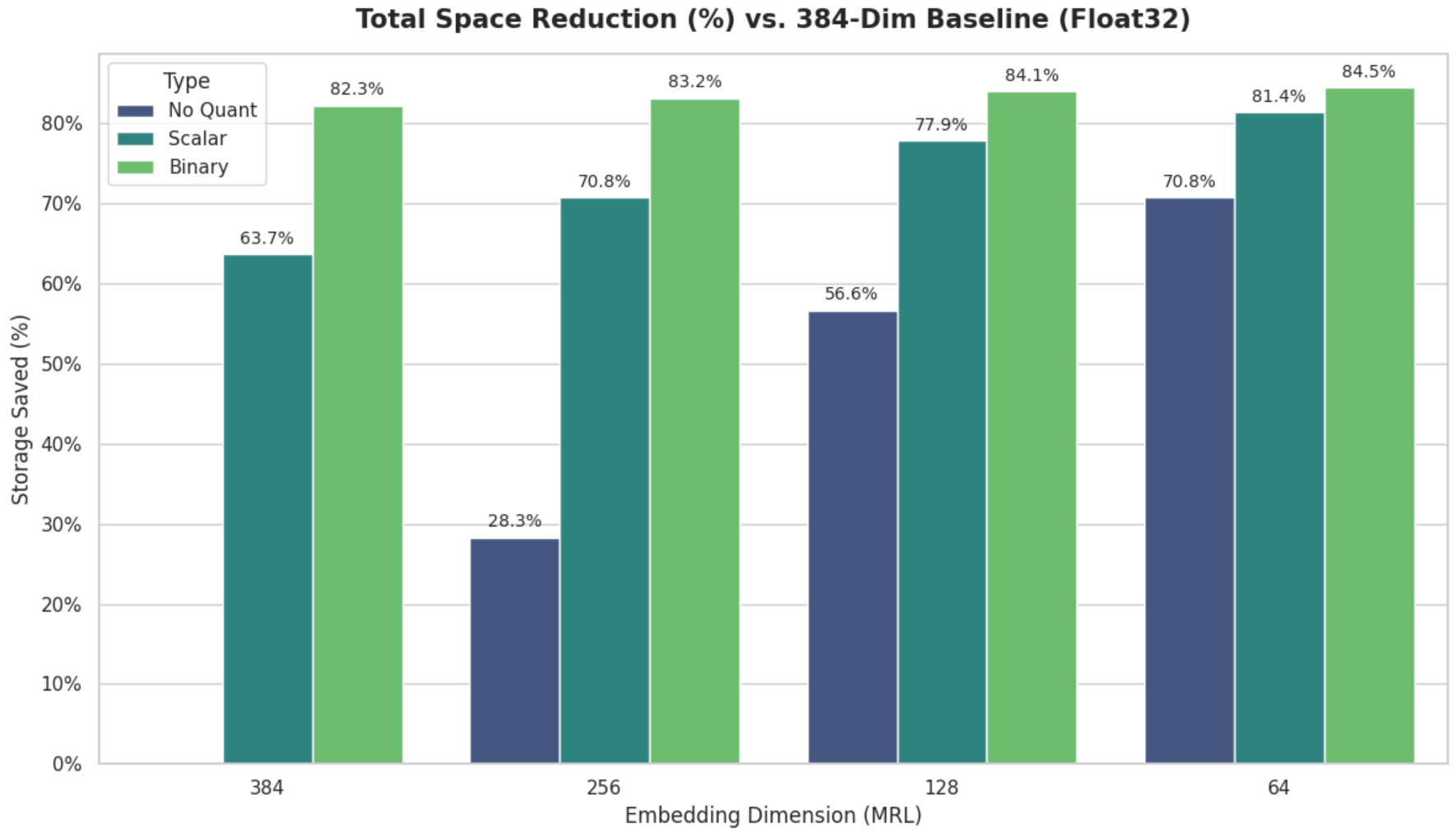
To compare the approaches discussed above, we measured the storage footprint across different dimensionalities and quantization methods.
Our baseline for the 100k index (384-dimensional, Float32) started at 172.44 MB. By combining both techniques, the reduction is massive:
| Matryoshka dimensionality/quantization methods | No Quantization (f32) | Scalar (int8) | Binary (1-bit) |
| 384 (Original) | 172.44 MB (Ref) | 62.58 MB (63.7% saved) | 30.54 MB (82.3% saved) |
| 256 (MRL) | 123.62 MB (28.3% saved) | 50.38 MB (70.8% saved) | 29.01 MB (83.2% saved) |
| 128 (MRL) | 74.79 MB (56.6% saved) | 38.17 MB (77.9% saved) | 27.49 MB (84.1% saved) |
| 64 (MRL) | 50.37 MB (70.8% saved) | 32.06 MB (81.4% saved) | 26.72 MB (84.5% saved) |
Our data demonstrates that while each technique is highly effective in isolation, applying them in tandem yields compounding returns for infrastructure efficiency:
- Quantization: Moving from Float32 to Scalar (Int8) at the original 384 dimensions immediately slashes storage by 63.7% (dropping from 172.44 MB to 62.58 MB) with minimal effort.
- MRL: Utilizing MRL to truncate vectors to 128 dimensions—even without any quantization—yields a respectable 56.6% reduction in storage footprint.
- Combined Impact: When we apply Scalar Quantization to a 128-dimensional MRL vector, we achieve a massive 77.9% reduction (bringing the index down to just 38.17 MB). This represents nearly a 4.5x increase in data density with almost zero architectural changes to the broader system.
The Accuracy Trade-off: How much do we lose?

Storage optimizations are ultimately a trade-off. To understand the “cost” of these optimizations, we evaluated a 100,000-document index using a test set of 1,000 queries from HospotQA dataset. We focused on two primary metrics for a retrieval system:
- Recall@10: Measures the system’s ability to include the relevant document anywhere within the top 10 results. This is the critical metric for RAG pipelines where an LLM acts as the final arbiter.
- Mean Reciprocal Rank (MRR@10): Measures ranking quality by accounting for the position of the relevant document. A higher MRR indicates that the “gold” document is consistently placed at the very top of the results.
| Dimension | Type | Recall@10 | MRR@10 |
| 384 | No Quantization (f32) | 0.481 | 0.367 |
| Scalar (int8) | 0.474 | 0.357 | |
| Binary (1-bit) | 0.391 | 0.291 | |
| 256 | No Quantization (f32) | 0.467 | 0.362 |
| Scalar (int8) | 0.459 | 0.350 | |
| Binary (1-bit) | 0.359 | 0.253 | |
| 128 | No Quantization (f32) | 0.415 | 0.308 |
| Scalar (int8) | 0.410 | 0.303 | |
| Binary (1-bit) | 0.242 | 0.150 | |
| 64 | No Quantization (f32) | 0.296 | 0.199 |
| Scalar (int8) | 0.300 | 0.205 | |
| Binary (1-bit) | 0.102 | 0.054 |
As we can see, the gap between Scalar (int8) and No Quantization is remarkably slim. At the baseline 384 dimensions, the Recall drop is only 1.46% (0.481 to 0.474), and the MRR remains nearly identical with just a 2.72% decrease (0.367 to 0.357).
In contrast, Binary Quantization (1-bit) represents a “performance cliff.” At the baseline 384 dimensions, Binary retrieval already trails Scalar by over 17% in Recall and 18.4% in MRR. As dimensionality drops further to 64, Binary accuracy collapses to a negligible 0.102 Recall, while Scalar maintains a 0.300—making it nearly 3x more effective.
Conclusion
While scaling a vector database to billions of vectors is getting easier, at that scale, infrastructure costs quickly become a major bottleneck. In this article, I’ve explored two main techniques for cost reduction—Quantization and MRL—to quantify potential savings and their corresponding trade-offs.
Based on the experiment, there is little benefit to storing data in Float32 as long as high-dimensional vectors are utilized. As we have seen, applying Scalar Quantization yields an immediate 63.7% reduction in storage space. This significantly lowers overall infrastructure costs with a negligible impact on retrieval quality — experiencing only a 1.46% drop in Recall@10 and 2.72% drop in MRR@10, demonstrating that Scalar Quantization is the easiest and most efficient infrastructure optimization that almost all RAG use cases should adopt.
Another approach is combining MRL and Quantization. As shown in the experiment, the combination of 256-dimensional MRL with Scalar Quantization allows us to reduce infrastructure costs even further by 70.8%. For our initial example of a 100-million, 1024-dimensional vector index, this could reduce costs by up to $50,000 per year while still maintaining high-quality retrieval results (experiencing only a 4.6% reduction in Recall@10 and a 4.4% reduction in MRR@10 compared to the baseline).
Finally, Binary Quantization: As expected, it provides the most extreme space reductions but suffers from a massive drop in retrieval metrics. As a result, it is much more beneficial to apply MRL plus Scalar Quantization to achieve comparable space reduction with a minimal trade-off in accuracy. Based on the experiment, it is highly preferable to utilize lower dimensionality (128d) with Scalar Quantization—yielding a 77.9% space reduction—rather than using Binary Quantization on the unshortened 384-dimensional index, as the former demonstrates significantly higher retrieval quality.
| Strategy | Storage Saved | Recall@10 Retention | MRR@10 Retention | Ideal Use Case |
| 384d + Scalar (int8) | 63.7% | 98.5% | 97.1% | Mission-critical RAG where the Top-1 result must be exact. |
| 256d + Scalar (int8) | 70.8% | 95.4% | 95.6% | The Best ROI: Optimal balance for high-scale production apps. |
| 128d + Scalar (int8) | 77.9% | 85.2% | 82.5% | Cost-sensitive search or 2-stage retrieval (with re-ranking). |
General Recommendations for Production Use Cases:
- For a balanced solution, utilize MRL + Scalar Quantization. It provides a massive reduction in RAM/disk space while maintaining high-quality retrieval results.
- Binary Quantization should be strictly reserved for extreme use cases where RAM/disk space reduction is absolutely critical, and the resulting low retrieval quality can be compensated for by increasing top_k and applying a cross-encoder re-ranker.
References
[1] Full experiment code https://github.com/otereshin/matryoshka-quantization-analysis
[2] Model https://huggingface.co/mixedbread-ai/mxbai-embed-xsmall-v1
[3] mteb/hotpotqa dataset https://huggingface.co/datasets/mteb/hotpotqa
[4] FAISS https://ai.meta.com/tools/faiss/
[5] Matryoshka Representation Learning (MRL): Kusupati, A., Bhatt, G., Rege, A., Wallingford, M., Sinha, A., Ramanujan, V., … & Farhadi, A. (2022). Matryoshka Representation Learning.
