



What Is Instagram SEO?
Instagram SEO (search engine optimization) is the process of optimizing your Instagram profile and content, so you show up in Instagram search results when users are actively searching for what you offer.
In other words, it’s how you help Instagram’s algorithm understand who you are, what you do, and which audience should see your content.
When someone types in search queries like “Miami realtor” or “strength coach for moms,” Instagram scans profiles, captions, and content for relevant keywords and signals. If your Instagram account clearly matches those searches, you’re more likely to appear in search results, the Explore page, and even external search engines like Google.
Unlike traditional search engines, Instagram’s ranking system is heavily driven by user activity. It looks at how people interact with your Instagram posts, how relevant your content is to audience searches, and whether users interested in that topic actually engage.
That means your Instagram SEO strategy isn’t just about keywords and hashtags. It’s about creating SEO-friendly content that aligns with user intent and delivers real value.
At its core, Instagram SEO matters because it helps you reach relevant users, grow your Instagram presence, and turn your content into something people can actually discover, not just scroll past.
How to use Instagram SEO to actually get discovered
But enough of the theory.
Let’s get into how to actually apply Instagram SEO in a way that improves your visibility, helps you show up in search results, and strengthens your overall presence.
I’ll walk you through a practical, step-by-step Instagram SEO strategy you can use to optimize your profile, improve your content strategy, and align with how Instagram’s algorithm and search functions actually work today.
From keyword research and optimizing your Instagram profile to creating SEO-friendly content and understanding ranking factors, this is everything you need to turn your Instagram account into something people can actually find, not just scroll past.
To make things easier, here’s a quick Instagram SEO checklist you can follow to improve your rankings, reach relevant users, and build a stronger Instagram presence:
- Optimize your Instagram profile for search
- Optimize every Instagram post for search ranking and visibility
- Use Instagram search to guide your content strategy
- Trigger Explore page signals to boost discovery
- Prioritize video content (especially Reels) for reach
- Strengthen engagement signals through user activity
- Track performance and refine your Instagram SEO strategy
Step 1: Optimize your Instagram profile for search
Start by figuring out which Instagram SEO keywords you actually want to show up for.
The easiest way to do this is directly inside Instagram. Type your niche into the search bar and look at the auto-suggestions. Those are real search queries from users, not guesses.
Once you know your keywords, your profile is the first place to apply them.
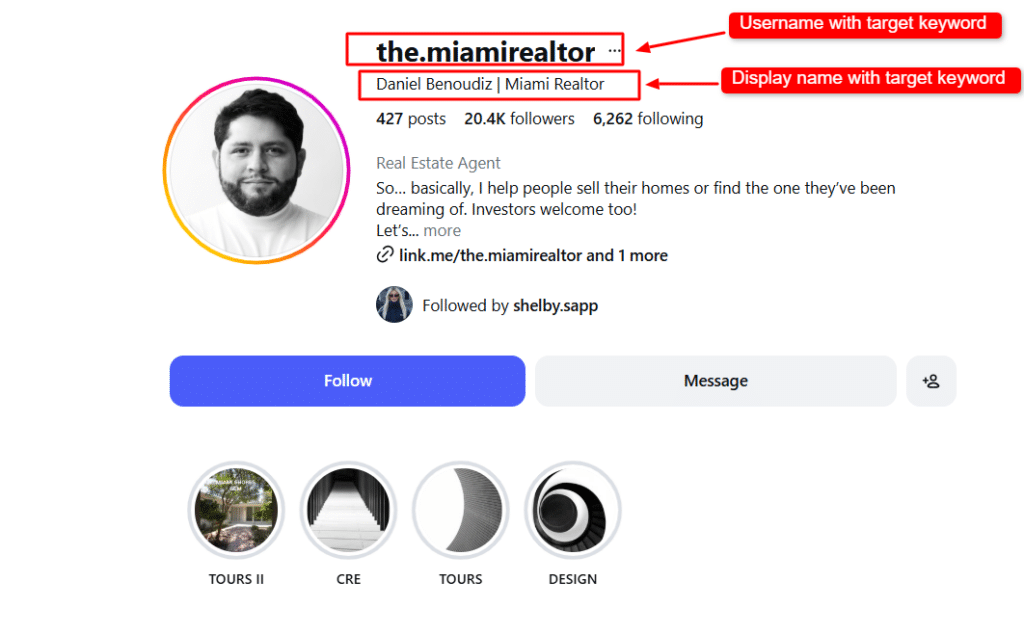
Your username and display name matter more than most people think. Instagram uses both as strong ranking signals, so they should be clear, recognizable, and keyword-focused.
Instead of something vague like @jessicacreates, you could use @jessicacreates.design if “design” is a keyword you want to rank for. The same applies to your display name. Most people only use their name here, but it’s actually prime space for primary keywords.
Here’s an example where both include a local keyword like “Miami realtor”:
Next comes your bio, which should be clear, searchable, and easy to understand at a glance.
Skip vague phrases and focus on what you do and who you help. Think in terms of what your target audience is actually typing into search, not what sounds clever.
A simple structure that works well for users’ search is:
For example:
“We help overwhelmed first-time founders build simple sales systems that increase monthly revenue.”
Or:
“I help retail managers transition into higher-paying corporate roles with a clear promotion strategy.”
Finally, think about what happens after someone finds you.
Your link and contact options should make it easy to take the next step. Send people to a page that matches what they searched for. If you offer multiple services, a clean link-in-bio page with clear, keyword-based labels works best.
Turn on your contact buttons and add your email or call option if relevant.
You can also use Story Highlights with simple, searchable titles like “Client results,” “Case studies,” or “Marketing tips,” and point each one to a relevant page.
Step 2: Optimize every post for Instagram search ranking and brand visibility
Think like an SEO strategist every time you create Instagram content.
Start with your captions. The first line should include a clear, searchable phrase that tells Instagram what your post is about. Use natural language and avoid keyword stuffing, but be intentional with your wording.
Instead of something generic, anchor your content in real search queries your audience is typing. For example, a creator in Austin talking about car costs will get better results with something specific like “cost of car insurance in Texas” than a vague “car tips” hook.
Alt text is another easy win that most people ignore.
When you upload a post, describe what’s in the image using relevant keywords. This helps with accessibility, but it also supports how Instagram understands and indexes your content.
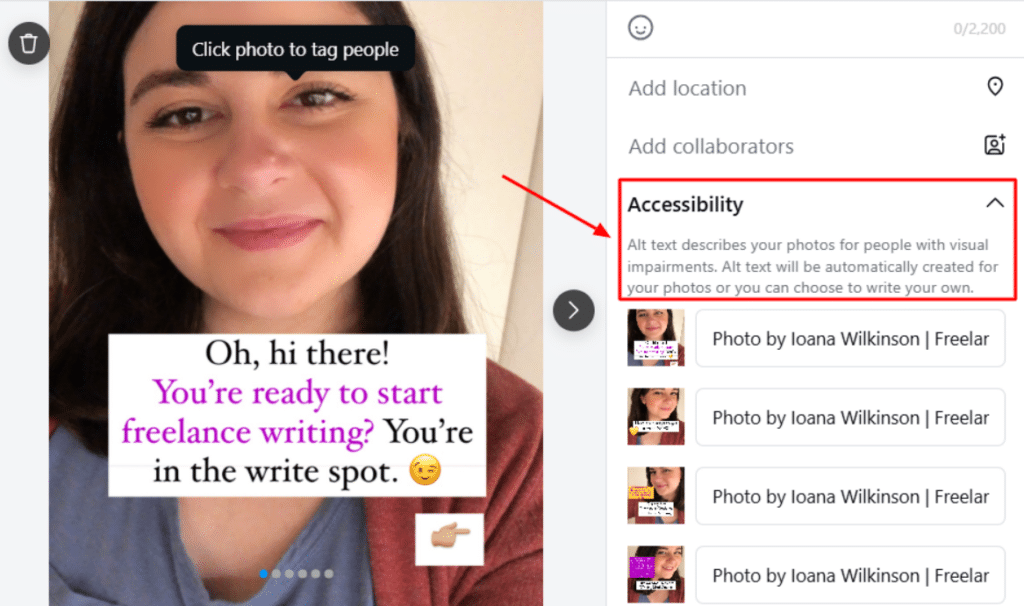
A simple example: “Business coach teaching high-ticket sales strategies on a laptop in an office.”
If you skip this step, Instagram will generate alt text for you, but it won’t be optimized. That’s a missed opportunity.
Hashtags still matter, just not in the way most people think.
Your main keywords should already live in your:
- Username and display name
- Bio
- Captions
- Alt text
Hashtags are there to support that positioning, not replace it. Focus on a mix of niche, keyword-based hashtags and a few broader, relevant tags
If you’re a career coach for retail managers, something like #retailmanagement or #careergrowth makes sense.
Think of hashtags as reinforcement. They strengthen your keyword signals, they don’t carry the whole strategy.
Step 3: Use Instagram search to guide your content strategy
Now it’s time to use Instagram search to shape your content strategy.
Start by typing your main topic into the Instagram search bar. Look at the suggested search queries, then click into them and study the top results.
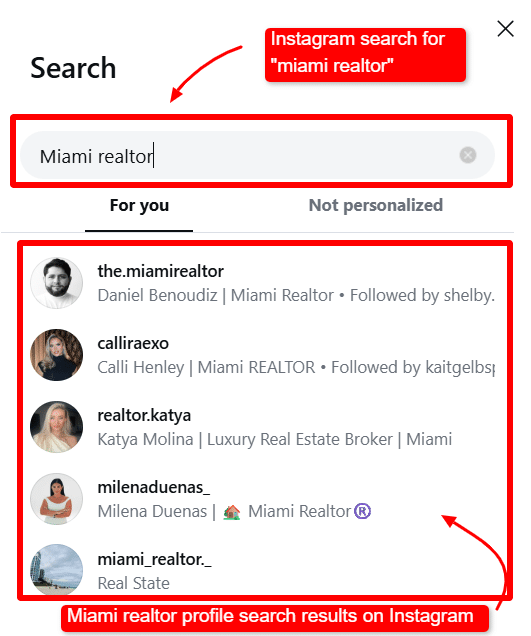
Pay attention to:
- Top-ranking profiles in Instagram search results
- Content formats (Reels, carousels, static posts)
- Caption structure and keyword usage
Do this on both mobile and desktop. You’ll often notice slightly different search results.
As you go, you’ll start spotting patterns. Use those to define your content pillars.
Choose three to five core topics you want your Instagram account to rank for. This helps Instagram’s algorithm understand your niche and improves how your content appears in relevant searches.
If your primary keyword is low-volume, expand around it. If you’re targeting a low-volume keyword like “strategic portfolio management,” add related terms like “portfolio optimization,” “investment strategies,” or “asset allocation tips.”
Finally, test your visibility manually. Publish a post using a target keyword, wait 24–72 hours, then search that exact phrase on Instagram.
If your content appears, you’re aligned with Instagram’s ranking system. If not, adjust your keywords, captions, or format and test again.
Step 4: Trigger Explore page signals to boost discovery
If you want to show up on the Explore page, your content needs to drive action.
That means getting people to save, share, and comment. One of the easiest ways to do this is by creating carousel posts that solve a clear problem. This is when you post multiple photos on Instagram in one post, guiding users through something step by step.
Make sure you hook attention early, either in the first slide or within the first three seconds. Then guide users with simple, direct CTAs like:
- Save this for your next content planning session
- Share this with someone who needs it
- Send this to your team
Beyond posts, your engagement habits matter just as much.
Reply to DMs, answer Story replies, and keep conversations going. This kind of user activity sends strong signals to Instagram’s ranking system and increases your chances of getting featured on the Instagram Explore page.
You can also streamline this with automation tools that help you respond faster and make sure no message gets missed.
Step 5: Prioritize video content (especially Reels) for reach
If you want reach, Reels should be a core part of your Instagram content strategy.
Post consistently, use clear keywords, and make sure your hook shows the benefit right away. People decide fast, so your first few seconds matter most.
For example, instead of something vague, go straight into a searchable, benefit-driven hook like:
“Struggling with post-workout soreness? Here’s a simple stretch sequence that works.”
Creators like Maria Wendt have built massive reach through Reels. Her take is simple: more Reels = more traffic, because Reels are pushed to non-followers.

To help Instagram understand and rank your content, repeat your main keyword in a few key places:
- On-screen text: Show the hook visually in the first 1–3 seconds
- Caption: Use the keyword naturally in your post caption
- Alt text: Describe what’s happening in the video using keywords
- Hashtags: Add a few relevant, niche hashtags
This helps reinforce your topic across different signals without overdoing it.
Pro tip: If staying consistent with Reels feels messy, tools like SocialBee can help you plan, schedule, and publish content in one place. You can schedule Reels at the best times, generate captions and hashtags, write alt text for SEO, and track what’s actually working. |
Step 6: Strengthen engagement signals through user activity
Engagement is what tells Instagram your content is worth showing to more people.
A big part of that comes from how you guide interaction. Use your captions to ask clear, specific questions that invite responses. Something like “Which tip will you try first?” or “Tag someone who needs this” works much better than vague prompts. And once people reply, make sure you reply back. That back-and-forth matters.
You can also drive more interaction through Stories, with features like:
- Story polls
- Question boxes
- Quizzes
These are simple, but they consistently trigger user activity and help keep your account visible.
The goal is to turn passive viewers into active participants. More interaction means stronger signals, better visibility, and higher chances of showing up in Instagram search results and the Explore page.
Pro tip: If you’re getting a lot of comments and DMs, using a tool with a Social Inbox (like SocialBee) makes it easier to keep up and respond faster, which helps boost engagement signals. |
Step 7: Track performance and refine your Instagram SEO strategy
If you’re not tracking what’s working, it’s really hard to grow.
Set aside a bit of time each week to look at your Instagram performance and see what’s actually driving visibility.
Focus on metrics that tell you how people are finding and interacting with your content, like:
- Instagram search impressions and discovery reach
- Engagement signals like saves, shares, and profile visits
- Performance of keyword-focused Instagram posts
This gives you a much clearer picture of what’s helping you show up in Instagram search results.
After a few weeks, patterns start to stand out.
Look at your top posts and ask yourself what they have in common. It could be the hook, the topic, the keywords, or even the format. Then lean into that.
You don’t need to reinvent everything. Small tweaks to your captions, keywords, or structure can go a long way.
Pro tip: SocialBee can help you track exactly what’s driving visibility: from post reach and engagement to how different captions, hashtags, and posting times perform. This makes it easier to spot patterns and double down on what’s working. |
Common Instagram SEO mistakes to avoid
There are a few common mistakes that can quietly hurt your Instagram SEO, even if your content is good.
- Keyword stuffing: If your captions feel forced or overloaded with keywords, it backfires. Instagram prefers natural language that clearly signals what your content is about.
- Weak Instagram profile and bio: Vague bios and unclear display names make it harder to show up in Instagram search results. Use clear keywords and a strong value proposition.
- Skipping engagement: Not replying to comments, DMs, or Story interactions reduces your visibility. Engagement is an important ranking factor.
- Ignoring alt text: This is an easy win most people skip. Describing your images with relevant keywords helps with both accessibility and search.
- Relying only on hashtags: Hashtags still matter, but they’re not enough. Your captions, profile, and engagement signals carry more weight in Instagram’s ranking system.
Frequently asked questions
1. What is the 5-3-1 rule on Instagram?
The 5-3-1 rule means you do a small daily set of engagement actions after posting: 5 likes, 3 meaningful comments, and 1 follow.
The numbers are just a simple structure to keep you consistent without overdoing it. Instead of randomly engaging, you follow a repeatable pattern that helps you stay active and visible on the platform.
2. What is the 80/20 rule for Instagram?
The 80/20 rule means 80% of your content should be valuable, while 20% can be promotional.
The numbers come from a broader marketing principle where the majority of your effort builds trust, and a smaller portion focuses on selling. On Instagram, that translates into mostly helpful or engaging content, with occasional posts about your product or service.
3. What is the 4-1-1 rule on Instagram?
The 4-1-1 rule means that for every 6 posts, you share 4 value-driven posts, 1 soft promotion, and 1 direct promotion.
The numbers are there to give your content a clear balance. Instead of guessing what to post, you follow a simple ratio that keeps your feed useful, while still making room for sales.
It’s time to get discovered on Instagram
Instagram SEO essentials come down to one thing: making it easy for the right people to find you.
That means using the right keywords, creating content that matches real search intent, and giving Instagram enough signals to understand and push your content. It’s not about hacks or trends. It’s about clarity and consistency.
Start simple. Update your Instagram profile, test one keyword in your captions, or post a Reel with a clear hook. Small changes stack up fast when you do them consistently.
If you want to make this process easier, using an Instagram social media management tool like SocialBee can save you a lot of time.
Instead of manually posting, guessing hashtags, and tracking results across different tools, you can manage everything in one place. From scheduling your Instagram posts at the best times, to generating captions and hashtags with AI, to adding alt text and tracking performance, it helps you stay consistent without the overwhelm.
The Social Inbox also makes it easier to reply to comments and messages quickly, which directly supports your engagement signals and overall Instagram SEO.
At the end of the day, the goal isn’t just to post more, but to post smarter.
P.S.: Want to save time and streamline your Instagram content? Create, schedule, and optimize everything in one place with SocialBee. Start SocialBee’s 14-day free trial now.
