


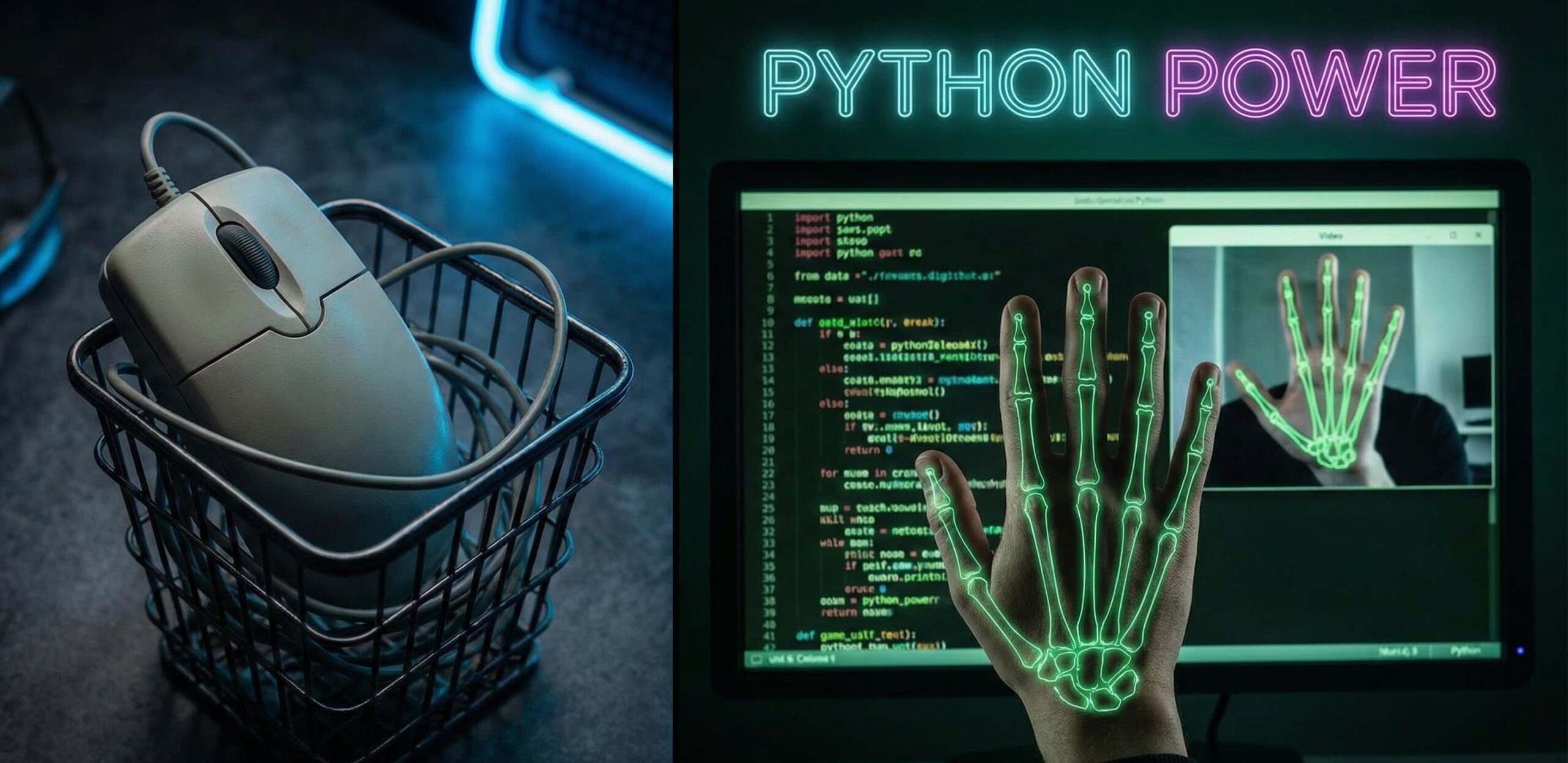
of autonomous vehicles and AI language models, yet the main physical interface through which we connect with machines has remained unchanged for fifty years. Astonishingly, we are still using the computer mouse, a device created by Doug Engelbart in the early 1960s, to click and drag. A few weeks ago, I decided to question this norm by coding in Python.
For Data Scientists and ML Engineers, this project is more than just a party trick—it’s a masterclass in applied computer vision. We will build a real-time pipeline that takes in an unstructured video stream (pixels), sequentially applies an ML model to extract features (hand landmarks), and finally converts them into tangible commands (moving the cursor). Basically, this is a “Hello World” example of the next generation of Human-Computer Interaction.
The aim? Control the mouse cursor simply by waving your hand. Once you start the program, a window will display your webcam feed with a hand skeleton overlaid in real time. The cursor on your computer will track your index finger as it moves. It’s almost like telekinesis—you’re controlling a digital object without touching any physical device.
The Concept: Teaching Python to “See”
In order to connect the physical world (my hand) to the digital world (the mouse cursor), we decided to divide the problem into two parts: the eyes and the brain.
- The Eyes – Webcam (OpenCV): To get video from the camera in real time, that is the first step. We’ll use OpenCV for that. OpenCV is an extensive computer vision library that allows Python to access and process frames from a webcam. Our code opens the default camera with
cv2.VideoCapture(0)and then keeps reading frames one by one. - The Brain – Hand Landmark Detection (MediaPipe): In order to analyze each frame, find the hand, and recognize the key points on the hand, we turned to Google’s MediaPipe Hands solution. This is a pre-trained machine learning model which is capable of taking the picture of a hand and predicting the locations of 21 3D landmarks (the joints and fingertips) on a hand. To put it simply, MediaPipe hands not only “detect a hand here” but even shows you exactly where each finger tip and knuckle is in the image. Once you get those landmarks, the main challenge is basically over: just choose the landmark you want and use its coordinates.

Basically, it means that we pass each camera frame to MediaPipe, which outputs the (x,y,z) coordinates of 21 points on the hand. For controlling a cursor, we will follow the location of landmark #8 (the tip of the index finger). (If we were to implement clicking later on, we could check the distance between landmark #8 and #4 (thumb tip) to identify a pinch.) At the moment, we are only interested in movement: if we find the position of the index finger tip, we can pretty much correlate that to where the mouse pointer should move.
The Magic of MediaPipe
MediaPipe Hands takes care of the challenging parts of hand detection and landmark estimation. The solution utilizes machine learning to predict 21 hand landmarks from only one image frame.
Moreover, it is pre-trained (on more than 30,000 hand images, actually), which means that we are not required to train our model. We just get and use MediaPipe’s hand-tracking “brain” in Python:
mp_hands = mp.solutions.hands
hands = mp_hands.Hands(max_num_hands=1, min_detection_confidence=0.7)So, afterwards, each time a new frame is sent through hands.process(), it gives back a list of detected hands along with their 21 landmarks. We render them on the picture so that visually we can verify it is working. The crucial thing is that for each hand, we can obtain hand_landmarks.landmark[i] for i running from 0 to 20, each having normalized (x, y, z) coordinates. Specifically, the tip of the index finger is landmark[8] and the tip of the thumb is landmark[4]. By utilizing MediaPipe, we are already relieved from the challenging task of figuring out the geometry of hand pose.
The Setup
You don’t need a supercomputer for this — a typical laptop with a webcam is enough. Just install these Python libraries:
pip install opencv-python mediapipe pyautogui numpy- opencv-python: Handles the webcam video feed. OpenCV lets us capture frames in real time and display them in a window.
- mediapipe: Provides the hand-tracking model (MediaPipe Hands). It detects the hand and returns 21 landmark points.
- pyautogui: A cross-platform GUI automation library. We’ll use it to move the actual mouse cursor on our screen. For example,
pyautogui.moveTo(x, y)instantly moves the cursor to the position(x, y). - numpy: Used for numerical operations, mainly to map camera coordinates to screen coordinates. We use
numpy.interpto scale values from the webcam frame size to the full display resolution.
Now our environment is ready, and we can write the full logic in a single file (for example, ai_mouse.py).
The Code
The core logic is remarkably concise (under 60 lines). Here’s the complete Python script:
import cv2
import mediapipe as mp
import pyautogui
import numpy as np

# --- CONFIGURATION ---
SMOOTHING = 5  # Higher = smoother movement but more lag.
plocX, plocY = 0, 0  # Previous finger position
clocX, clocY = 0, 0  # Current finger position

# --- INITIALIZATION ---
cap = cv2.VideoCapture(0)  # Open webcam (0 = default camera)

mp_hands = mp.solutions.hands
# Track max 1 hand to avoid confusion, confidence threshold 0.7
hands = mp_hands.Hands(max_num_hands=1, min_detection_confidence=0.7)
mp_draw = mp.solutions.drawing_utils

screen_width, screen_height = pyautogui.size()  # Get actual screen size

print("AI Mouse Active. Press 'q' to quit.")

while True:
    # STEP 1: SEE - Capture a frame from the webcam
    success, img = cap.read()
    if not success:
        break

    img = cv2.flip(img, 1)  # Mirror image so it feels natural
    frame_height, frame_width, _ = img.shape
    img_rgb = cv2.cvtColor(img, cv2.COLOR_BGR2RGB)

    # STEP 2: THINK - Process the frame with MediaPipe
    results = hands.process(img_rgb)

    # If a hand is found:
    if results.multi_hand_landmarks:
        for hand_landmarks in results.multi_hand_landmarks:
            # Draw the skeleton on the frame so we can see it
            mp_draw.draw_landmarks(img, hand_landmarks, mp_hands.HAND_CONNECTIONS)

            # STEP 3: ACT - Move the mouse based on the index finger tip.
            index_finger = hand_landmarks.landmark[8]  # landmark #8 = index fingertip

            x = int(index_finger.x * frame_width)
            y = int(index_finger.y * frame_height)

            # Map webcam coordinates to screen coordinates
            mouse_x = np.interp(x, (0, frame_width), (0, screen_width))
            mouse_y = np.interp(y, (0, frame_height), (0, screen_height))

            # Smooth the values to reduce jitter (The "Professional Feel")
            clocX = plocX + (mouse_x - plocX) / SMOOTHING
            clocY = plocY + (mouse_y - plocY) / SMOOTHING

            # Move the actual mouse cursor
            pyautogui.moveTo(clocX, clocY)

            plocX, plocY = clocX, clocY  # Update previous location

    # Show the webcam feed with overlay
    cv2.imshow("AI Mouse Controller", img)

    if cv2.waitKey(1) & 0xFF == ord('q'):  # Quit on 'q' key
        break

# Cleanup
cap.release()
cv2.destroyAllWindows()This program continuously repeats the same three-step process each frame: SEE, THINK, ACT. At first, it grabs a frame from the webcam. Then, it applies MediaPipe to identify the hand and draw the landmarks. Lastly, the code accesses the index fingertip position (landmark #8) and applies it for moving the cursor.
As the webcam frame and your display have distinct coordinate systems, we first transform the fingertip position to the entire screen resolution with the help of numpy.interp and subsequently invoke pyautogui.moveTo(x, y) to relocate the cursor. To enhance the steadiness of the movement, we additionally introduce a small amount of smoothing (taking the average of positions over time) to lessen jitter.
The Result
Run the script through python ai_mouse.py. The window “AI Mouse Controller” will pop up and show your camera activity. Put your hand in front of the camera, and you will see a skeleton colored (hand joints and connections) drawn on top of it. Then, move your index finger, and mouse cursor will smoothly move across your screen following your finger motion in real time.
Initially, it seems odd—quite like telekinesis in a way. However, in a matter of seconds, it gets familiar. The cursor moves exactly as you would expect your finger to because of interpolation and smoothing effects that are part of the program. Hence, if the system is momentarily unable to detect your hand, the cursor may stay still until detection is regained, but in general, it is awesome how well it works. (If you want to leave, simply hit the q key on the OpenCV window.)
Conclusion: The Future of Interfaces
Only about 60 lines of Python were written for this project, but it was able to demonstrate something quite profound.
First. we were limited to punch cards, then keyboards, and after that, mice. Now, you simply wave your hand and Python understands that as a command. With the industry focusing on spatial computing, gesture-based control is no longer a sci-fi future—it is becoming the reality of how we will be interacting with machines.

This prototype, of course, doesn’t seem ready to replace your mouse for competitive gaming (yet). But it has given us a glimpse of how AI makes the gap between intent and action disappear.
Your Next Challenge: The “Pinch” Click
The logical next step is to take this from a demo to a tool. A “click” function can be implemented by detecting a pinch gesture:
- Measure the Euclidean distance between Landmark #8 (Index Tip) and Landmark #4 (Thumb Tip).
- When the distance is less than a given threshold (e.g., 30 pixels), then trigger
pyautogui.click().
Go ahead, try it. Make something that seems like magic.
Let’s Connect
If you manage to build this, I’d be thrilled to see it. Feel free to connect with me on LinkedIn and send me a DM with your results. I’m a regular writer on topics that cover Python, AI, and Creative Coding.
References
- MediaPipe Hands (Google): Hand landmark detection model and documentation
- OpenCV-Python Documentation: Webcam capture, frame processing, and visualization tools
- PyAutoGUI Documentation: Programmatic cursor control and automation APIs (
moveTo,click, etc.) - NumPy Documentation:
numpy.interp()for mapping webcam coordinates to screen coordinates - Doug Engelbart & the Computer Mouse (Historical Context): The origin of the mouse as a modern interface baseline
