


Safety Isn’t Just a Feature – It’s the Foundation
Walk onto any jobsite and you’ll see the same story, guys pushing through fatigue, dealing with tools that kick back, breathing dust they can’t see, and ignoring the vibration that’s slowly damaging their hands and arms. It’s treated as part of the job, the price you pay to get work done.
Hilti sees it differently. Look, I know I probably sound like a salesman right now, but I’ve seen firsthand how Hilti approaches this stuff, and it’s just not the same as everyone else. So sorry if this comes across as a sales pitch, I’m just passionate about what I’ve seen.
While most tool companies bolt on safety features as an afterthought or a checkbox for compliance, Hilti engineers safety into every tool from the ground up. It’s not about meeting regulations or adding a sticker to the box. It’s about recognizing that safer workers are more productive, more precise, and able to work longer careers without the chronic injuries that plague the trades.
This approach shows up everywhere. Active Torque Control stops your drill from jerking your wrist when it hits rebar. Active Vibration Reduction keeps your hands from going numb after a day of breaking concrete. Dust extraction systems pull silica out of the air before it reaches your lungs. Lighter tool designs reduce shoulder and back strain. Even their accessories are engineered to work with specific tools to minimize risk.
But Hilti goes beyond the tools themselves. They build exoskeletons that take the load off your shoulders during overhead work. They offer training programs so crews know how to work safely. They provide fleet management software that tracks tool maintenance and compliance automatically. It’s a complete system built around one goal: getting the job done without getting hurt.
This isn’t marketing talk. It’s engineering discipline. And when you see how it all works together, the difference is obvious.
I saw it firsthand with my grandfather and my uncles. By the time they hit 50 to 60 years old, the toll was undeniable. Bad backs, worn-out joints, hands that couldn’t grip like they used to. I get it, when you’re young, you feel invincible. Pain is something that happens to someone else. But it catches up to everyone, and once the damage is done, there’s no undoing it. Anything you can do now to protect your body makes all the sense in the world. And no one does it better than Hilti.
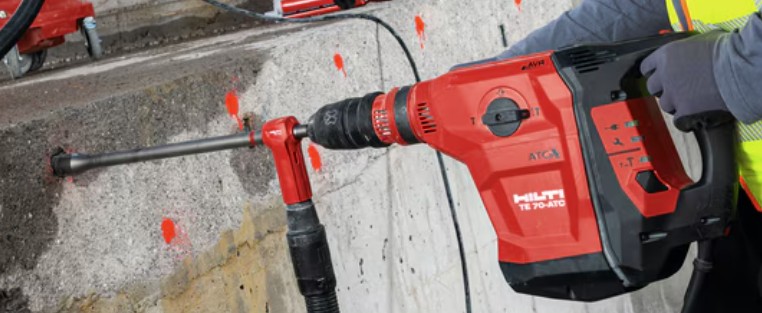
Active Torque Control (ATC)
Anyone who’s drilled into concrete knows the feeling: you’re going smooth, making progress, then the bit hits rebar or binds up and the drill tries to rip itself out of your hands. If you’re lucky, you just get a sore wrist. If you’re not, you’re looking at a sprain, a broken bone, or worse.
Active Torque Control shuts that down before it happens.
ATC monitors the tool’s rotation in real time. The moment it detects an uncontrolled spin, whether from hitting rebar, binding in a hole, or catching on material, it kills the motor instantly and applies the brake. We’re talking milliseconds. Faster than you can react. The tool stops before it has a chance to twist your arm or throw you off balance.
This isn’t just about comfort. Kickback injuries are serious. Torqued wrists, dislocated shoulders, broken fingers from tools spinning out of control. ATC eliminates that risk entirely. You stay in control, the tool stays predictable, and you keep working without the constant threat of a sudden jerk that could put you out for weeks.
Hilti integrates ATC across their drilling, fastening, and demolition tools. It’s standard, not optional. Because they know that the pros using these tools every day can’t afford downtime from preventable injuries. The system works quietly in the background until the moment you need it, and when you do, it’s the difference between finishing the day and heading to the ER.
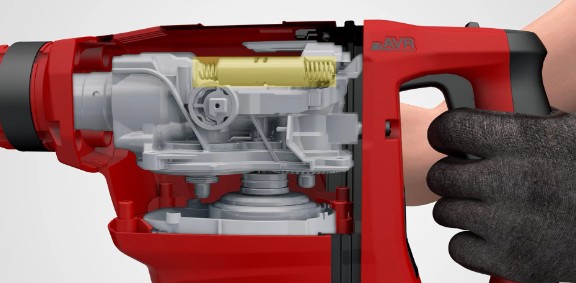
Active Vibration Reduction (AVR)
Vibration is the silent killer of the trades. You don’t feel it destroying you in the moment. Your hands work fine today, tomorrow, next week. But give it five years, ten years of running jackhammers, breakers, and rotary hammers, and suddenly your hands go numb. Your fingers turn white in the cold. You lose grip strength. You can’t feel small objects anymore.
It’s called Hand-Arm Vibration Syndrome, and it’s permanent.
Most guys don’t think about it until the damage is done. But Hilti does. That’s why Active Vibration Reduction is built into their heavy-duty tools from the start.
AVR uses a counterbalance system that absorbs vibration before it reaches your hands and arms. It’s not just rubber grips or soft handles that dampen the feeling. It’s mechanical isolation that actually reduces the vibration energy transferring into your body. The result is measurable: Hilti’s breakers and rotary hammers produce significantly lower vibration levels than comparable tools on the market, often by 30% or more.
Lower vibration means you can work longer without fatigue. Your hands don’t go numb halfway through the day. You’re not shaking so hard you can’t hold a coffee cup after your shift. And over the long term, you’re protecting the nerves and blood vessels in your hands and arms from the kind of damage that ends careers.
This is one of those things you don’t appreciate until you’ve used a tool without it. Once you’ve run a Hilti breaker with AVR and then picked up a competitor’s tool, the difference is instant. One feels controlled and manageable. The other feels like it’s trying to beat you into submission.
SensTech
Grinders are one of the most dangerous tools on any jobsite. They spin at thousands of RPM, and when a disc catches, binds, or breaks, the tool can kick back with enough force to cause serious injury. Cuts, lacerations, broken bones, even fatalities. It happens fast, and once it starts, there’s no stopping it manually.
SensTech changes that.
Hilti’s SensTech system uses sensors built into the grinder that monitor movement and detect any sudden, uncontrolled motion. If the tool kicks back, drops, or moves in a way that indicates loss of control, SensTech immediately shuts down the motor and applies the disc brake. The entire sequence happens in a fraction of a second, stopping the disc before it can do damage.
This isn’t a reactive system that waits for you to let go of the trigger. It’s predictive. It sees the problem developing and stops it before you even register what’s happening. That split-second response is the difference between a close call and a trip to the hospital.
The system also includes a dead man’s switch that requires both hands on the tool to operate. If you lose grip or drop the grinder, it shuts off instantly. No runaway tools, no spinning discs bouncing across the floor, no injuries from equipment you’re no longer holding.
Grinder accidents are preventable, and Hilti engineered SensTech to prove it. It’s one of those features you hope you never need, but when it kicks in, you’re glad it’s there.
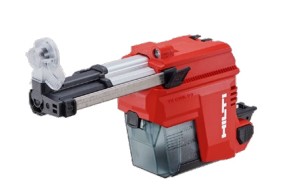
Dust Control Systems
If you can see the dust, it’s already too late. By the time concrete dust is visible in the air, you’ve already breathed in enough silica to start doing damage. And unlike a cut or a broken bone, silica doesn’t hurt. You don’t feel it destroying your lungs until years later when the scarring is permanent and irreversible.
Silicosis is a death sentence, and it’s entirely preventable.
Hilti takes dust control seriously because they know most workers don’t. It’s easy to ignore a hazard you can’t see or feel. That’s why Hilti engineers dust extraction directly into their tools and systems, making it automatic rather than optional.
Their vacuum systems aren’t just shop vacs with a hose taped to a grinder. They’re purpose-built extractors that integrate with Hilti tools through quick-connect ports and auto-start technology. You turn on the drill or grinder, and the vacuum kicks on automatically via Bluetooth. No extra step, no forgetting to flip a switch. The dust gets captured at the source before it ever reaches the air.
Hilti’s new vacuum hose connection system is a step up from everything else on the market. Hoses stay connected, don’t pull loose under vibration, and allow you to move freely without constant adjustments. It’s one less thing to fight with when you’re trying to get work done.
Their SafeSet technology takes it even further for drilling and chemical anchoring. It combines drilling, hole cleaning, and dust extraction into one cordless system. The dust never escapes the hole, and you’re not manually cleaning with brushes and compressed air, which just blows silica into your face.
You can’t see the damage dust is doing, but your lungs will remember. Hilti’s approach makes protection automatic, and that’s the only way it actually works on a jobsite.
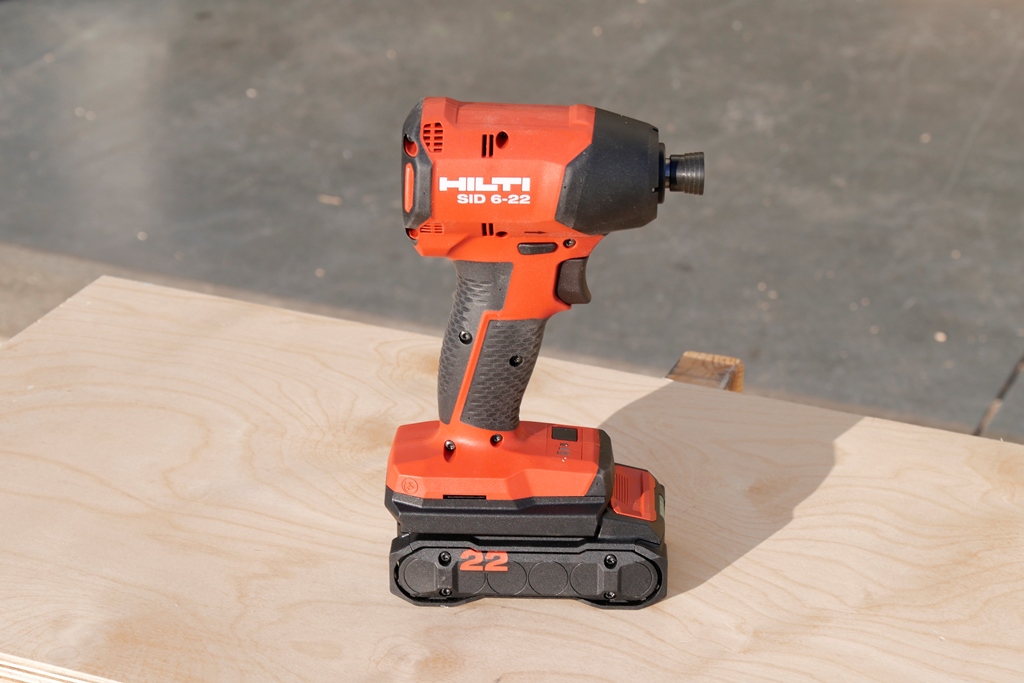
Lighter Tools, Less Fatigue
A few pounds doesn’t sound like much when you’re picking up a tool in the morning. But hold that tool overhead for eight hours, carry it up scaffolding, or use it in awkward positions all day, and those few pounds turn into shoulder pain, back strain, and fatigue that builds up over weeks and months.
Most manufacturers add power by adding weight. Bigger motors, heavier batteries, thicker housings. Hilti goes the other direction. They engineer tools to be lighter without sacrificing power or durability, and the difference is real.
Their approach starts with material selection. High-strength composites replace metal where it doesn’t need to be. Motor designs are optimized for efficiency so they can deliver the same power from a smaller, lighter package. Battery placement is balanced to keep the tool’s center of gravity in your hand, not pulling your wrist down. Every component is scrutinized to cut unnecessary weight.
The result is tools that feel easier to control, cause less strain, and let you work longer without burning out. When you’re drilling overhead or holding a grinder at arm’s length, even a half-pound reduction makes a noticeable difference by the end of the day.
Lighter tools also mean fewer injuries from dropping or losing control. A 12-pound tool that slips is a bigger problem than an 8-pound tool. Less mass means less momentum, and that translates to safer handling in tight spaces or awkward positions.
This is one of those things that’s hard to explain until you’ve actually used the tools. You just feel less beat up at the end of the day. Your shoulders aren’t screaming, your back isn’t stiff, and you’re not dreading picking the tool up again tomorrow. That’s not by accident. That’s intentional design.

The Right Tool With the Right Accessory
Here’s something most people miss: the tool is only half the equation. The bit, the blade, the anchor, the fastener – all of that matters just as much for safety as the tool itself. A mismatched accessory can bind, break, or cause kickback even if the tool is working perfectly.
Hilti doesn’t leave that to chance. Their accessories are engineered specifically for their tools, designed to work together as a system. The bits are optimized for the power delivery and rotation speed of Hilti drills. The blades are balanced for their grinders and saws. The anchors are tested with their fastening tools to ensure proper installation without failure.
This isn’t about brand loyalty or forcing you to buy proprietary parts. It’s about eliminating variables that cause accidents. When a bit is designed for a specific tool’s torque curve and chuck system, it doesn’t slip, doesn’t bind unexpectedly, and doesn’t break under load. When a diamond blade is matched to a grinder’s RPM and power output, it cuts predictably without grabbing or kicking back.
Their drill bits are a perfect example. The geometry, the flute design, the carbide quality – all of it is tuned to work with Hilti’s hammering action and motor characteristics. You get faster drilling, cleaner holes, and bits that last longer because they’re not fighting the tool. More importantly, you get consistent performance without surprises.
The same goes for their fastening systems. The anchors are paired with specific installation tools and torque settings. The chemical adhesives are designed for their dispensers. Everything fits together with tolerances that reduce the risk of installation errors, which are one of the biggest causes of anchor failure and jobsite accidents.
When the tool and accessory are engineered together, you’re not guessing. You know it’s going to work the way it’s supposed to, every time. That predictability is what keeps people safe.
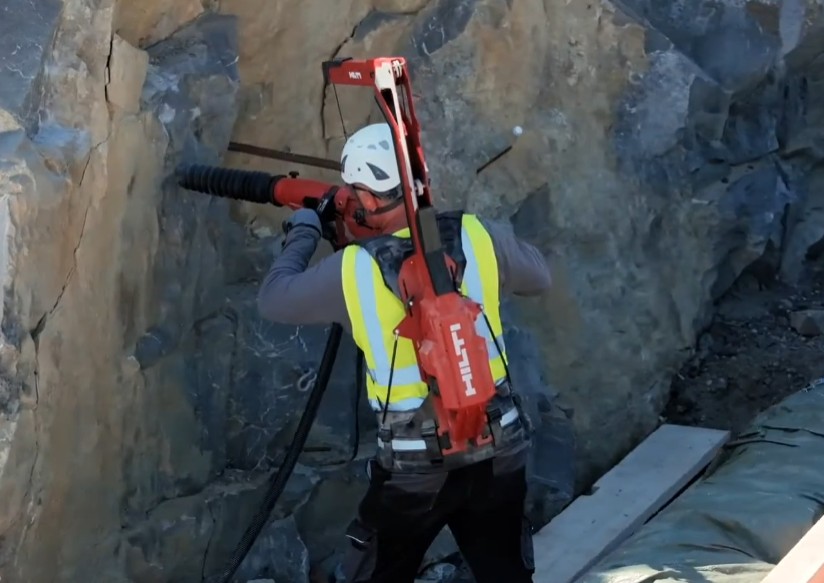
Construction Exoskeletons
Overhead work is brutal. Installing ceiling anchors, running conduit, drilling into decks – your arms are above your head for hours, fighting gravity with every move. By midday your shoulders are burning. By the end of the week, you can barely lift your arms. Do it for years, and you’re looking at rotator cuff damage, chronic pain, and limited range of motion that never fully recovers.
Hilti recognized this as a solvable problem, and their answer is construction exoskeletons.
These aren’t science fiction. They’re wearable support systems that take the load off your shoulders and upper back during overhead tasks. The exoskeleton uses mechanical support to counteract the weight of your arms and whatever tool you’re holding, transferring that load to your hips and core instead of your shoulders.
The result is immediate. Tasks that would normally exhaust you in an hour become manageable for a full shift. Your shoulders don’t burn, your arms don’t go numb, and you’re not fighting through pain just to finish the day. You can work at the same pace without the same physical toll.
This isn’t about making weak workers stronger. It’s about protecting experienced tradesmen from the repetitive strain that slowly destroys their bodies. Overhead work is unavoidable in construction, but the damage doesn’t have to be.
The exoskeletons are adjustable, lightweight, and designed to work with the tools and movements you’re already doing. You’re not learning a new way to work or dealing with bulky equipment that gets in the way. You just strap it on, and it quietly does its job while you do yours.
It’s the kind of innovation that makes you wonder why this wasn’t standard decades ago. Because once you’ve used one, going back to unsupported overhead work feels like a punishment.
Beyond Tools – Training, Compliance, and Culture
You can have the safest tools in the world, but if your crew doesn’t know how to use them properly or cuts corners to save time, accidents still happen. That’s why Hilti invests in education, compliance tools, and resources that go far beyond the hardware.
Hilti Academy provides on-demand training and certifications covering health and safety, power tools, fastening systems, and fire protection. Managers can enroll employees, track progress, and ensure everyone on the crew is trained to the same standards. It’s not a one-time orientation video. It’s ongoing education that keeps pace with new tools, techniques, and regulations.
ON!Track Asset Management automates compliance tracking for your entire fleet. When a tool needs testing, maintenance, or calibration, the system alerts the right people automatically. No more spreadsheets, no more guessing if equipment is up to date. You know your tools are compliant, and you have the documentation to prove it if OSHA or a site manager asks.
Fieldwire puts all your safety documents in one place, accessible from any mobile device. Create checklists, run inspections, and generate automated reports so office teams stay updated on compliance. It’s designed for jobsite reality – quick, mobile, and built for crews that don’t have time to fight with complicated software.
Toolbox Talks are free, downloadable safety discussions you can use with your crew. They cover real jobsite hazards in plain language, giving you ready-made content to keep safety top of mind without spending hours creating your own materials.
All of this adds up to something bigger than individual tools or programs. It’s a system designed to build a culture where safety isn’t just a meeting you sit through or a poster on the wall. It’s built into how the work gets done, from the tools in your hands to the training in your head to the software tracking it all in the background.
FAQ
SensTech is predictive, not reactive. It uses sensors to detect sudden, uncontrolled movement and stops the disc before you can react. It also requires both hands on the tool to operate. If you lose grip or the grinder kicks back, it shuts down and brakes instantly – faster than any manual response.
No. Hilti’s exoskeletons are adjustable, lightweight, and designed to support your natural movements during overhead work. You strap them on and they transfer shoulder load to your hips and core. They don’t restrict your range of motion or require you to learn new techniques – they just make overhead work less exhausting.
Hilti tools include multiple integrated safety systems (ATC, AVR, SensTech, dust extraction) as standard features, not add-ons. Independent testing shows their breakers produce 30%+ lower vibration, their grinders stop faster in kickback events, and their dust systems capture more silica at the source. The measurable difference is significant.

Why Hilti’s Approach Works
Most companies treat safety as a feature list. Check the boxes, meet the regulations, slap on a warning label, and call it done. Hilti treats it as a design requirement that influences every decision from the first sketch to the final product.
That’s why you see safety integrated at every level. The tools have ATC, AVR, and SensTech built in. The accessories are engineered to match the tools. The dust extraction connects automatically. The exoskeletons reduce strain. The training ensures proper use. The software tracks compliance. It’s not one clever feature – it’s an entire system built around keeping people safe and productive.
This approach costs more. It requires more engineering time, better materials, tighter tolerances, and ongoing investment in things like training and software that don’t directly sell tools. But Hilti is family-owned, and they’re playing the long game. They’re not cutting corners to hit quarterly numbers or please shareholders. They’re building a reputation on tools that protect the people using them.
The results speak for themselves. Lower injury rates. Less fatigue. Longer careers. Fewer workers dealing with chronic pain, nerve damage, and lung disease in their 50s and 60s. That’s not marketing spin – that’s measurable impact.
Safety isn’t exciting. It doesn’t make for flashy ads or viral videos. But it’s the difference between finishing your career on your own terms and being forced out by a body that can’t take it anymore. Hilti understands that, and they’ve built their entire company around it.
When you pick up a Hilti tool, you’re not just getting more power or better runtime. You’re getting decades of engineering focused on one question: how do we get this job done without destroying the person doing it? And that’s why their approach works.
