


:max_bytes(150000):strip_icc():format(jpeg)/20260206-SEA-BrooklynBlackoutCake-MatejaZviroticAndrijanic-27-956dde10bb8f431f8e37229cfe142269.jpg)
Why It Works
- Including cocoa powder in the pudding adds structure as well as flavor, helping it set firmly enough to function as both filling and frosting.
- Using oil instead of butter helps the cake stay very moist even after chilling, rather than firming up as butter-based cakes do.
- Blooming the cocoa with hot water intensifies its chocolate flavor.
- Mixing the batter briefly by hand limits air incorporation, producing the blackout cake’s signature dense, even crumb rather than a light or fluffy cake.
When I first started researching Brooklyn blackout cake, I did what felt like the only reasonable thing to do: I dragged two very patient friends on a self-guided blackout cake tour across New York. We crisscrossed neighborhoods on a crisp early winter day, ducking in and out of bakeries, taking detailed notes, snapping photos, and tasting slice after slice, trying to pin down what actually qualifies as a Brooklyn blackout cake. Having lived in Brooklyn for several years, I’d naturally heard of the cake and seen its name around, but I’d never actually had the classic version—only a doughnut inspired by it.
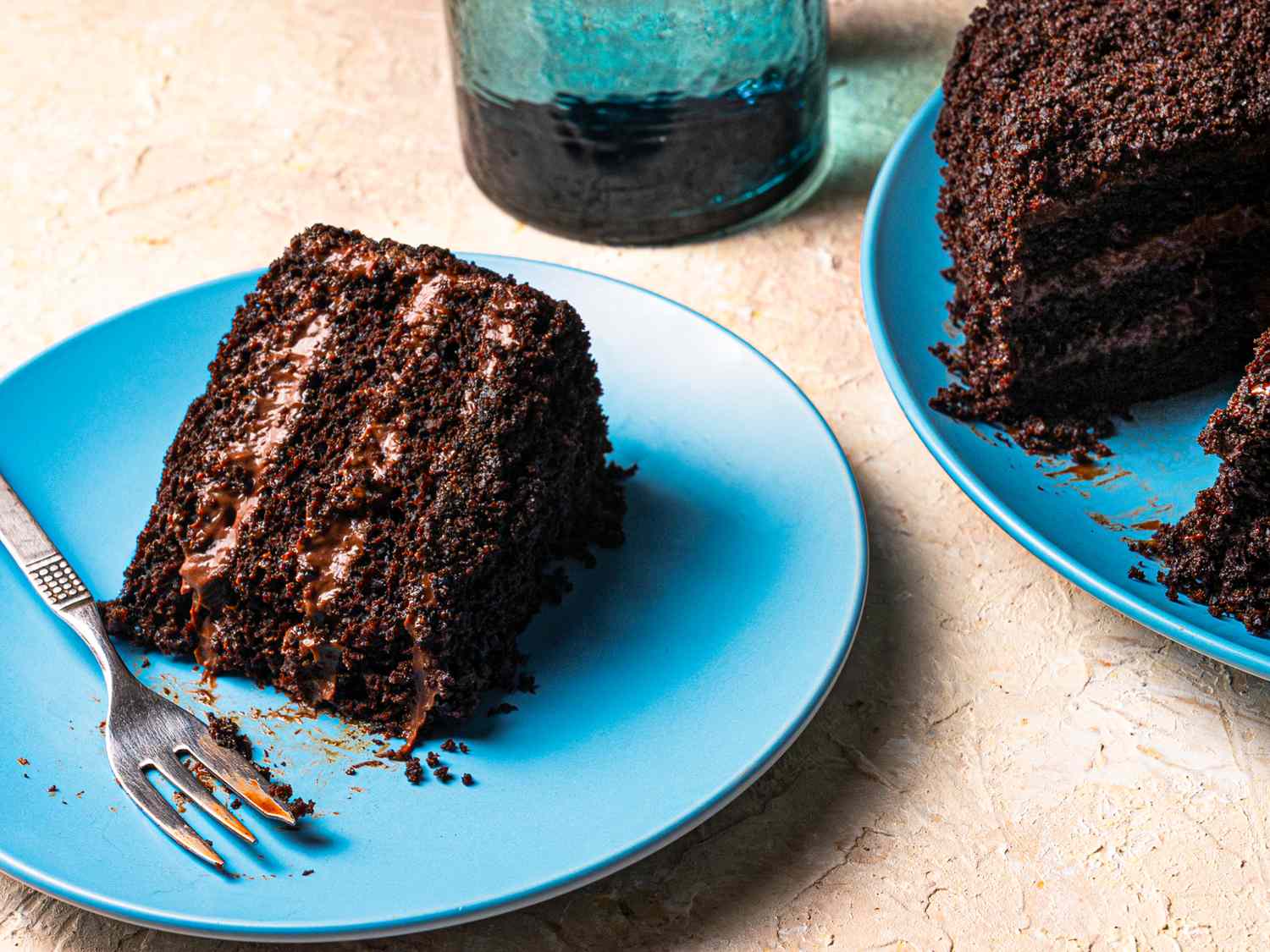
Brooklyn blackout cake is a layered chocolate cake filled and coated with chocolate pudding rather than buttercream or ganache, then finished with a generous coating of chocolate cake crumbs pressed onto the sides and top. The dessert is intensely dark, its crumb so saturated that it appears nearly black once assembled. The pudding softens the layers as it settles into the cake, while a crumb coating adds a dry, sandy contrast that offsets the cake’s soft interior and gives it a deliberately unfinished look.
My recipe below is an interpretation that leans into the cake’s defining traits. It prioritizes deep chocolate flavor, pudding in abundance, and a soft texture meant to be enjoyed shortly after it’s made—here’s how I got there.
The Origins of Brooklyn Blackout Cake
Brooklyn blackout cake was created by Ebinger Baking Company, a Brooklyn bakery founded in the Flatbush neighborhood in 1898 that later grew into one of the borough’s most influential institutions before closing in 1972. By the mid-20th century, Ebinger’s operated dozens of storefronts across Brooklyn and was known for its German-style pastries and layer cakes.
The cake first appeared in the early 20th century under the name “chocolate fudge cake,” but it later became known as blackout cake during World War II, according to a 2011 article by food writer Louise McCready published in Edible Brooklyn. The name refers to blackout drills conducted by the Civilian Defense Corps, during which city lights were extinguished and windows covered when naval ships departed from the Brooklyn Navy Yard.
What distinguished the blackout cake from other chocolate layer cakes of its era was its construction. Rather than being filled and frosted with buttercream or icing, the cake was both filled and coated with chocolate pudding, then finished with a layer of chocolate cake crumbs. That pudding-based design gave the cake a notably soft texture and a short shelf life: Pudding introduces moisture without the stabilizing sugar and fat structure of buttercream, meaning the cake quickly absorbs liquid, softens, and begins to lose definition. For that reason, it’s a cake meant to be sliced and eaten not long after it is made.
Despite the bakery’s closure in ’72, blackout cake endured. Its defining elements—dark chocolate layers, pudding filling, and crumb coating—remained recognizable even as interpretations multiplied, preserving the cake’s identity long after Ebinger’s storefronts disappeared.
Brooklyn Blackout Cake Today
The idea of blackout cake has become so embedded in New York dessert culture that it extends beyond layer cakes, including the beloved Brooklyn Blackout Doughnut at Doughnut Plant—a chocolate cake doughnut filled with chocolate pudding, glazed with chocolate, and finished with cake crumbs.
My informal tour turned up wildly different interpretations under the same name. In some cases, the cake has drifted far from its pudding-soaked origins, evolving into tall, cleanly sliced layer cakes with smooth finishes and firm fillings that hold their shape.
Two of the versions that stood out to me the most were, somewhat surprisingly, in Manhattan. The blackout cake at Hani’s bakery in the East Village was a clear departure from the denser, almost fudgey versions of the cake. Layered with silky ganache rather than pudding, it stood tall and sliced cleanly, with a refined structure and a tender, even crumb. It was less a replica of the soft, pudding-filled classic and more a reinterpretation.
The version that came closest to what I imagined a Brooklyn blackout cake to be, based on oral history and description, was at Claude Bakery in the West Village. Its crumb was dense and deeply chocolatey, unable to hold itself upright beneath thick layers of pudding that visibly seeped out from between the cake layers. The cake had a homey, almost box-cake appeal—unabashedly rich and unpolished. It may have lacked the refinement of Hani’s version, but it felt closer in spirit to a traditional blackout cake.
Taken together, those versions made it clear that there’s no single way blackout cake is made today. But the cakes that feel most true to its origins share a common instinct: They prioritize depth of chocolate flavor, favor a particularly moist cake, and treat pudding as a defining feature rather than a decorative one. That understanding shaped my approach.
The Cake Layers
The cake layers in a Brooklyn blackout cake have a difficult job. They need to be soft enough to absorb pudding without feeling dry, but sturdy enough to be stacked and sliced without collapsing. At the same time, they need to deliver an intense chocolate flavor and a dark enough color to live up to the cake’s name, rather than relying on the filling to do all the work.
To achieve that balance, Dutch-process cocoa is key here because it’s darker in color and smoother in flavor than natural cocoa, helping push the cake toward the near-black look that’s echoed in its name. Blooming the cocoa with hot water intensifies its chocolate flavor by releasing aromatic compounds that stay muted in dry cocoa, ensuring the cake tastes rich and chocolate-forward on its own.
Dark brown sugar further reinforces that flavor profile. Its molasses content deepens the chocolate and adds the dark, rounded notes associated with a blackout cake. In my testing, I found that using all brown sugar added too much moisture to the cake, making the layers overly soft after baking and cooling. To balance that, my recipe calls for a combination of brown sugar and granulated sugar. Without molasses, granulated sugar brings sweetness without additional water, allowing the cake to set more cleanly as it bakes. The combination produces layers that are flavorful and dark, yet firm enough to hold their shape and slice neatly once cooled.
To dial in the texture, I use oil instead of butter in the cake batter because it stays liquid as the cake cools, keeping the crumb moist even after chilling. Butter-based cakes tend to firm up as they cool, which works against the soft, pudding-soaked texture that defines blackout cake.
Finally, the mixing method also controls structure. Despite the final cake’s showstopping appearance, it comes together with nothing more than a whisk—no stand mixer or hand mixer required. Because the cake relies on oil rather than creamed butter, there’s no need to aerate the batter. Minimal mixing limits air incorporation, producing a dense, even crumb that supports the pudding.
The Chocolate Pudding Layers
I’ve never been especially fond of buttercream, which is why Brooklyn blackout cake—with its pudding layers—is my ideal chocolate cake. Because the pudding acts as both filling and frosting, it needs to be thick enough to hold between layers while still spreading cleanly over the outside of the cake.
Cocoa powder plays an important structural role in the pudding. Along with cornstarch, it helps thicken the mixture as it cooks, giving the pudding enough body to function as frosting once chilled. Cooking the pudding until it gently bubbles ensures the cornstarch is fully activated, and cooking the cornstarch long enough prevents a raw or chalky texture.
Unsweetened chocolate is added after cooking to deepen the pudding’s flavor. Using both cocoa powder and solid chocolate creates a pudding that’s firm yet smooth, with a dark, rounded chocolate flavor that matches the cake.
Serious Eats / Mateja Zvirotić Andrijanić
Assembling the Cake
Once cooled, the cake layers are split horizontally to create four even layers. One layer is finely crumbled and set aside, while the remaining layers are stacked with generous spreads of pudding in between, allowing the pudding to settle naturally into the cake.
The pudding is then smoothed over the top and sides, fully enrobing the cake, before the reserved crumbs are pressed on to form a dark, textural mantle. More than decorative, the crumb coating helps anchor the pudding in place. A brief chill firms the pudding just enough for clean slices, after which the cake is best served promptly.
Serious Eats / Mateja Zvirotić Andrijanić
An Enduring Legacy
Part of the Brooklyn blackout cake’s magic is that no one actually knows the original recipe. When Ebinger Baking Company closed its doors in 1972, the recipe disappeared with it. What remains instead are descriptions passed down and preferences argued over.
Every modern version is, by necessity, an interpretation. My version sits within that lineage, shaped by observation, testing, and a commitment to the traits that have defined this exemplar of over-the-top chocolate desserts.
Ebinger’s may be long gone, its recipe effectively entombed, but the Brooklyn blackout cake refuses to be buried. As long as bakers keep making it, the cake endures, not as a relic, but as a living tradition.
