


It doesn’t always make the headlines, but the performance improvements we’ve seen since solid state storage went mainstream have been staggering. Which is a little ironic, since most of the things we do on our computers (even most video games) don’t really need faster storage than a SATA III SSD provides. Certainly the only time I really get to enjoy my 7GB/s SSD is when I copy files to and from it.
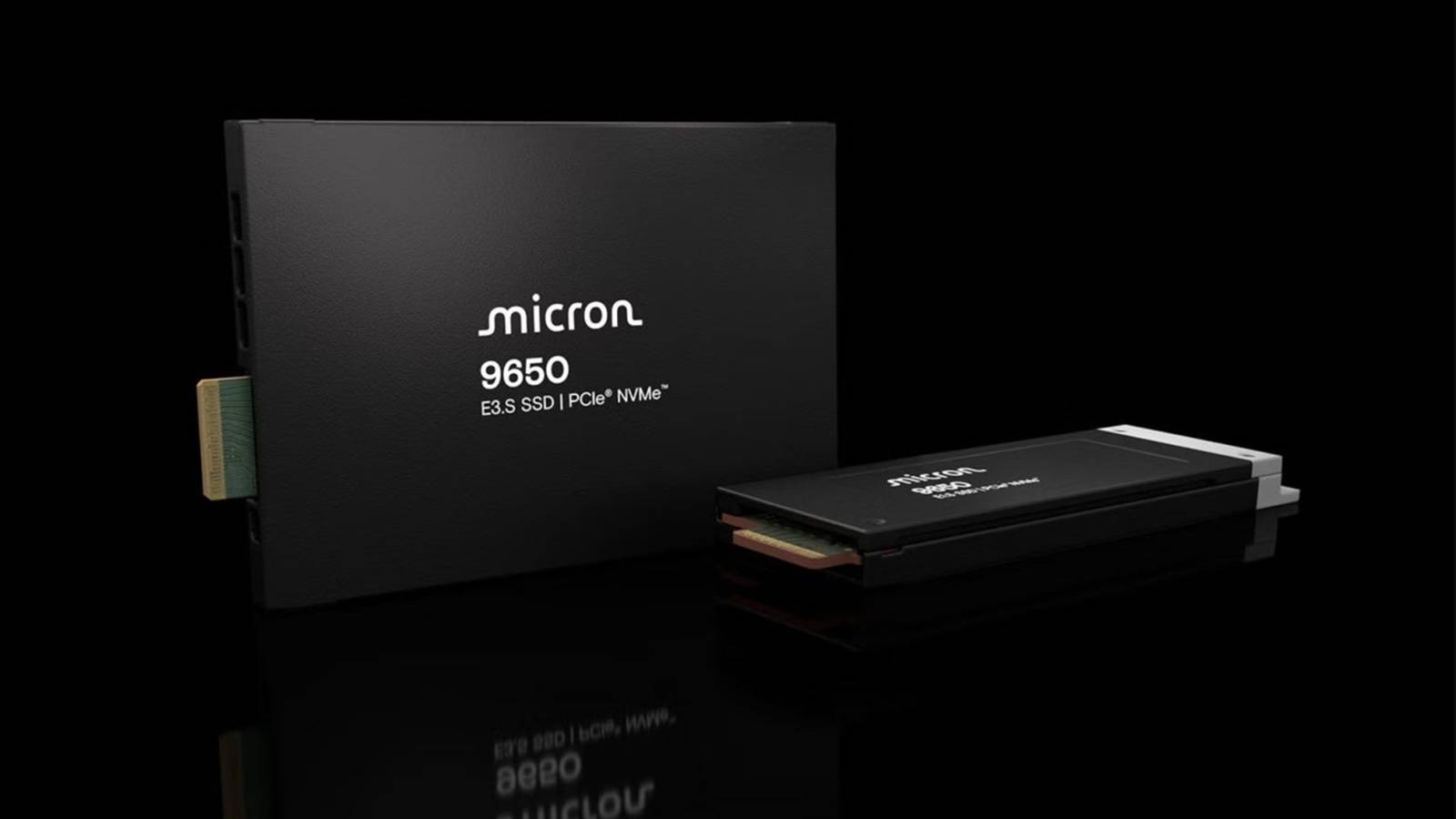
Still, while us mere mortals may not have a use for anything faster than a PCIe 3.0 drive, (although you really shouldn’t buy those) the march of progress is relentless, which is why we now have the absolutely bonkers Micron 9650 PCIe Gen6 SSD.
The world’s fastest SSD is here
Excuse me, how fast did you say?!
Micron claims that the 9650 is the fastest data center SSD in the world, and looking at the spec sheet there’s no reason to doubt that:
- Up to 28,000 MB/s sequential read speeds
- 14,000 MB/s sequential writes
- Up to 5.5 million random read IOPS
This is a real generational leap, since if that peak transfer rate checks out, it’s a doubling of what the best PCIe Gen5 drives can do. The reason anyone needs a drive like this is, as you might expect, at least partially because of AI computational demand. One of Micron’s stated reasons for developing this SSD is that GPUs in data centers can achieve less than 50% of peak performance because they’re waiting for the SSDs to provide data.
What caught my eye about this SSD, apart from its support for liquid cooling, is the sequential read number, because it’s just a bit higher than the 25-ish gigabytes per second that a single channel of standard DDR4 can achieve. Yes, the same DDR4 that people are still using in their computers today.
The gap between RAM and SSDs is shrinking
Not quite there, but close!

Maybe it’s not the most useful comparison, but remember that RAM exists because secondary storage systems aren’t fast enough to keep our CPUs and GPUs fed with data. The problem that data centers are facing is that the size of the datasets needed to feed these processors is so large, that you literally can’t fit enough RAM in the system to contain it all. Hence, the need for this speed demon of an SSD.
So now you have a data storage device that can feed you data as fast as single-channel DDR4 with a capacity of up to 25.6TB. Even if you could slot that much RAM into a server, the cost would be absolutely enormous. Though no doubt these Micron SSDs won’t exactly be cheap.
Could this be the real RAM drive one day?
The dream might come true.
A RAM drive or RAM disk is a virtual drive that your operating system sees as a normal hard drive or SSD. However, it’s actually a partitioned segment of your RAM. When the power goes out, your RAM drive goes “poof” as well, but in the days before SSDs, RAM drives were an expensive but necessary solution for certain computers that could not do their computation efficiently while waiting for a spinning rust disk.
Fast mainstream SSDs have made RAM disks unnecessary in most cases, but with this latest generation of SSDs we’re actually seeing the beginnings of secondary storage that offers RAM-class performance with much larger capacities, and it’s non-volatile storage to boot.

Why Can’t You Download RAM?
I was so preoccupied with whether or not I could download RAM, I didn’t stop to think if I should.
We’ve already seen a glimmer of what it means to have secondary storage fast enough that it can act as a second-tier memory. In the PlayStation 5, for example, the high speed of the SSD allows for a smaller amount of system RAM, because data can be streamed just in time without the player noticing anything amiss. This works for consoles because the developers know exactly how fast their disk access is, so games can be designed around it.
On PC, there’s no guarantee at all, so often you need larger amounts of system memory to run the same software, as a buffer against slower disk speed. I can envision a point in the future where these speeds become the norm on PCs, which makes the need for more and more system RAM less necessary.
Speed isn’t RAM’s only advantage
It’s not a one-trick pony.

So it is technically true that this drive has a faster sequential read speed than single-channel top-spec DDR4 running within JEDEC specifications. However that’s just one performance metric. RAM has many other advantages where no SSD comes close.
Latency is a big one. RAM latency is measured in nanoseconds, while SSDs have latency measured in microseconds. From a human point of view, both are insanely short amounts of time, but they differ by a factor of 1000. CPUs and GPUs absolutely rely on this low level of latency to work at their peak.
The other big advantage is random access. It’s right there in the name. The SSD might be faster than DDR4 when copying a sequential stream of data, but it takes a huge hit when you try to randomly read data from the drive. RAM is designed for this and remains fast enough to do its job.
Finally, the CPU talks to RAM differently than it does to an SSD, though as these SSDs become faster and the PCIe standard advances, we might see that change as system architects look to take advantage of new technology.
For now, we can all just admire this exotic piece of hardware from afar, and dream of the day that storage this fast will just be run-of-the-mill on your new laptop or desktop PC.
