


AI search is already influencing how buyers discover brands — and the results are measurable. According to the 2026 HubSpot State of Marketing report, 58% of marketers say visitors referred by AI tools convert at higher rates than traditional organic traffic. As platforms like ChatGPT, Perplexity, and Gemini increasingly shape buying decisions, visibility inside AI-generated answers is quickly becoming a competitive advantage. 
This shift has given rise to answer engine optimization (AEO) — the practice of structuring content so AI systems can extract, cite, and recommend it in generative responses. But while many marketers are experimenting with lists, tables, and FAQs, few teams fully understand which strategies actually produce business results.
That’s where real-world examples matter. By analyzing recent AEO case studies across SaaS, agencies, and legal services, clear patterns begin to emerge about what drives AI citations, brand mentions, and revenue.
In this article, we’ll break down answer engine optimization case studies that demonstrate the real ROI of AEO in 2026 — including how companies increased AI-referred trials, boosted citation rates, and even generated millions in revenue from AI discovery.
Table of Contents
What these answer engine optimization case studies reveal now.
Across recent AEO case studies, one pattern shows up consistently — visibility shifts before traffic does. Brands see earlier gains in AI citations, brand mentions, and assisted conversions.
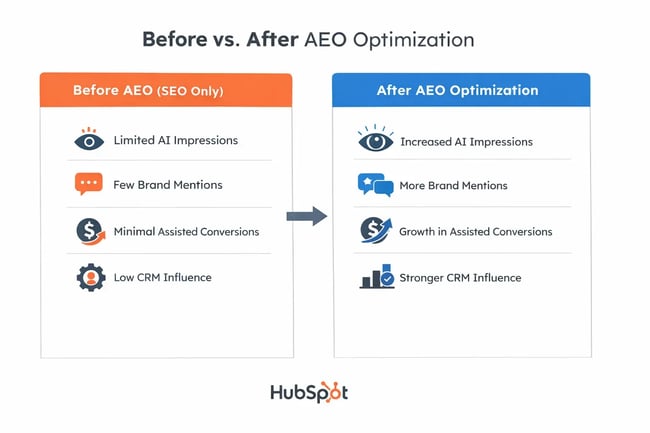
Another finding touches upon measurements and ROI.
Before AEO, teams measured rankings and clicks. Now, measurement shifts toward AI Overview visibility, citation frequency, and CRM influence. Marketers start attributing value to assisted deals, influenced revenue, and brand recall surfaced through generative answers rather than direct visits.
Similarly, the AEO case studies recognize a clear sales impact, albeit indirectly, in many of them. Agencies report higher baseline brand familiarity in early sales conversations, fewer “what do you do?” questions, and shorter evaluation cycles after AI citations increase. Likewise, more than half of marketers report AI-referred visitors convert at a higher rate than traditional organic traffic.
HubSpot’s AEO Grader evaluates websites based on how they show up across LLMs and offers suggestions for improvements.
Answer engine optimization case studies that prove AEO’s ROI.
Answer engine optimization delivers measurable ROI when brands increase their visibility inside AI-generated answers, leading to higher-quality traffic and stronger brand recall. The following case studies showing ROI from answer engine optimization campaigns demonstrate how companies across different industries implemented AEO strategies to improve how AI systems interpret and cite their content.
From B2B SaaS companies driving thousands of AI-referred trials to agencies generating sales-qualified leads directly from LLMs, these examples highlight the tactics that helped both established brands and emerging players compete for AI visibility and turn citations into real business outcomes.
Discovered: From 575 to 3,500+ trials per month in 7 weeks for a B2B SaaS
This is the story of how Discovered, an organic search agency, pulled off a miracle for their client and 6x AI-referred trials.

The Before
The client’s company had a mature SEO program that was no longer delivering and had no deliberate AEO strategy, which translated into minimal business impact. Potential buyers simply couldn’t find the company because it was invisible inside AI answers.
What made the matter worse is that the existing strategy focused primarily on top-of-funnel informational content that wasn’t converting.
So the fix had to be immediate and tied to business outcomes.
Execution Teardown
The work began with a thorough technical SEO audit and AI visibility audit. The team found issues with broken schema (a major red flag for AI citations), duplicating content, and poor internal linking. Needless to say, there was no optimization for LLMs.
Once the technical issues were fixed, Discovered moved to publishing dozens of content pieces targeting buyer-intent queries that LLMs had already answered. Instead of the usual 8–10 monthly posts, they published 66 AEO-optimized articles in the first month.
Here’s the winning AEO content framework the teams used to structure articles:
- Clear, verifiable facts that LLMs could cite with confidence.
- Entity optimization and schema markup for better knowledge graph integration.
- Answer-focused structures targeting actual buyer questions.
- Intentional internal linking to high-intent conversion pages.
Although the result of publishing 66 decision-level intent articles brought in an influx of AI citations within 72 hours, that wasn’t enough.
To make the client’s tool top-of-mind for LLMs, the Discovered team had to increase trust signals. To do so, they extended the strategy beyond owned content and went on Reddit. Using aged accounts, they seeded helpful comments in relevant subreddits that ranked #1 for the target discussion.
The Results
The downstream impact didn’t take long to show up. Within just seven weeks, Discovered delivered astonishing AEO results:
- 6x increase in AI-referred trials from 575 to 3,500+ trials attributed to ChatGPT, Claude, and Perplexity recommendations.
- 600% citation uplift.
- 3x SERP performance on high-intent keywords, driving qualified traffic that converted.
- #1 Reddit rankings.
Curious if your business’s website is AEO-ready? Run it through HubSpot’s AEO Grader to get a detailed competitive analysis, brand sentiment scoring, and strategic recommendations to optimize your brand’s AI visibility.
How Apollo lifted its brand citation rate by 63% for AI awareness prompts.
Brianna Chapman leads Reddit and community strategy at Apollo.io, so she greatly influences how LLMs cite Apollo today. Without revamping its website content, Chapman increased the brand citation rate solely by using Reddit as the main source of information for AI search engines.
The Before
When Chapman started digging into whether Apollo was actually showing up in ChatGPT, Perplexity, or Gemini about sales tools, she found herself frustrated. “LLMs kept positioning us as ‘just a B2B data provider’ when we’re actually a full sales engagement platform. Competitors were getting cited for capabilities we had, and sometimes did better,” shares Chapman.
The major problem was that LLMs were pulling content from old Reddit threads with incomplete or outdated information about Apollo, but because those threads existed and were crawlable, the information kept being treated as truth.
Execution Teardown
Chapman stopped treating AI visibility as an SEO problem and began thinking of it as narrative control. The goal was to shape conversations in places LLMs already trust (mainly Reddit) without being sketchy about it.
Here’s what Chapman did precisely to flip the narrative and drive brand citations.
First, she figured out which prompts actually mattered (aka how people ask inside LLMs) and audited the brand’s visibility in AI search engines.
To do so, Chapman pulled first-party data from Enterpret (customer feedback), social listening, and prompts people were giving inside Apollo’s AI Assistant. She got about 200 prompts per topic, like:
- “ai that verifies emails before sending outreach”
- “what ai sales tools don’t feel spammy?”
From there, she tracked all of them in AirOps to see where Apollo was (or wasn’t) getting cited.
Then it was time to act.
She built r/UseApolloIO as a credible resource and grew this subreddit to 1,100+ members with 33,400+ content views in over five months. The major shift happened when Chapman posted a detailed comparison in r/UseApolloIO about when teams should choose Apollo versus a competitor.
Within a couple of days, AirOps showed the new thread getting picked up, and within a week, it had displaced the old one, gaining +3,000 citations across key prompts in LLMs.
The Results
The results speak for themselves: 63% brand citation rate for AI awareness prompts, 36% for category prompts. Reddit sentiment also got more positive, driving beta sign-ups and demo requests.
Featured resources:
How Broworks generates SQLs directly from LLMs after AEO.
One day, Broworks, an enterprise Webflow development agency, wondered what if they could build a pipeline from AI tools instead of just traditional search engines? So the team rolled up their sleeves and dug deep into AEO optimization of their entire website.
The Before
Broworks had their brand already cited in LLMs here and there, but those mentions didn’t translate into anything the business could measure. On top of that, there was no structured way to influence AI-generated answers and no attribution tying AI-driven sessions back to pipeline outcomes.
Execution Teardown
First, the Broworks team realized they had had a schema markup problem. So they implemented custom schema markup across key landing pages, case studies, and blog posts. They added FAQ Schema, Article Schema, and Local Business, and Organization Schema — essential schema attributes for LLM indexing.
They also placed comparison tables directly on the landing pages.
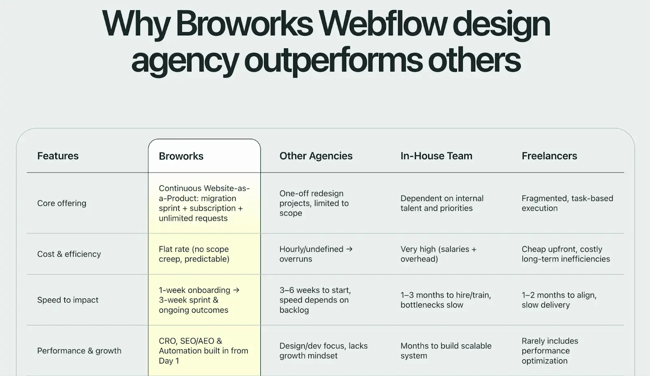
Their second step was to align the website’s content with prompt-driven search. Meaning, optimize content not around traditional keywords but questions people ask ChatGPT, like: “Who is the best Webflow SEO agency for B2B SaaS?”
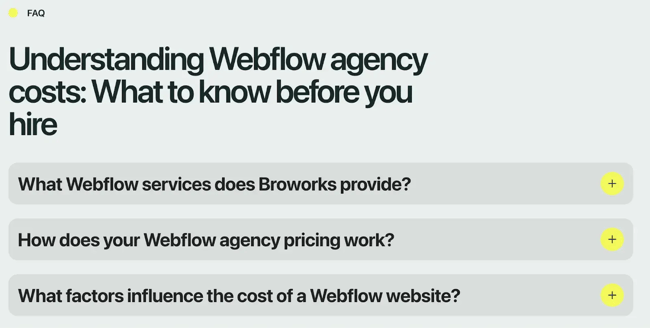
They also added FAQ sections to most pages and summarized key takeaways at the top of articles.
Even Broworks’ pricing page has an FAQ section.
The Results
Within three months, AEO and GEO outcomes became visible in both analytics and sales data:
- 10% of organic traffic originated from LLMs, including ChatGPT, Claude, and Perplexity.
- 27% of AI-referred sessions converted into SQLs.
- 30% higher time on site compared to traditional organic traffic.
Sales teams reported stronger baseline awareness and fewer introductory conversations. Prospects arrived already aligned on the problem and solution, shortening qualification cycles.
Intercore Technologies achieved $2.34M in total revenue attributed to AI discovery over six months.
Intercore Technologies, a digital agency for law firms, helped an established Chicago personal injury firm rise from an invisibility crisis. The brand’s SEO was stellar; they ranked #1 for “Chicago personal injury lawyer” and had over 15,000+ monthly organic visitors — but their lead volume dropped.
The brand actually leaked its clients to competitors that were more visible in AI search engines, as search behavior drastically shifted in this niche.
The Before
In short, Intercore’s client was not recognized by AI search engines at all. The brand didn’t appear in LLM results for the query “personal injury lawyer Chicago,” despite strong domain expertise. Competitors, on the other hand, were mentioned 73% of the time.
Execution Teardown
Intercore Technologies approached AEO as a precision problem. They focused their work on making the firm’s expertise legible and quotable for AI search engines evaluating legal intent.
Execution centered on four pillars:
- Legal entity clarification. Practice areas, case types, and jurisdictional relevance were explicitly defined so LLMs could associate the firm with specific legal scenarios (e.g., personal injury claims, settlement processes, local statutes).
- Answer-first content restructuring:
- 50 core pages were rewritten to lead with direct answers to high-intent legal questions commonly surfaced in AI responses.
- Added 500+ word FAQ sections to each practice area.
- Created “Ultimate Guide to Personal Injury Claims in Illinois.”
- Implemented semantic HTML structure (H1–H4 hierarchy).
- Created comparison tables (Auto vs. Slip & Fall vs. Medical).
- Schema and the site’s speed. Structured data was applied to reinforce legal services, locations, and professional credibility, thereby improving extraction accuracy across AI platforms. They optimized page load speed to under two seconds.
- Established a multi-platform presence for maximum AI visibility. LinkedIn was used for a thought leadership campaign with over 5,000 engagement actions in the first month. They also launched a YouTube channel and published on Reddit, Quora, and Forbes Legal Council.
The Results
After this massive undertaking, AI visibility started translating into both reach and revenue. AI visibility increased to 68% across ChatGPT, Perplexity, and Claude.
The revenue impact followed quickly:
- 156 new clients attributed directly to AI recommendations.
- $47,500 average case value from AI-referred clients.
- $2.34M in total revenue attributed to AI discovery.
- 16.9% average AI conversion rate.
Takeaways From These AEO Case Studies
Let’s develop a playbook from these answer engine optimization ROI case studies so growth specialists can easily modify their AEO efforts and see similar results.
1. AI visibility compounds before traffic does.
Across all case studies, brands saw AI citations, mentions, and awareness lift weeks or months before any meaningful traffic changes. Marketers should treat AI visibility as a leading indicator of their answer engine optimization efforts.
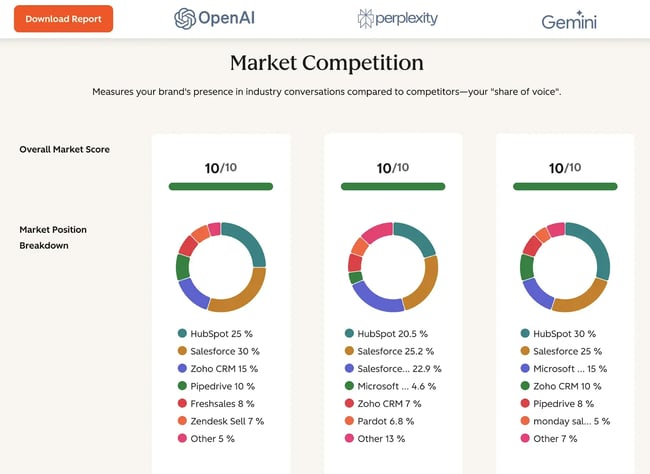
Use HubSpot’s AEO Grader to learn and monitor how leading answer engines like ChatGPT, Perplexity, and Gemini interpret your brand. The AEO Grader audit reveals critical opportunities and content gaps that directly impact how millions of users discover and evaluate your brand using LLMs.
2. Answer-first content is your new textbook for content creation.
Answer-first content consistently outperforms keyword-first content. Pages that open with direct answers, summaries, or FAQs were cited more reliably by LLMs than traditional blog-style introductions. This pattern shows up across SaaS, agency, and legal services examples. Answer-first content flips the traditional SEO model by prioritizing immediate clarity over keyword stuffing or narrative build-up.
To put this into practice, start every page with a clear answer to the top-intent question, followed by context, examples, or supporting detail. Use headings that mirror natural queries, like “How can I optimize my SaaS website for AI search?” and provide a short, self-contained answer immediately below. By doing so, marketers increase the likelihood that AI systems extract their content confidently and cite it as a trustworthy source. Over time, this approach compounds visibility and can drive higher-quality AI-referred traffic.
3. Schema markup is no longer optional for AEO.
Schema markup is the backbone of machine-readable content, allowing AI systems to understand pages and determine how to cite them. Case studies repeatedly show that implementing structured data — including FAQ, HowTo, Product, Offer, Breadcrumb, and Dataset schema — directly improves AI extraction and citation rates. Without schema, even high-quality content risks being overlooked by LLMs because it’s harder for them to parse and verify information.
Actionably, audit all high-value pages for relevant schema types. Start with FAQ and HowTo for decision-stage content, Product and Offer for transactional pages, and Breadcrumb or Organization for site hierarchy and entity clarity. Test the schema using Google’s Rich Results Test or other structured data validators, and iterate based on AI citation performance. Proper schema not only increases the likelihood of being surfaced but also ensures that AI systems interpret the content accurately, improving trust signals and downstream conversions.
HubSpot Content Hub helps marketers publish schema-ready content across websites.
4. Narrative control matters as much as on-site optimization.
On-site AEO optimization alone isn’t enough. LLMs pull from trusted external sources, which means a brand’s AI visibility is influenced heavily by third-party content. Apollo’s case demonstrates that managing a brand’s narrative in platforms like Reddit or Quora can shift how AI systems describe and recommend it. If outdated or incomplete information dominates these sources, LLMs will continue to propagate misaligned messages, even if the website is fully optimized.
To take control, identify the key prompts or topics an audience is querying inside AI tools. Then, actively shape the conversation in trusted communities by providing accurate, detailed, and helpful content. For example, creating dedicated subreddits, participating in niche forums, or posting authoritative comparisons can guide AI systems toward citing a brand correctly. By pairing on-site optimization with external narrative control, marketers increase both the quantity and quality of AI citations, which can drive higher conversions and strengthen brand recognition.
HubSpot’s AI Content Writer helps marketers create high-quality content at scale across channels.
5. Internal linking to high-intent conversion pages is a must.
Internal linking signals context and relevance to AI systems as much as to human users. Case studies show that AI crawlers benefit when content across a site is connected intentionally, particularly linking answer-first pages to high-intent landing pages or product offers. Without a clear internal linking structure, LLMs may surface content that is informative but fails to guide users toward conversion opportunities.
To implement this, map out high-value pages and identify key answer-first articles that can serve as entry points. Link these strategically to product pages, service pages, or other high-intent conversion targets. Use descriptive anchor text that aligns with user queries, so AI systems understand the relationship between pages. This approach ensures that AI-referred traffic not only discovers the content but also moves through the conversion funnel efficiently, improving assisted conversions and pipeline influence.
6. Page speed counts for AEO.
AI systems rely on fast, reliable access to content. Pages that take too long to load may fail to be fetched or fully parsed by AI crawlers, limiting citations and AI visibility. Case studies show that even sites with excellent content and schema lose out when load times exceed two seconds. Slow pages increase fetch latency, raise the risk of incomplete parsing, and reduce the likelihood of the content being surfaced in AI answers.
Action steps include auditing page speed with tools like Google PageSpeed Insights or HubSpot’s Website Grader, optimizing images and scripts, enabling caching, and minimizing render-blocking resources. Additionally, prioritize mobile performance, as many AI systems evaluate content using mobile-first indexing. By improving load times, businesses not only enhance user experience but also ensure that AI systems can reliably extract and cite their content, translating into higher AI visibility and measurable ROI.
7. Question-based subheadings are AEO gold.
Question-based H2s and H3s work wonders because they directly match how users query answer engines. For example, add an H2 “How can marketers structure pages for answer engine optimization?” and then expand using informative H3s.
Answer the query immediately below the heading, so as not to leave room for misinterpretation for AI.
Marketers can simplify their lives with the HubSpot Content Hub that includes built-in AEO and SEO recommendations for headings and structure, as well as drag-and-drop modules for FAQ sections and lists.
Featured resources:
Frequently Asked Questions About Answer Engine Optimization Case Studies
What is answer engine optimization, and how is it different from traditional SEO?
Answer engine optimization (AEO) focuses on making content easy for AI systems and LLMs to extract, understand, and reuse as direct answers. The goal is visibility inside AI Overviews, chat responses, and generative search results, where users often never click through to a website.
Traditional SEO prioritizes rankings, clicks, and traffic. AEO prioritizes answerability, entity clarity, and citation likelihood. In practice, AEO builds on SEO foundations but shifts success metrics toward AI mentions, assisted conversions, and CRM influence rather than sessions alone.
Which schema types should I start with for AEO?
Teams should start with schema that clarifies intent and relationships. FAQ, HowTo, Product, Organization, Breadcrumb, and Article schema consistently improve AI extraction and citation accuracy across AEO case studies.
The priority is not schema volume but relevance. Schema should reinforce what the page is clearly about and how concepts connect.
How do I adapt my content for AI Overviews and chat answers without hurting my UX?
The most effective approach is an answer-first structure. Sections should begin with a direct, self-contained answer, followed by context, examples, or depth for human readers. This pattern serves both audiences without duplicating content.
AEO case studies show that short paragraphs, clear headings, summaries, and FAQs improve AI reuse while keeping pages scannable and readable. AEO works best when it aligns with good UX principles rather than competing with them.
How do I prove ROI for AEO when traffic does not always increase?
AEO ROI rarely shows up first in traffic. Instead, teams track AI citations, brand mentions, assisted conversions, influenced deals, and sales feedback inside CRM systems. These indicators surface earlier and compound over time.
Many AEO case studies validate ROI by correlating AI visibility gains with higher lead quality, shorter sales cycles, and lower acquisition costs. The key is expanding measurement beyond last-click attribution.
When should I consider bringing in AEO services versus keeping it in‑house?
In-house teams perform well when they already own content, schema, and analytics workflows and can iterate quickly. This works best for companies with mature SEO foundations and access to CRM-level attribution data.
External AEO services make sense when teams lack entity modeling expertise, schema depth, or visibility into how AI systems reference their brand.
Answer engine optimization is your growth lever.
AEO delivers real business impact when teams stop treating AI visibility as a byproduct of SEO. And it delivers fast: From the first week of optimizing their website for AEO, digital marketers can see a forming pipeline directly attributed to AI recommendations.
If you want to speed up AEO implementation, tools matter.
Platforms like HubSpot Content Hub help teams publish schema-ready, answer-first content at scale, while visibility checks through tools like HubSpot’s AEO Grader or Xfunnel reduce guesswork and speed up iteration.
Gear up and make AEO your growth lever.
