


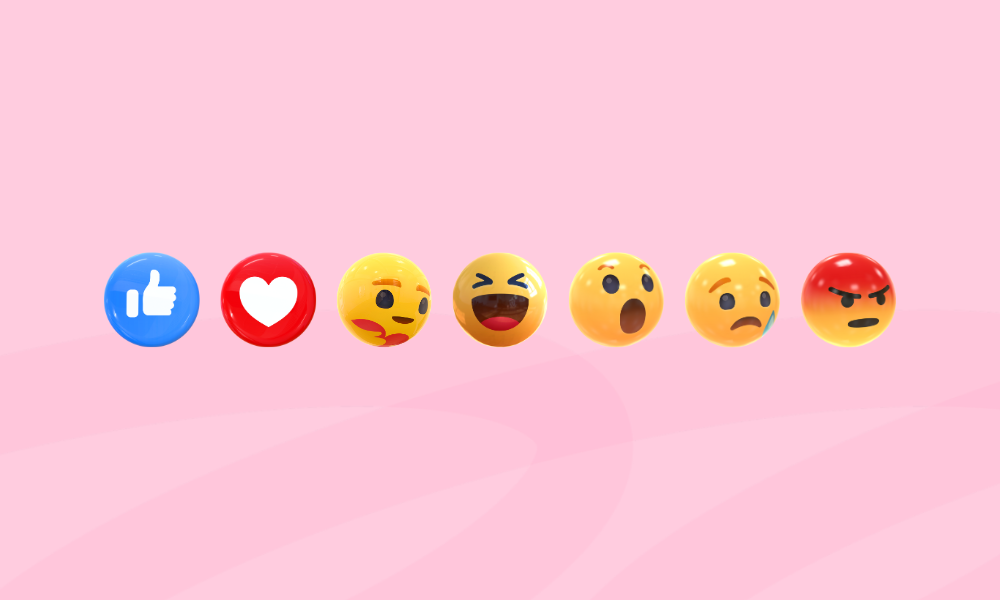
Facebook Reactions are seven different emoji-based ways of “reacting” to content on Facebook.
Reactions are more emotionally natural, and include the following options: Like, Love, Care, HaHa, Wow, Sad, and Angry.
Understanding what they mean for businesses and brands, and how to use them in social media campaigns is essential for success on Facebook.
In this guide, we’ll explain each Facebook reaction, show how they influence the platform’s algorithm, how to use them to create better, and create high-performing social media content.
Quick Summary: Facebook reactions in 2026
- Like 👍 Basic acknowledgement or approval; lowest emotional engagement.
- Love ❤️ Strong positive sentiment and appreciation; indicates high-quality content.
- Care 🥰 Empathy and support, often used for emotional or community-focused posts.
- Haha 😂 Funny: usually triggered by memes or funny content.
- Wow 😮 – Surprise or admiration: for impressive or unexpected posts.
- Sad 😢 – Response to emotional and sad or upsetting content.
- Angry 😡 – Annoyance or frustration; often triggered by controversial posts.
Algorithmic weightings in 2026
- “Love” vs. “Care” Weight: Since 2024, Facebook’s algorithm prioritises “Love” and “Care” more than “Haha” or “Wow” for feed placement.
- “Angry” Penalty: High volumes of “Angry” reactions can now trigger low quality content flags that will negatively impact Page reach. It’s a way of discouraging AI slop, rage-bate posts, and fake news.
Why reactions matter for social media strategy
- They provide real-time insight into audience sentiment and interest.
- Different reaction patterns reveal what types of content resonate emotionally.
- Reactions help identify high-performing content themes and potential content fatigue.
How to increase positive reactions
- Create more emotional or relatable content, like stories, behind-the-scenes, and testimonials.
- Ask questions and use storytelling to encourage engagement.
- Focus on educating, inspiring, or entertaining rather than purely promotional posts (roughly an 80/20 value vs promotion mix).
What are Facebook reactions?
Facebook Reactions are emoji-based reactions, and they include the following ways to react to content: Like, Love, Care, HaHa, Wow, Sad, and Angry.
Let’s talk about each one.
👍 Like
Like is the most basic interaction. When someone likes your post, it usually means they viewed it and found it appropriate or relevant. The Like button serves as a quick way to show approval but does not necessarily reflect strong emotions.
When would a follower “Like” a post? A post with information about new store hours or an event you’re hosting. This shows they understand the information, but it doesn’t elicit excitement.
❤️ Love
Love takes things to another level. It shows deep appreciation or emotional resonance with the post. Check your most popular content using this reaction, as it serves as a quality indicator.
A customer might use the Love reaction to show appreciation for heartfelt testimonials alongside team milestones and behind-the-scenes stories.
🥰 Care
The Care reaction emerged during the coronavirus pandemic (2019-2023) to help people express their support and empathy toward others. If your post contains an emotional or humanizing connection, chances are you’ll notice users select this softer response at a higher rate.
In a business setting, you may not see this reaction very often. However, Care can emerge when users view employee spotlights or stories about charitable initiatives.
😂 Haha
Haha is a humor marker, of course. Haha indicates to users that a piece of content brought them amusement, created a light-hearted connection, or was just flat-out funny.
Well-timed memes, funny captions, and relatable customer experiences tend to elicit many Haha reactions.
😮 Wow
Used for amazement, surprise, or admiration. Users use this reaction to express their amazement when encountering unexpected or impressive content.
Before-and-after transformations, unexpected statistical information, or major announcements tend to trigger Wow reactions from your followers.
😢 Sad
Sad is a reaction to somber news, emotional stories, or reflective moments. This can also show that your brand isn’t afraid to be real.
If you share news about a community loss or a meaningful cause, expect Sad reactions.
😡 Angry
Users express their anger through the Angry reaction when they disagree with something or feel frustrated. People use this reaction when content becomes controversial or when their customer expectations remain unfulfilled.
Unexpected pricing changes, perceived insensitivity, or service delays might provoke Angry reactions.
Facebook reactions 2026 algorithmic weighting changes
For social media managers, it’s important to think about the following algorithmic-based weightings in 2026:
- “Love” vs. “Care” Weight: Since 2024, Facebook’s algorithm prioritises “Love” and “Care” more than “Haha” or “Wow” for feed placement.
- “Angry” Penalty: High volumes of “Angry” reactions can now trigger low quality content flags that will negatively impact Page reach. It’s a way of discouraging AI slop, rage-bate posts, and fake news.
Sources: Meta’s 2025/2026 Transparency Reports and recent Buffer research on engagement weights.
By tracking these reactions, you’ll get immediate insight into how posts are landing emotionally and how audiences perceive your voice and brand values.
How Facebook reactions impact your organic reach
Facebook’s algorithm prioritises content that generates engagement metrics, like interactive Facebook posts. However, not all engagement is created equal.
According to Facebook, posts that spark meaningful interactions are more likely to appear in News Feeds. Reactions — especially Love, Wow, and Haha — are interpreted as signals of engaging, high-quality content.
Comments and shares still hold significant weight, but Reactions help the algorithm determine emotional intensity.
Facebook doesn’t just count how many users reacted to a post. The algorithm uses Reactions as a barometer to measure the emotional “pressure,” as it were, of a post. The algorithm treats posts with 20 Haha reactions as more valuable than posts with 50 standard Likes.
The types of reactions reveal information about both sentiment and interest levels.
What do reactions say about sentiment and interest
Monitoring the type of reaction, not just the total number, can help you understand audience sentiment.
- Did you see a surge in Love and Wow reactions? You’re doing well with your audience, creating content they love/want to see more of.
- Was there an uptick in Sad or Angry? Time to assess the tone, topic, or timing of your post. Try to avoid too many of these.
- Is there a consistent stream of Haha reactions? You might’ve found your brand’s funny sweet spot, so keep producing more content like this if it fits with your audience.
Using reactions to guide your content strategy
Think of Reactions as mini-feedback tools. They help you measure not just what content performs well, but why it does by showing how people feel about it.
The general “Like” is selected most of the time, but don’t settle for that. The other reactions obviously suggest a stronger emotional response, which is your goal.
Measure emotional response to campaigns
Let’s say you run a three-week brand awareness campaign that combines product demos, testimonials, and lifestyle content. You can compare the types of Reactions to each to see which content format sparks the most emotional response.
- More Loves and Wows on testimonials? Lean into stories and user-generated content.
- More Haha on lifestyle memes? Consider developing a recurring humor series.
Spot content fatigue or a mismatched brand tone of voice (ToV)
If a previously high-performing content type starts attracting fewer reactions (or more negative ones), your audience might be experiencing fatigue. Or the tone be off.
For instance, Sad or Angry reactions to what was intended to be an inspiring post might point to cultural tone-deafness. Use social listening tools to dive deeper into these emotional signals.
Use “Love” and “Haha” to identify high-share potential
Not all Reactions drive shares, but Love and Haha are found on highly shareable content more than any other reaction. Love and Haha indicate emotional resonance and relatability, which are two of the biggest motivators for content sharing.
After a post racks up Love and Haha Reactions, consider resharing it later or creating spin-off content on that theme. See what kind of reaction the spin-off gets. Let that data inform your future content strategy.
Do Facebook Reactions weigh more than likes in 2026?
Yes, and the gap matters more than ever for organic reach. Facebook’s algorithm has long treated Reactions as stronger engagement signals than a standard Like, because they indicate emotional investment rather than passive acknowledgment.
A post collecting Love, Wow, or Haha reactions tells the algorithm that your content resonated deeply, which typically translates into broader distribution in the News Feed.
While Facebook hasn’t published a definitive weighting breakdown, the principle is consistent: the more emotionally charged the reaction, the more the algorithm interprets your content as meaningful. This means chasing Reactions — not just Likes — should be a core part of your Facebook content strategy in 2026.
How to see who reacted to your Facebook post
On any post, click or tap the reaction summary icon (the small emoji row displayed beneath your post). This opens a breakdown showing each reaction type and the individual accounts that used them. You can filter by reaction — Love, Haha, Wow, etc., — to see exactly who responded and how.
For business pages, this data is especially useful for identifying your most engaged followers and brand advocates. Keep in mind that on mobile, the process is the same: tap the reaction count to reveal the full list.
Using reactions to measure brand sentiment
Reactions give you a read on how your audience feels about your content, not just whether they saw it. Tracking reaction types over time reveals patterns that raw engagement numbers can’t.
For example, a spike in Angry or Sad reactions on what you intended as a positive post is an early warning sign of a tone mismatch or audience disconnect.
On the other hand, a consistent stream of Love and Haha reactions signals content that’s genuinely connecting. Use this as an audience-centric feedback loop.
If testimonials earn Love and behind-the-scenes posts earn Haha reactions, you’ve identified content pillars worth doubling down on. Tools like Sendible make it easier to monitor reaction trends across posts and campaigns, so you’re making strategy decisions based on emotional data, not guesswork.
Tips for increasing positive reactions on Facebook
Here are three proven ways to help you get the reactions you want.
1. Post relatable, emotional, or funny content
Emotions fuel engagement. Whether it’s laughter, nostalgia, inspiration, or empathy, it doesn’t matter. Emotional content earns better reactions.
Example: Use storytelling with customer experiences or behind-the-scenes content to create a connection.
2. Use questions and storytelling
Begin your post with a narrative, then finish it by asking your audience for their responses.
“We still remember our first client pitch like it was yesterday. What’s your most nerve-wracking work story?”
This kind of post typically generates a combination of Like, Love, or Haha reactions.
3. Inspire, educate, or entertain: Don’t just promote
Social media isn’t a sales channel. It’s a place to connect. Focus 80% of your posts on non-promotional value. Teach your audience something. Entertain them. Surprise them.
Wrapping it up: Facebook reactions
Facebook Reactions may seem simple on the surface, but they offer a wealth of insight for your business. When you understand what each reaction means and use that data to guide your strategy, you can create content that not only gets seen but is felt.
Whether you’re scheduling posts, measuring sentiment, or testing new content types, tools like Sendible make it easier to keep your social media strategy in tune with your audience’s emotional responses. Book a demo or get started for free today.
Facebook Reactions FAQs
Which Facebook reaction gets the most engagement?
Because of its simplicity, the “Like” is still the most commonly used reaction. When it comes to meaningful engagement, “Love” and “Haha” produce better results because they show deeper audience connections and higher share potential.
Do Facebook reactions help with reach?
Yes. The number of Reactions determines how well Facebook’s algorithm understands when to display content to additional users. Posts that generate Love, Haha, and Wow reactions achieve greater organic visibility.
Can I see who reacted to my business page posts?
Yes. You can view reaction statistics for each post by clicking on the reaction summary icon, which shows reaction types alongside their corresponding user counts. The feature lets you detect leading fans while detecting how audiences feel about your content.
Which Facebook reaction is most powerful?
Love is generally considered the most powerful reaction in terms of algorithmic weight and emotional signal. It indicates strong positive sentiment, making it more valuable than a standard Like.
At the same time, Haha and Wow also carry significant weight, as they suggest your content made a genuine impression.
Can I turn off reactions on Facebook?
Not entirely. Facebook doesn’t allow you to disable reactions on individual posts or your page.
However, if you’re running a Facebook ad, you can limit certain interactions through your ad settings.
For organic posts, reactions remain on by default.

