


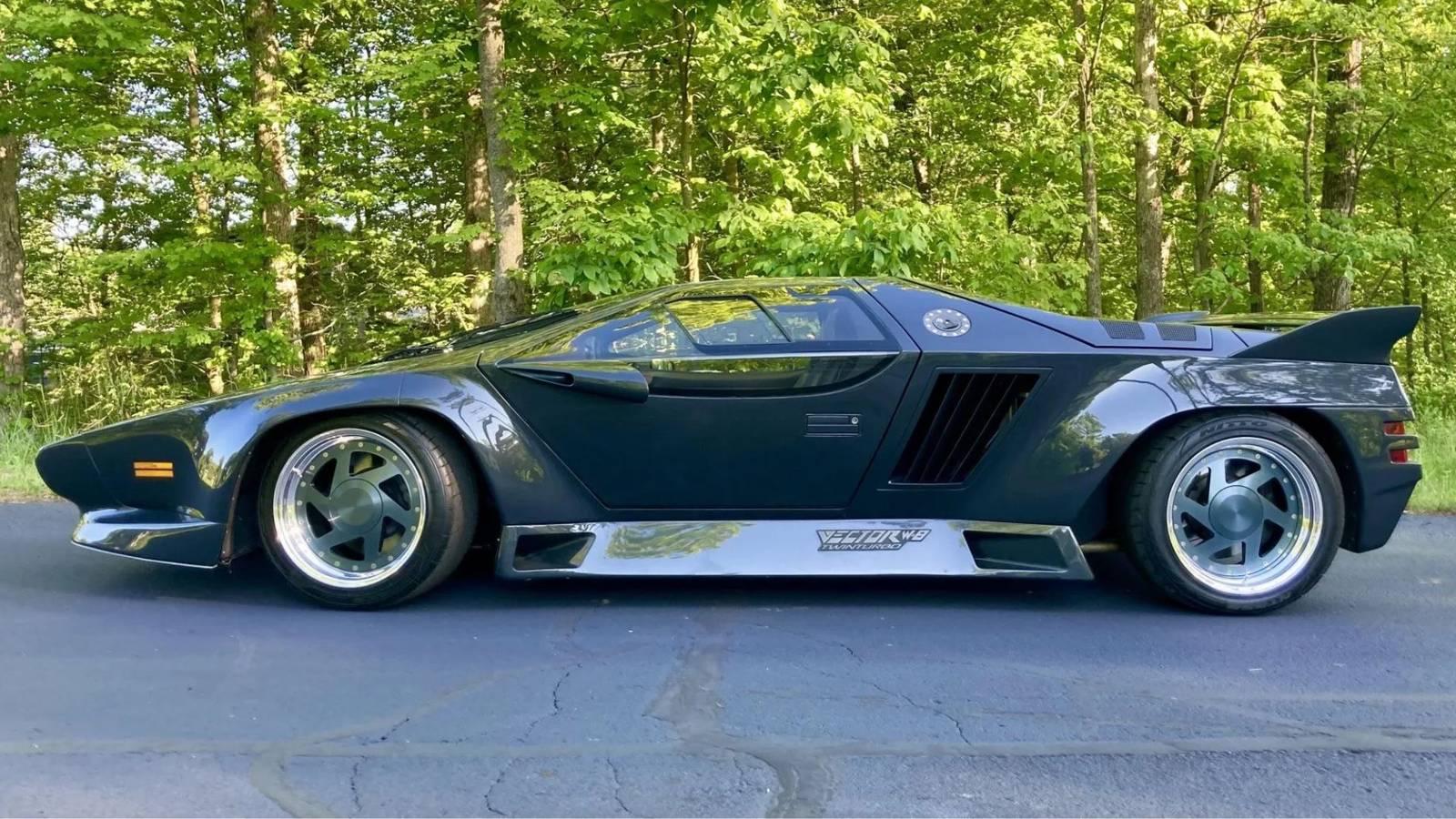
Back in the late ’80s, when American muscle was all about big V-8s and playing it safe, one tiny manufacturer decided to flip the script entirely. They weren’t trying to beat Detroit at its own game—they were rewriting the whole playbook.
This beast of a car was built from scratch with aerospace materials, insane power targets, and a cockpit that felt more fighter jet than road car. Its specs could hang with the world’s top exotics, but it wasn’t just about numbers—it was decades ahead of its time, packing tech and performance ideas most automakers wouldn’t touch for years.
It never got the recognition it deserved, not for lack of vision. The result was a supercar that felt like the future, even if the world wasn’t ready for it yet, remembered more for its daring than its fame.

The 205 MPH American super sedan that embarrasses sports cars
This monstrous machine leaves sports cars in its dust.
The Vector W8 threw Detroit’s rules out the window
A supercar so ahead of its time, the world struggled to keep up
The Vector W8 rolled out in 1989, a product of late ’80s ambition, and only trickled into the early ’90s. Nobody’s completely sure on the exact count, but most sources agree fewer than 20 of these machines were ever made.
That scarcity wasn’t a marketing gimmick—it was the collision of big ideas and the limits of tiny-scale production. This wasn’t meant to chase Corvettes or polish up muscle-car formulas.
Vector’s goal was something else entirely: a low-volume, aerospace-inspired supercar that ignored conventions and focused on clever engineering over comfort or familiarity.

Vector Aeromotive founder Gerald Wiegert dreamed up the W8 as America’s answer to Ferrari and Lamborghini, but copying Europe was never the plan. Instead of lightweight chassis tricks or Detroit’s budget-minded engineering, the W8 leaned hard on aircraft design principles.
Looking back, what really set the W8 apart wasn’t just the materials or power—it was the intent. Unlike big, well-funded automakers, Vector built for control and capability, even if that made ownership tricky.
Owning a W8 meant deep pockets and patience, because it felt more like a prototype than a production car. In other words, it wasn’t about modernizing Detroit—it was about skipping it entirely.

These are the only inline-six engines still available in America
Once common, now coveted — these remaining sixes keep the legacy alive.
The Vector W8’s engineering was way ahead of its time
A supercar built more like an aircraft than a typical road car

While most late-’80s supercars were just tweaking formulas that already worked, the Vector W8 was playing a different game entirely. Its structure leaned on composites like carbon fiber and Kevlar over an aluminum honeycomb chassis, more racecar and aircraft than typical road car.
Even when other exotic makers were still using steel or plain aluminum, Vector focused on stiffness, strength, and raw performance over easy manufacturing. It wasn’t about convenience—it was about building a car decades ahead of the pack.
The W8’s interior drove the philosophy home. Its cockpit-style layout wrapped controls around the driver, borrowing cues straight from aircraft instead of standard dashboards.
Digital readouts, stacked switches, and an intense focus on the driver made it feel worlds apart from the analog dials and plush leather common in ’80s supercars. Vector believed a performance car should function as a fully integrated system, not just a collection of parts.
Twin-turbo V-8 delivers insane performance

Power came from a twin-turbo 6.0-liter V-8, based on Chevy’s small-block but souped-up to the extreme. Estimates put it anywhere from 625 to over 700 horsepower, depending on boost and setup.
Vector mated that engine to a three-speed automatic built to handle massive torque—630 lb-ft—trading some driver feel for sheer durability.
Performance was insane: 0 to 60 in 3.8 seconds and a theoretical top speed of 242 mph, though verified runs hit 218 mph. Remember, this was the early ’90s—insane numbers for the time.
Engine | 6.0-liter twin-turbo V-8 |
|---|---|
Transmission | Three-speed GM auto |
Power | 625 hp @ 5,700 rpm |
Torque | 649 lb-ft @ 4,900 rpm |
0–60 mph | 3.8 seconds |
Top speed | 242 mph (theoretical) / 218 mph (verified) |
Weight | 3,320 lbs |

This Hyundai Electric Car Concept Is a Time Warp on Wheels
The Heritage Series Grandeur is a modern take on Hyundai’s 1986 flagship sedan.
Why the W8 never quite lived up to its promise
A supercar ahead of its time, but held back by reality

Let’s be clear: the W8 didn’t fail for lack of vision. Its ambition just outpaced what a tiny, independent manufacturer could realistically pull off. Building an aerospace-inspired supercar is one thing; making it a reliable, road-ready machine is a whole different mountain to climb.
As any seasoned gearhead might guess, Vector didn’t have the production muscle or supplier network of the big automakers. The W8’s drivetrain showed that tension—engineered for insane power, but tricky to manage in the real world.
Add early engine management and evolving turbo tech into the mix, and you’ve got a supercar that demanded constant attention. It was brilliant on paper, but exhausting in practice.

Gearheads also know that Vector’s business struggles made everything harder. With such a tiny production run, cash flow was unpredictable, and internal shifts often pulled resources to future projects before the W8 was fully sorted.
The result was a car full of brilliant ideas, but with unresolved issues left in its wake.
In the end, the W8 didn’t stumble because the concept was bad—it stumbled because it tried to cram decades of tech into a single, low-volume car. Vector aimed high, and even if it didn’t deliver perfectly, it showed the world what was possible.

10 Affordable Used Sports Cars That Can Keep Up With A Porsche 911
These 10 affordable used sports cars deliver impressive speed and handling, proving you don’t need a Porsche 911 to experience thrilling performance.
How the Vector W8 earned its place in history—then slipped into obscurity
A supercar ahead of its time, too ambitious for the small team behind it

Looking back, the Vector W8 didn’t fade because it was slow or unimportant. It disappeared because it existed outside the systems that keep cars famous. With fewer than two dozen ever built, no racing pedigree, and no ongoing production, it never had a chance to cement itself like Ferraris, Lamborghinis, or even later American exotics.
Timing didn’t help either. The early ’90s weren’t kind to ultra-low-volume supercars, especially ones without global dealer networks or factory backing.
As other exotics grew more refined and reliable, the W8 started to feel like an oddball. Without ongoing exposure or development, it quietly slipped into obscurity, remembered more as a wild experiment than a benchmark.
Other supercars that shared the W8’s bold approach

Gearheads will remember a few cars that played in the same rarefied league as the Vector W8. The Bugatti EB110 and McLaren F1 come to mind.
Fewer than 150 EB110s rolled out between 1991 and 1995, and just over 100 McLaren F1s were built between 1992 and 1998. Both were low-volume, extreme-performance machines that, like the W8, pushed the boundaries of what a supercar could be.
Even though production numbers were tiny, the real difference between these cars and the Vector W8 was resources. The EB110 and McLaren F1 had deep pockets and production systems that actually made their ambitious concepts work reliably.
Vector didn’t get that luxury. Without the same safety net, even small missteps hit hard, and the W8 never had the margin for error to match its peers.
What a Vector W8 goes for in today’s market

Today, the Vector W8 sits in a tiny but growing collector niche. Its rarity, complexity, and condition sensitivity make values tricky to pin down.
When one does change hands, the price usually reflects history and scarcity more than everyday drivability.
1991 Vector W8 market values
Condition | Estimated value |
|---|---|
Fair | $500,000 |
Good | $734,000 |
Excellent | $989,000 |
Concours | $1,300,000 |
One 1990 Vector W8 Twin Turbo popped up on Bring a Trailer a couple years ago. Finished in graphite gray, it climbed to a staggering $740,000—but the reserve wasn’t met, and it didn’t sell.
The W8 isn’t collected as a daily driver so much as a piece of engineering history—a snapshot of American ambition gone radical.
Three decades on, its legacy isn’t about what it didn’t become, but how clearly it pointed the way for the future of supercars.
Sources: Classic.com, Hagerty, HotCars, McLaren Automotive
