


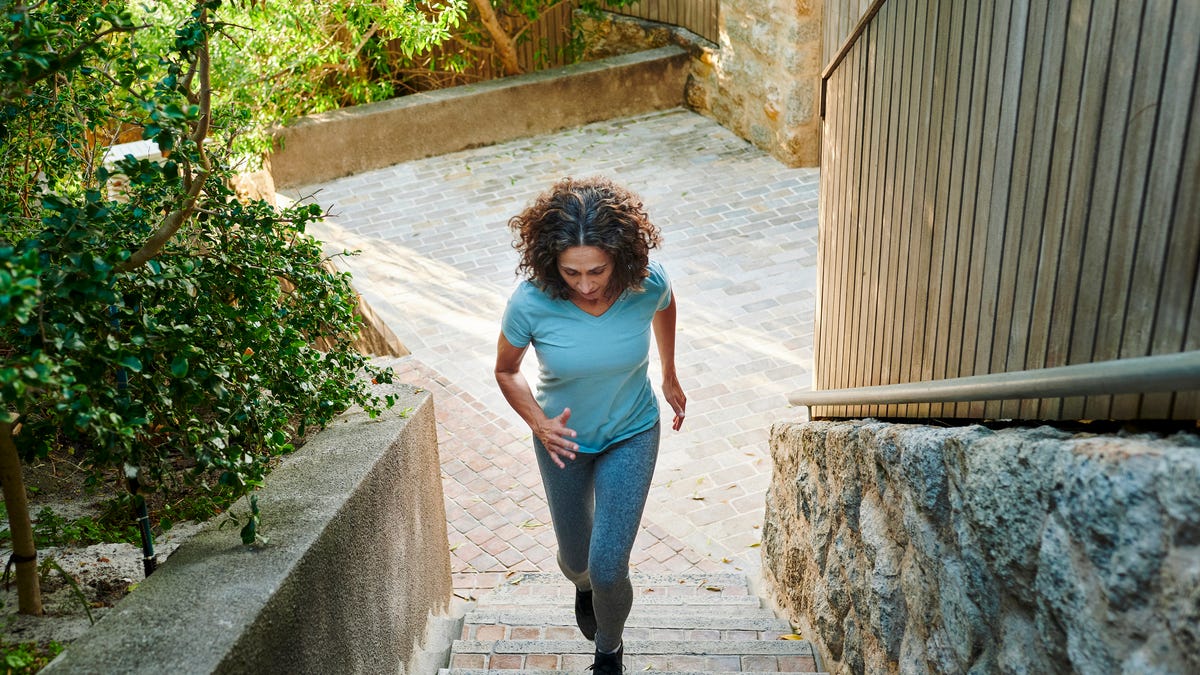
Climbing up sets of stairs is a natural part of life, but it’s one that can easily leave you bent over and gasping for air. Even if you regularly work out, or maintain your endurance on fitness equipment like a treadmill, you can still find yourself winded once you reach the top, meaning that it’s not necessarily a reflection of your fitness level.
Whether you already have a dedicated workout routine or simply want to make going up stairs easier, you can perform some simple exercises so the next set of stairs doesn’t leave you trying to catch your breath.
Why do I get winded when going upstairs?
If you check your heart rate, it’s likely to have spiked.
The fancy medical term for what’s happening when you get winded climbing stairs is “exertional intolerance.” While approaching stairs, you’re not warmed up — your muscles are cold, your heart rate is low and your body is not ready to move suddenly. When you start climbing, you’re essentially doing single-leg squats with some cardio mixed in, and your heart rate quickly skyrockets. Your body suddenly needs more oxygen — hence the feeling of being winded.
Another reason it affects you so strongly is that walking upstairs uses your fast-twitch muscles, which are used for explosive movements, as well as muscles like your glutes, which you may not commonly train. If you’re an endurance cardio nut like me, you’re in great shape, but sustained exercise like this uses slow-twitch muscles. So, it won’t transfer over super well to exercises like stair climbing.
If you’ve been hitting the gym regularly but the stairs are still giving you trouble, don’t fret that you’re not in good shape. There are plenty of other ways to measure your overall health and fitness, including your heart rate or other metrics like body composition and strength.
How to make going up stairs easier
Lunges will help you conquer the stairs with ease.
If getting out of breath while climbing stairs is putting a damper on your life, there are steps you can take to lessen the annoyance. I’m not going to suggest that you jog in place for a moment to warm up before ascending a short staircase with your boss, but here are a few ways you can prepare yourself ahead of time.
First, incorporate stair-specific exercises into your workout routine to train your body for the stimulus. Exercises such as sprints, jumps or other explosive movements will help with the sudden exertion. To train your glutes and legs, try bodyweight exercises like squats and lunges.
If you’re looking for exercises to do to improve endurance, consider the following:
If you smoke cigarettes, it’s almost certainly contributing to your winded-ness. Although e-cigarettes are touted as a healthy alternative, preliminary studies suggest that vaping also damages your lungs.
What is VO2 max?
Used to test aerobic endurance or cardiovascular fitness, VO2 max is the maximum amount of oxygen you can utilize during exercise. It is measured in milliliters of oxygen consumed in 1 minute, per kilogram of body weight (mL/kg/min).
VO2 max is measured with a mask and a heart rate monitor, both hooked up to a treadmill or an exercise bike. Because of this, you will need proper equipment to accurately measure your VO2 max. If you think this is a measurement you can benefit from, especially if you’re working on your endurance while climbing stairs, consult your doctor for their opinion. There may be VO2 max testing at a health center or gym near you.
When to call your doctor
If you think your windedness is out of the range of normal, call your doctor.
If you’re debating whether or not to call a medical professional, you’re better safe than sorry. One major warning sign to look out for is chest pain that comes on when you get winded — it could be a sign of heart disease or a coronary blockage. The doctor will do a stress test, and if you do have a blockage, there’s a simple procedure to fix it. Swollen feet and ankles, or coughing, are other signs that something may be wrong with your heart.
Another reason to seek medical help is if getting winded from basic activities is affecting your daily life — for example, if you avoid walking short distances. Or if the situation doesn’t improve once you start exercising more, it may be time to consult a doctor.
The only way to be certain if your shortness of breath is heart-related is to visit your doctor. Your provider can evaluate your symptoms and medical history.
There are a lot of reasons for shortness of breath with little exertion. It could be anything from anxiety to anemia to cardiovascular issues. It’s extremely important to bring up these concerns with your doctor.
Your VO2 max range depends on your gender. According to a chart on Garmin’s website, men aged 20 to 29 can have a VO2 max of 45.4 to 55.4. Women of the same age bracket can have a good VO2 max of 39.5 to 49.6.
You can improve your VO2 max by pushing yourself with intense aerobic exercises, such as tempo runs or HIIT workouts, proper rest and recovery, in addition to great nutrition and hydration.
