


:max_bytes(150000):strip_icc():format(jpeg)/20260204-SEA-No-Knead-Whole-Wheat-Bread-Debbie-Wee-HERO-ef1677f08e9f4327ba23be7c5eedee0c.jpg)
Why It Works
- Blending whole wheat flour with bread flour strikes the right balance between flavor and structure, avoiding the dense crumb common in 100% whole wheat loaves.
- A long, hands-off fermentation allows enzymes and yeast to develop gluten gradually while building deeper, wheaty flavor—without extensive kneading or handling.
- Baking the bread in a Dutch oven boosts radiant heat and traps steam, maximizing oven spring and promoting a thin, crisp, crackly crust.
By mid-February—when my optimistic, vegetable-forward New Year’s resolutions have fully collapsed under the weight of darkness, school pickup logistics, and yet another runny nose—I reliably enter what I’ve come to call my homesteader era. It’s brief. It’s dramatic. And it mainly involves me putting on an impractical, ruffled apron that I would never be caught wearing professionally, rolling up my sleeves, and deciding that today is the day I bake my own bread.
This is not aspirational homesteading. I am not milling my own flour. I am not maintaining a sourdough starter named something whimsical. I am not interested in nurturing another living thing right now—between work, kids, a dog, and aging parents, that thought exhausts me. What I do want, every winter, is a loaf of freshly-baked bread that tastes genuinely good and nourishing, and fits into a life where I cannot spend all day hovering over dough. This loaf is that bread.
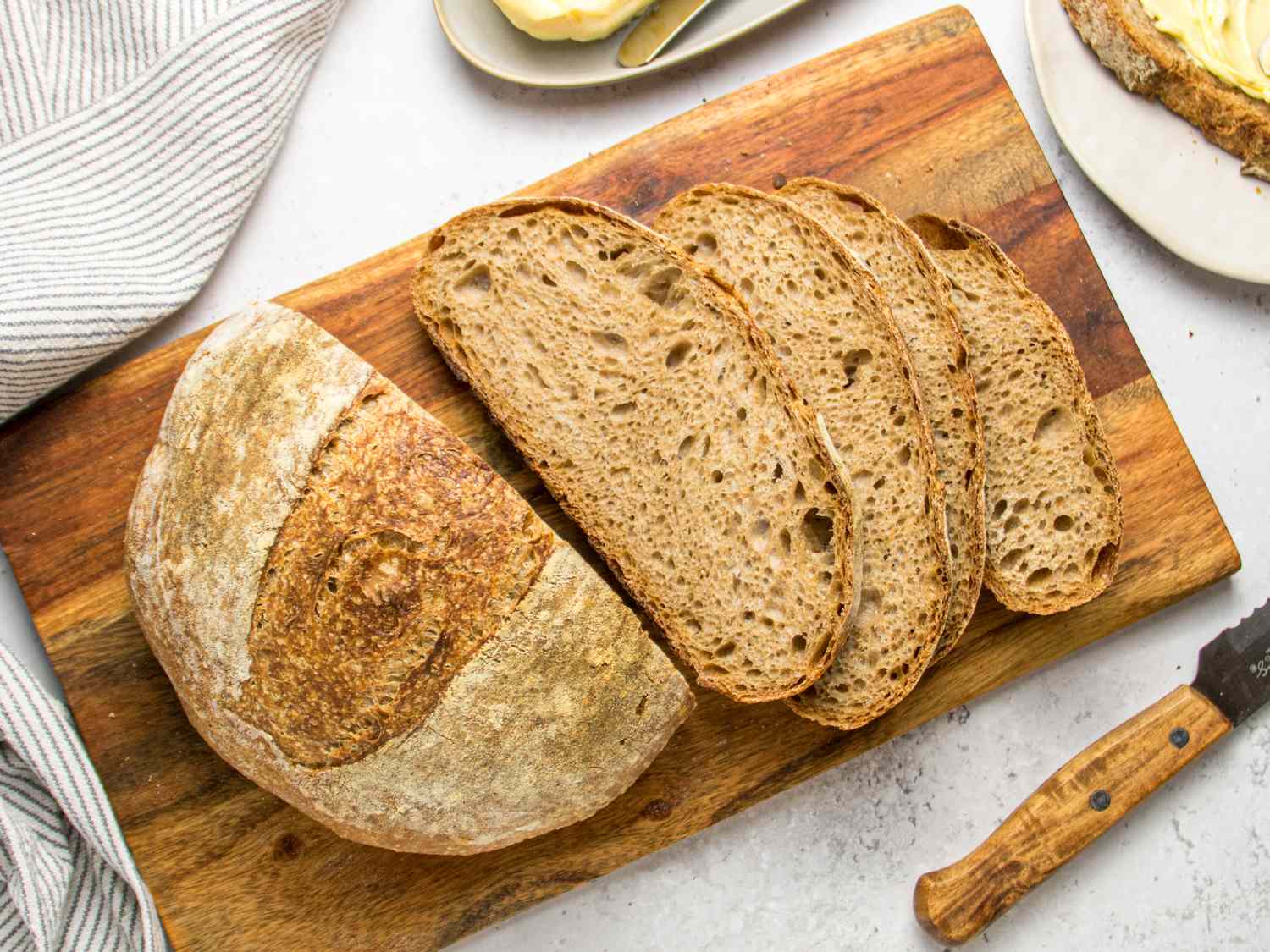
It’s an almost no-knead whole wheat boule that’s deeply browned and crackly-crusted, chewy but not dense, with a soft interior that’s sturdy enough for toast and sandwiches yet still tender. This is the bread I make when I want homemade bread without making bread my personality. It uses pantry ingredients, requires no stand mixer or starter, and comes together in exactly one bowl. You stir everything together, walk away for the day (or night), shape briefly, and bake. I bake a loaf, then keep slicing all week. My daughter currently eats three slices of it, toasted with butter every single morning, which feels like both a compliment and a threat.
There’s nothing flashy or revolutionary about this recipe. This bread stands squarely on the shoulders of giants. This general Dutch oven bread method was popularized in 2006 when Mark Bittman introduced the world to a recipe from Jim Lahey of Sullivan Street Bakery. It was later explained in detail by our former culinary director Kenji, in his no-knead bread recipe. What is new (or at least personal) is how this loaf solves a specific problem I kept running into with whole wheat bread: I wanted the flavor of whole wheat without the penalty of a tight, dry crumb that felt like penance. Here’s how I get it to work with this recipe.
Serious Eats / Debbie Wee
The Whole Wheat Problem: Flavor Versus Texture
Whole wheat flour tastes great. It’s nutty, earthy, slightly sweet, and satisfying. It is also, frankly, can be a structural menace in bread baking.
Unlike refined white flour, whole wheat contains the bran and germ of the wheat kernel. Those interfere with gluten development in two ways: First, the bran and germ physically interfere with gluten development, cutting through and preventing gluten strands from linking into a strong, continuous network. Second, whole wheat flour absorbs significantly more water than refined flour, leaving less available hydration for gluten formation overall and making the gluten harder to fully develop. The result—especially in 100% whole wheat loaves—is often bread that’s dense, dry, or crumbly unless you use very specific techniques (multiple rests, higher hydration, intensive kneading, or even mechanical help with a stand mixer).
Stella Parks’ 100% whole wheat sandwich bread is a master class in solving this problem—but it also requires finesse, staggered proofs, and a food processor. That’s not what I want on a Tuesday in February. Instead, what I wanted with my recipe was the rich flavor of whole wheat with the buoyancy and chew of a classic boule. The solution, unsurprisingly, is not to use all whole wheat flour.
By blending whole wheat with bread flour, you give gluten room to form properly while still capturing that earthy wheat flavor. After a lot of testing (and some aggressively dry loaves), I landed on a ratio that delivers structure without sacrificing flavor: roughly 55% white flour to 45% whole wheat, by weight. In practice, that’s 9 ounces of bread or all-purpose flour to 7 ounces of whole wheat flour. That’s enough refined flour to build a strong, elastic gluten network, but enough whole wheat flavor to impart a rich flavor and color.
How to Develop Gluten Without Kneading
Once the flour ratio was dialed in, the question remained: how to build a strong gluten network without kneading—especially when nearly half the flour is whole wheat?
The answer, thankfully, is neither a stand mixer nor a series of elaborate folds. This is a true mix-and-wait dough. You stir everything together with a spoon, cover the bowl, and let time do the work.
If you’ve ever made bread before, you’ve probably been told that gluten development requires kneading—lots of it. That’s true, until it isn’t.
Instead of manual manipulation, this loaf relies on time to develop gluten. When flour and water mix, enzymes begin breaking down proteins in a process called autolysis. Over hours, those proteins become more flexible and more willing to link up into gluten networks with minimal effort.
That’s why this dough looks shaggy and unimpressive at first—and then, hours later, turns stretchy and elastic without you touching it.
Serious Eats / Debbie Wee
As the yeast ferments, it produces carbon dioxide, inflating bubbles throughout the dough. As those bubbles slowly expand, they gently stretch and align gluten strands around them. The yeast is doing the kneading for you.
Starting with a minimal amount of instant yeast gives you a huge margin of error. This dough ferments slowly, which means you’re far less likely to overproof it. If dinner runs late or life intervenes, the bread can work on your schedule and will wait for you.
Why Baking Bread in a Dutch Oven Works
The real breakthrough of no-knead bread isn’t just that you don’t have to knead, it’s that the loaf bakes inside a Dutch oven.
Baking bread in a heavy pot transforms a standard home oven into something that behaves much more like a professional bread oven. It does this in two critical ways: by delivering heat more efficiently and by creating a humid baking environment, both of which are essential for good oven spring and a great crust.
A Dutch oven’s thick walls—whether cast iron, enameled steel, or ceramic—store a tremendous amount of thermal energy. As the pot and dough heat together in the hot oven, that energy is transferred steadily and evenly from all sides, encouraging strong oven spring before the crust has time to set. The faster the dough absorbs energy, the more the trapped gases expand, and the larger and lighter the loaf becomes.
The second half of the equation is humidity and steam. Professional bread ovens inject steam during the early stages of baking because humidity is what allows bread to rise to its full potential and develop a great crust. Steam transfers heat more efficiently than dry air, jump-starting oven spring—the dough’s initial burst of expansion in the oven—while keeping the dough’s surface flexible long enough for the loaf to fully expand before the crust sets. At the same time, that moisture gelatinizes starches on the surface of the dough. As the steam dissipates and the loaf continues baking, the gelatinized starches dry and harden, forming a thin, crisp, crackly crust rather than a thick, dull one.
Home ovens lack the power to inject steam. That’s why so many recipes suggest spritzing oven walls with water or tossing ice cubes onto sheet pans—methods that are, at best, annoying, and at worst, a great way to get burned. The Dutch oven eliminates the need for this. As the dough heats up, moisture naturally evaporates from its surface. Inside a sealed pot, that moisture gets trapped, creating a steamy microclimate around the loaf. No need for spritzing or lava rocks.
One note, especially if the idea of wrestling a screaming-hot pot out of the oven to dump in dough makes you nervous: This recipe does not require preheating the Dutch oven. Unlike Jim Lahey’s original method, the dough goes into the pot cold, and everything heats together in the oven. In my testing, I found that you still get the benefits of even heat and trapped steam, without the white-knuckle experience.
Serious Eats / Debbie Wee
Another important note: When baking, please make sure your Dutch oven has a heatproof knob. Many models come with plastic knobs that aren’t rated for high oven temperatures; if yours does, swap it out for a metal one before baking.
Jim Lahey popularized this technique, Mark Bittman brought it to the masses, and Kenji explained why it works so beautifully. I’m just here happily using it—with my own tweaks— because it delivers the rustic, satisfying, freshly baked bread I want most days—well, at least during my annual homesteader month.
