


This piece is part of Trending Forward, our video and podcast series that peers into the world of how disruptive technology is coming to change the way we live. This week, we speak to Arun Gupta, founder and CEO of Hapiko, about the
If you’re one of those that says ‘it feels like AI is everywhere’ – well, you’re wrong. Yes, it’s sliding into work, school and other places, but it’s moving into so many other new worlds at pace.
One of those is the toy aisle – and that comes with terrifying risks. As a parent, the thought that your child has almost unfiltered access to the best (and worst) of the web feels like a huge no-no, and yet we’re seeing a proliferation of toys that can turn bedtime stories into truly Grimm fairy tales.
That’s why we spoke to Aron Gupta, an entrepreneur who successfully started companies in the wearables and fashion retail space. But as he spent time with his family, he started to think about how technology could not only entertain children but educate them and encourage their creativity.
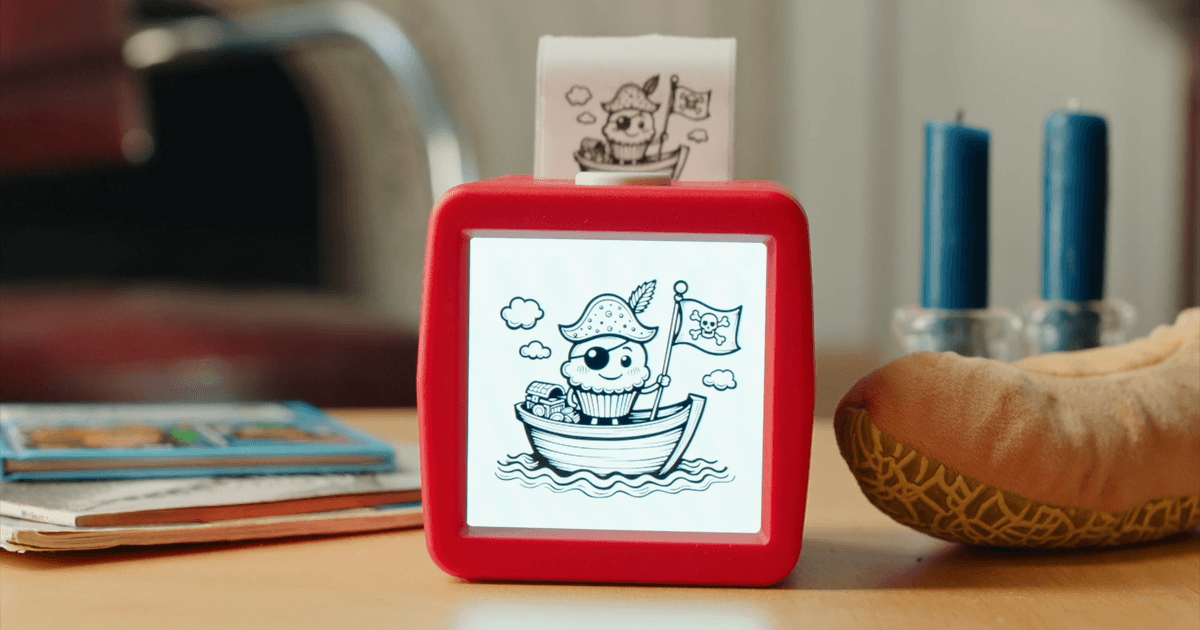
Gupta reconnected with his technical partner, Robert Whitney, and they started to work creating Stickerbox, a self-contained device that uses AI to let kids describe the pictures they imagine – pretty much anything – and see them shown on the monochrome display on the front before having them printed on demand.
The design is reminiscent of the old Etch a Sketch, and the stickers are printed on an embedded thermal printer, which means less mess, and kids can then color them as they wish.
The concept is simple, and I’ve found it’s already left the early adopter orbit and is getting wider fame. When speaking about the Stickerbox recently to a friend in the UK with young children, she said ‘Oh, that Etch-a-Sketch AI sticker thing? I want one of those so much!’
While I assume she meant that she wanted it for her children, it shows that the AI is secondary here – the ability to create tangible things with your voice is something that’s lighting up the excitement, not that it has machine learning at the core.
A new breed of toy
Stickerbox seems to have been designed, constructed and functions as a clear contrast to some other AI toys on the market. The most problematic ones offer to be your child’s friend and confidante.
They constantly listen to everything that’s said in the environment and can even manipulate children. There have been examples of AI toys telling kids how to find weapons and matches.
And there is the conflict: AI tools can support wonder and creativity in children, allowing them to do things that just weren’t possible before. But that opportunity also comes with incredible risk – and that’s the reason we’re speaking to Gupta is simple: how can you make a toy that brings the benefits of AI without the dangers that access brings?
A study recently published by PIRG highlighted huge concerns about toys based on access to LLMs like OpenAI’s ChatGPT, and the way that – even if there are guardrails – they can be bypassed.

So how does Stickerbox differ?
“We started with a very simple question: what if AI was built for kids?” says Gupta.
“I think that Bob and I, when we started this company, were very inspired by social media and the impact that social media has had on the younger generation. Social media, everybody knows this, was built with casino mechanics, designed to give you that dopamine hit, built for as much engagement as possible so they can serve you as much as possible.
“But then you take that and think about that model for kids and… this doesn’t really fit super well. There is no social media that’s really built for kids. And I think you see the same thing with AI.”
Stickerbox was, therefore, designed to harness the creative power of AI while being kid-safe. There are three specific safety factors: the device only “listens” when the microphone button is pushed; there are strict guidelines for content safety on output; and parents can fully monitor their kids’ creations on the accompanying app.
The box won’t allow kids to visualize nudity, gore, violence or blood, as Gupta said the company wanted to “err on the side of more safe rather than less safe as we’re starting out.”
Stickerbox does connect to the internet to access AI, but it’s a proprietary system rather than piggybacking off OpenAI, as many other companies do. Building their own LLM meant Hapiko could integrate what Gupta calls ‘chokepoints’:
“We have a lot of guardrails built into the box right now and it’s a lot of proprietary software, but basically you can think of it in this simple way: there’s a system where the child speaks a prompt, the prompt gets translated into text, the text gets translated into an image and the image comes back.
“So in that process, there are multiple choke points. There’s the choke point of where the text gets made, and you can scan what’s in the text. Then you can do safety filtering on that. (Then) there’s the prompt that goes from the text to the image, and you can scan that and see what’s going to the image.”
Stickerbox teaches children an important lesson about how to construct their instructions to the artificial intelligence engine. When the sticker isn’t exactly what they envisioned, they need to think about how to edit their prompt to get the result that they want.
While you can do the same thing with any chatbot, the printing element requires you to connect hardware, and it needs a guiding hand of a parent to oversee the process and potentially need to explain some sensitive subjects.
We delved deep into the future for this box – how it’s been received by parents and teachers alike, how they overcame some early challenges and questions, and what the future might hold in this quickly-growing AI toy space… and how Hapiko had to leave out some features to get this product to market safely.
