


Are you just starting out with soldering and want to practice on a few cheap and easy projects? That’s exactly where I am in my microcontroller journey, and these are the simple projects I did first to really start to hone my soldering skills.

HTG Wrapped 2025: 24 days of tech
24 days of our favorite hardware, gadgets, and tech
Put a resistor in-line with an LED
Every LED needs a resistor.
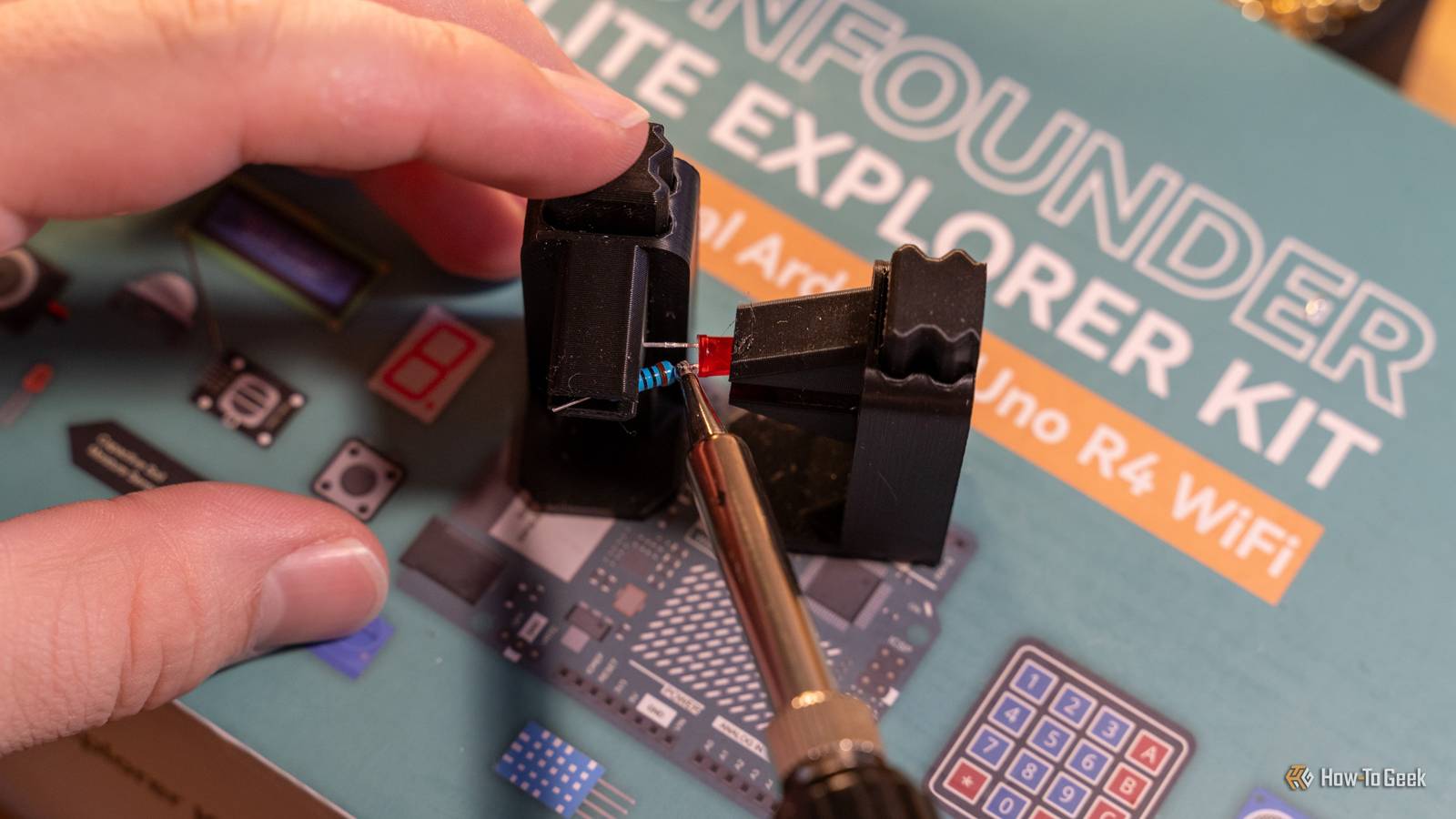
One of the easiest soldering projects to do as a beginner is to solder a resistor to an LED. You can technically put the resistor on either side, but I typically choose to put it on the long leg of the resistor (which is the leg that you hook up to an output pin on your microcontroller).
To do this soldering project, all you need is the LED, a resistor that matches what the LED needs, a pair of flush cutters, a soldering iron, and some solder. That might sound like a lot, but it’s all basic components that you’ll need to have on hand anyway for microcontroller projects. It would also be good to have some sort of helping hands to hold the components to make soldering easier—I 3D printed mine.

I Learned to Solder (And It’s Far More Useful Than I Expected)
Melt metal at home!
Start by finding the long leg of the LED that you plan to solder. Cut it pretty high up on the leg, but still leave enough of the wire exposed for you to solder to. Then, do the same on the resistor. Which side of the resistor you cut down doesn’t matter, just leave enough of the leg there to solder to.
Once your LED and resistor are prepped, pre-tin both of the legs you plan to solder with some solder. Having solder already on both legs will make attaching them easier. Once you’re done with that step, simply hold the two legs with solder together and heat up with the iron—now they’re attached!
Cut the remaining leg of the resistor down so it’s only slightly longer than the other LED’s leg and you’re ready to go. If you want, you can put some heat shrink tubing over the resistor and soldered leg, but I find that unnecessary personally.
Attach wires directly to a button
You might never do this again, but it teaches great technique.

After you attach a resistor to an LED, you’re ready to move onto the next challenge: soldering a wire to a button. Buttons are made up of much softer plastic than LEDs, so you’ll have to be careful not to overheat the button when soldering it.
This project starts very similarly to the LED—begin by pre-tinning a leg of the button and the wire you plan to use with solder. This process is much smoother and simpler than the LED, as all you have to do is pre-tin the wire and leg, touch the two together, and melt the leg and wire to each other.
It’s a pretty simple process, you just have to really control your heat so the button doesn’t start to melt.
Attach a USB cable to a 5V fan
This will be your biggest fan.

Once you’re through the previous two soldering projects, it’s time to tackle one that will require a bit more work—attaching a USB cable to a 5V (or higher) fan. I used an old PC fan I had lying around, which is technically rated at 12V, but it still worked, just slower than it would have on 12V. I also used a PWM fan, but only hooked up 5V and ground—there are data wires on the USB cable that you could technically try to make work with PWM, but that’s a bit too complicated for a beginner project.

Start by making sure the USB cable is unplugged, and then cut off the end you won’t be using. I started with an old USB-A/B cable and cut the USB-B end off. Then, I stripped the outer shell off to expose the inner wires. Mine had four color wires: red, black, white, and green. Red is the positive 5V, and black is ground. Those are the only two you’ll be using here. Strip a little off the end of the red and black wires so that you can solder them to the fan wires.

Next, identify and strip the wires on your fan. I had to use Gemini for this step, as my wires weren’t color coded, but a quick picture uploaded to Gemini helped me to test which wires were the 12V and ground. Once I identified those wires, I tested the system by plugging in the USB cable and touching the wire I thought was ground to black, and the one I thought was positive to red—it worked on the first try for me.

Once you’ve identified the positive and negative wires on the fan, I would put some heat shrink tubing around them so you’re ready to go for the next step. Since both of my wires were black, I put red heat shrink around the positive and black around the negative. I then proceeded to pre-tin all four wires—the two on the fan, and the two from the USB cable.

Once the wires were tinned, I simply repeated the same steps from the previous projects by holding the two wires together and heating them up to melt them to each other. Now that the soldering is done, let the solder joint cool down for a bit, then squeeze it between your fingers or with some pliers to flatten it. Now you’re ready to move the heat shrink over the connections and heat that up. I used my hot air gun from my reflow station, but a lighter also works well for this task.
Now you can plug in the fan and watch it spin up! You’ve successfully wired USB to power a fan and created clean connections that can’t cross over to each other or short out with the heat shrink tubing.
These soldering projects are a great way to get started with the hobby. I loved doing them, and it taught me a lot about both my soldering iron and soldering in general. Once you know how to solder these three simple projects, you’re ready to move on to more advanced tasks like soldering header pins or even surface mount components—something I plan to tackle myself in the future.
